Tuesday, 27 March 2012

Pictures of spring: Bovey Tracey

Comma butterfly. Presumably an overwintering adult - the forewings are looking a bit worn and faded, nectaring on Celandines next to the river Bovey.

River Bovey at Wilford Bridge, looking downstream into Parke.

Nice garden-escape anemone species (it grows in our garden too) amongst Celandines on the banks of the river Bovey

Green Alkanet

Magnolia, or: 'Spot the Robin'

Shining Cranesbill - a common hedgerow plant in this part of the world, but one which I really enjoy. The button-like shocking-pink flowers are outstanding amongst the vivid shining green leaves, and it somehow always looks fresh and clean, even in the height of summer.

Primroses and Celandines, splashing yellow along the foot of the hedges

Common Dog-violet, with Yarrow and Ivy-leaved Speedwell, injecting a tint of blue to the vegetation

Barren Strawberry growing amongst Yarrow on a dry bank

Honeybee on Grape-hyacinth in the garden. These flowers are absolutely heaving with honeybees at the moment, whilst the bumblebees seem to be concentrating on Rosemary flowers. The mass of tulips next to these Grape-hyacinths are attracting a large number of hoverflies and tiny beetles, all of which seem to be eating pollen. Nice to do the wildlife-watching the lazy way and sit on the doorstep!

Gratuitous picture of Sabina, to prove that she's doing very well, thankyou, and enjoying her second bird-ringing session on the moors. And that her sunhat's currently too big.

Wednesday, 21 March 2012

WeBS; migrants

I spent a while today covering someone's Wetland Bird Survey count on Dawlish Warren - an hour-long snapshot of the waterbirds present on the site, my contribution to the network of surveyors looking at the Exe today, themselves a contribution to the national WeBS survey data collected each month for the British Trust for Ornithology, who use it in part to gauge trends in waterbird populations.

Being a sunny day and a mid-afternoon count in mid-March, I wasn't expecting a great deal out of the survey, and add to the mix the fact that today was Mothering Sunday - and you can see that there was plenty of potential for people to be out and about on the beach. Sure enough, when I arrived the beach was packed to the gills; a few hardy souls even in the water. The northerly wind was keeping the swell down to nothing though, so checking the sea was a cinch - and there were only just more birds than waves. A measly half-dozen Great Crested Grebes was it...

On down to the pond beside the visitor centre, where in addition to a fine drake Teal with three females, a Chiffchaff sang lustily from the high willows, whilst another called quietly in the willows just in front of me. Buoyed by this sign of a rapidly-turning season I headed on to the main wader roost. Nothing much along the seafront - two Knot roosting on a groyne the best of it - and plenty of people walking the beach even this far up. The tide was still some way off the bight, so after a rapid scan of the waders there I headed off to check the end of the sandspit.

Here was another sign of spring arriving: a fine male Wheatear flipped off ahead of me, from behind a mix of stone-grey, black and white, then a rich apricot-buff when he turned to check whether I was still walking his way. The point proved as enduringly birdless as the rest of the beach, and so I headed back towards the main roost along the riverside. An immediate reward came in the shape of a small flock of Sanderling, still in their silver-grey plumage and without any hint of the freckly ginger-rust they will develop soon for their summer plumage, who skimmed along the waterline and landed within a couple of metres of me. Heads bobbing with initial alarm, they soon settled down and began trotting along the water's edge, dipping erratically to grab small invertebrates as the waves washed across the sand.

Sanderling, trotting gently along the sands. Perhaps having wintered in South Africa, and on the way to the high Arctic to breed.
On to check the bight again, where the main wader roost usually occurs on the Warren. Not many birds, as most of them have headed off towards their breeding grounds - but there was a massed pack of Oystercatchers, all black backs spiked through with orange bills, a couple of Curlew sauntering impassively along the edge of the water in search of a tasty crab, and a fringe group of small waders - Knot and Dunlin - silver-grey, picking daintily into the shallow water for crustaceans and molluscs. Lurking on the fringes were a trio of Ringed Plover, all black bands laid across white and brown, a huddle of Turnstone on a fishing boat and a lingering group of Brent Geese - another of the species which has pretty much gone for the summer now.


Brent Geese - the last few lingering on the Exe will soon be heading off to the tundra of Arctic Russia, via the Waddensee - a massive area of intertidal mud between Germany and Denmark.
Most of the waders and almost all the wildfowl have now gone north, perhaps to Scotland and northern England or to staging posts on their way to the Arctic, but for a month or six weeks yet we'll see a gradual turnover of birds which wintered further south still: Ringed Plover, Turnstone and Sanderling, Bar-tailed Godwit and Whimbrel which have avoided our gloomy winter and lived it up on the sandy beaches of western and southern Africa.


True to spring weather form, the rain began as I headed back to the car, so only a cursory check for interesting plants on the way back - one day I will spend  little more time looking through the dune grassland to see what I can find lurking...

Tuesday, 6 March 2012

Spring is springing well and truly here in Devon. We've been up to our eyeballs and beyond in learning how to cope with an infant, and consequently not been out and about as much as once we would. Funny that.

Anyway, after a shockingly bad night's sleep, I left Na to sleep off her cold this afternoon and took young Sabina up through the woods to see what was happening in the world around us. After a bit of a cold snap over the past couple of days, it was nice to be out in warm weather. The birds have been triggered by the rising temperatures and longer days, so even though it was early afternoon the air was sweet with the songs of Blackbird, Robin, Mistle Thrush and Chaffinch, whilst Great and Blue Tits chucked in their two-pennorth (I just can't bring myself to describe their songs as 'sweet', though they're undeniably pleasant to hear).

Along the river we managed to find a  Dipper singing and feeding in the riffles, so spent some time enjoying the sight of him wading energetically into the water, ducking down to search for invertebrates, then shrugging under the surface for a moment, only to reappear close by - either bobbing along the stones in the same unhurried fashion, or, in the deeper patches, popping to the surface like a cork and swimming along for a brief moment before flying to a nearby rock.


Argh! Not another walk! Why do you do this to me?

The river Bovey at Parke
The floor of the woods is a rapidly burgeoning carpet of green, as Pignut, Celandine, Dog's-mercury and Primrose surge into leaf, with the arrowhead leaves of Cuckoo-pint emerging in glossy, spiky clumps here and there. You could generally be forgiven for wondering why they are called Arum maculatum, until every so often you come across an absolute beauty with deep purple blotches sprayed across the rich green gloss of the leaves. It won't be long before the flowers emerge with their pale greenish-white bracts hooding the flower-spike.


Pignut (feathery leaves), Wild Strawberry (trefoil leaves), Lesser Celandine (heart-shaped leaves) claiming the open soil for the early part of the season.

Beech trunk covered with mosses (mainly Hypnum andoi) and lichens

The bulk of the green in the ground layer is still found in the ferns and mosses though; it's still somewhat surprising to realise how many species are involved in a reasonably varied bit of woodland here: testament to the generally moist climate we live in here.

Primroses; a splash of delicate colour to welcome the warmer weather in.

Another of the species making up the carpet: Wild Garlic, or Ramsons


Cuckoo-pint deserving the name 'maculatum'

Red-flushed ivy leaves on a post along the old railway line

Polypody, one of the commoner ferns in this part of the world; but which species? Difficult without a microscope, but perhaps Polypodium interjectum and P. vulgare - or more likely a hybrid between the two!

Polypody doing a semi-passable impression of Hard Fern
Above the green field layer the Hazels are already flowering, sprays of catkins covering most of the trees, and the first of the young Sycamores and Elders are bursting into leaf. Above these shrubby trees, the canopy trees proper are still tightly bound into bud, and we spent a while looking at the various patterns and colours of the shoot tips (reassuring myself that I can still identify them in their dormant state!).

The old railway line through Parke, glowing in the afternoon sun with Dog's-mercury along the sides of the track.

Sunday, 29 January 2012

Ring in the new...

A milestone today - our first ringing session of the year (non-garden) and somehow there's a need to include Sabina in this experience. I set off early with David and Peter, opening the nets early enough to make it worthwhile, whilst Na brought the youngest member of the group along at about 10 (bang-on 10 in fact: German punctuality strikes again!).

It was a typical day for this time of year: a couple of feeders are occasionally topped up by one or another of us so that there is some focus to the birds during the winter, and consequently much of the catch is Blue, Coal and Great Tits. However, we continue to accrue some useful information about the number of Poecile tits on site: three Willow Tits caught, two recaptures and one new bird; all of them last year's juveniles.

Willow Tit (Poecile montana kleinschmidti). A rather small and neat bib on this bird, but you can see many of the key features which indicate Willow rather than Marsh: clean white cheeks, strong bill (and longer than Marsh) with no clear white spot at the base of the upper mandible, a rather dull and extensive black cap, a hint of a pale panel in the wing - and if you look carefully, a very different tail pattern than you'll see on Marsh.

A closer look at that tail - notice that the outermost feathers are rather shorter than the innermost, and that there is a clear view of most of the feather tips at regular intervals between the extremes. On Marsh, this would not be the case; almost all the feathers being similar in length except for the outermost pair, which are rather shorter.

A bit overexposed, but here you can see that nice pale panel in the wing... as well as seeing how long the cap is.
We also caught two new Marsh Tits, a female Reed Bunting and an unusually-marked male Great Spotted Woodpecker. The woodpecker appeared to be one of last year's young as well, with new glossy black greater coverts and mantle feathers contrasting very strongly with a set of unusually pale outer greater coverts and primary coverts. You might also be able to pick out in the picture that the secondaries also appear rather washed-out.

Young male Great Spotted Woodpecker (Dendrocopos major). Those pale wing feathers stand out a mile in the hand, but would be almost impossible to see in the field, I think. Would be fascinating to catch him again after the next moult and see what's happened there.

Female Reed Bunting (Emberiza schoeniclus). The amount of wear on the tail in particular suggested to us that this was a bird born last year.

Sunday, 22 January 2012

Gulls, gulls, gulls

Gulls, gulls, gulls. Yesterday evening was an indulgence of mine, though many would consider it a penance. A friend organises an annual gull-count on the Exe, which attempts to keep tabs on the number of gulls using the river as a roost - they're not monitored in any other meaningful fashion here, unlike some other wetlands where the BTO's Wetland Bird Survey volunteers note the numbers each month. To be fair, the number of gulls present on the river in the daytime is a shadow of the numbers roosting overnight, so the WeBS counts would not be particularly representative. Anyhow, three of us gathered at the Topsham recreation ground to count the birds moving south down the river.

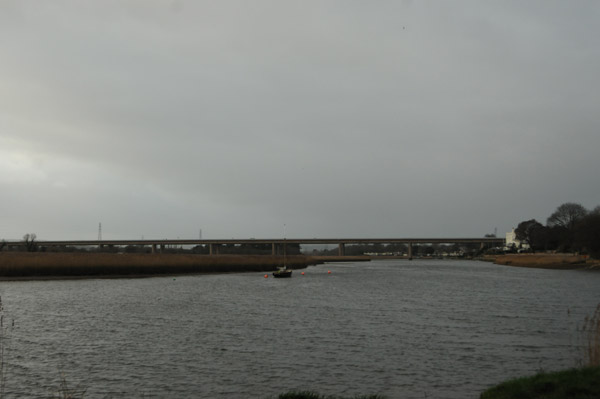
This is the gull-count view. Birds tend to mass over and behind the bridge in the background, before moving down the river at anything between 1 and 100m height.
The gulls tend to come downriver in a particular pattern. First of all, there are always a couple of hundred birds loafing around the river when we arrive; mainly Black-headed Gulls, with a smattering of Common and Herring Gulls here and there and perhaps the occasional Great Black-back. Looking upriver past the M5 road bridge which spans the floodplain, you can see a gathering mass of Black-headed Gulls floating and swirling around the Countess Wear sewage works. The first flocks of Black-headeds start to make their way purposefully down past us, initially twenties and thirties, but soon building to a constant stream of birds. The first birds come through low down, perhaps 10-20m above the water, but the bulk of them drop down from somewhere above 100m height, slight black silhouettes against the evening's grey skies. Common Gulls are sprinkled sparingly throughout the flocks; it's tricky, but feasible, to pick out their slightly more rakish shape amongst the Black-headeds which are by now sleeting past us.


Eventually the Herring Gulls put in an appearance. At first just singles and twos amidst the smaller gulls, soon they are the bulk of the flight, many of them dropping down from even higher than the Black-headed Gulls. The numbers of Black-headed and Common Gulls dries up rapidly, leaving us with a stream of Herring Gulls floating down in gathering darkness until they too peter out. A last quarter hour of patience is rewarded with a late flock of about a hundred Black-headed Gulls suddenly hurtling past, bellies almost touching the water, and a couple of groups of Herring Gulls, necks stretched and calling as they sail past.

Spot the Common Gull.

So, limbs numbed with the lack of movement in a biting northwesterly wind, and brains slightly numbed with counting gulls past in fifteen-minute blocks, we end up with a total count that is - once again - slightly lower than the previous year. One day we'll perhaps be able to find out why the number of gulls roosting on the river is dropping, but for now we're happy to guess that it might be a combination of climatic changes across Europe, population declines of some species (especially Herring Gulls) and/or changes in food supply and availability in the catchment of the Exe.
Either the sun just came through below the cloud, or Haldon Forest has just been taken out with a tactical nuke. I favour the former personally, as though it does make counting tricky for a while, at least it means dinner will still happen.

Today (Sunday), for variety's sake we took a pleasant mid-day walk down the river Otter; Na, Sabina and myself. We started out from Budleigh Salterton and wandered upriver to the footbridge across the river, then back down the eastern bank. Despite the continued presence of the same stiff north-west wind as yesterday's gull count, the weather was pleasant enough to find an increasing presence of spring flowers: hazel catkins are out in some numbers - yellow tassels bobbing and flapping in the wind, spreading pollen on the air; Red Campion and Herb-robert shining pink-red from the longer vegetation on the side of the path; Hogweed and Cow-parsley taller still with white umbels swaying in the gusts; and a small patch of White Deadnettle by the river, with their hooded creamy-white flowers looking richly succulent amongst a spray of vivid green leaves.

White Deadnettle

The rivermouth was alive with gulls (sorry!) using the fresh water of the ebbing tide to bathe and drink. The vast majority were Herring and Black-headed Gulls, with a trio of Great Black-backed Gulls hulking in the middle and a solitary Common Gull floating serenely downriver on the breeze. Further upriver, whilst Sabina settled into her lunch, a Dipper was peacefully hunting the edge of the water, ducking into the water and pulling out what looked like water-snails, then calmly battering them on a handy rock before swallowing them. We ended the walk - throughout which Sabina remained resolutely asleep - with a coffee on the beach, relaxing out of the wind in the afternoon sunshine. Couldn't really be much better than this, I guess...
Sabina relaxes and blows some bubbles after a tiring day being carried around in her sling.

The afternoon sunshine, looking westwards along the coast towards Ladram Bay.

Thursday, 19 January 2012

New year; fresh start

Another new experience at the start of the year to chalk up to life: we are now a family proper, with the arrival of a daughter (Sabina) on January 8th. It's been an interesting experience all round.

She was born at home at the ungodly hour of 3.30 a.m., which meant that all three of us slept in for quite a while on the Sunday morning. In common with the vast majority of newborn babies, she spends most of her time eating and sleeping, though she's already developing a short 'play' time in the afternoons, where she tends to lie around and wave her arms and stare intently at any moving objects in the room.

We've been out for a few walks as well - it's easy to feel a bit cabin-feverish when you're used to being out on a regular basis, so we've walked some undemanding local walks - Na's a little anaemic still, so we can't do too much yet. Fortunately Sabina sleeps readily when we go out, so she's fairly easy to please; although this means that she missed the Iceland Gull that we bumped into yesterday. Such is life...


She sleeps. A lot! I might post some more pictures when I have some with eyes open...

Tuesday, 3 January 2012

More New Year Cheer

(First of all, an apology - not only is this a bit of a beast of a blog, but there's no photos to relieve the monotony!)

Nice to get a new year off to a good birdy start... Pre-dawn, the peace was shattered by a Tawny Owl (according to Na - I was fast asleep and missed all the excitement), with a January dawn chorus filling the air a couple of hours later: the local Robins ensuring their territories are still secure, reminding themselves where their neighbours are - and sneakily checking to see whether next door made it through the night, and if their patch of land could in fact be annexed.

As it's been a rather mild winter so far, in stark contrast to the last two, there is a bit more to our January chorus. Dunnocks have been adding their silvery little warble to the mix for a couple of weeks now and a Song Thrush started some proper song about 10 days ago. The Blackbirds haven't yet got into full-throated melody, but a male has recently been singing to himself at the bottom of the garden; perhaps getting in tune for some early breeding, should the weather hold mild.

A little later - once there is some proper light in the sky - the Woodpigeons begin their raspy growls and the nearest Mistle Thrush can be heard shouting a simple strident series of notes into the air. Throw in some chirpy House Sparrows and there's a not-too-bad early morning chorus going on. There is something particularly satisfying about New Year's Day - there is so little traffic on the road in the early morning that the birds sound especially clear and crisp - we will have to wait until sunrise is about 4.30 in the morning before the dawn chorus is that peaceful again now.

We managed to get out before the hangover-cure walkers staggered along the river, adding a smattering of the local woodland birds to the new year's tally. The pair of Mandarin Ducks is still present and looking mighty furtive - perhaps they will settle in and breed successfully in the woods this year. Would be nice to see them more often (not something you can often say about non-native species, but there doesn't seem to be a negative impact associated with Mandarins, though I may have missed something in the literature somewhere) as they really brighten up a dull winter's day! Another early sign of spring - or perhaps a winter territory being reinforced - a couple of the local Dippers were in full song on bankside rocks, one interspersing his mix of chirps and jangles with a bit of mimicry of Grey Wagtail song.

Buoyed by a fine start to the day we returned home, collected my in-laws and  headed on out to the Exe. Although there isn't a lot of water around the marshes yet this winter, there was sufficient shallow flooding to have ducks peppered across the fields and pools. The bulk of the birds were Wigeon; males calling out their slightly suggestive whistle whilst the females growled and chattered amongst themselves as they waddle busily across the grass. On the shallowest water fringes, pairs and small groups of Teal were feeding and calling their 'preep' calls; males occasionally breaking off from feeding to surround a female and swim in excited circles, head-feathers raised to prove they really do have a neat crest.

Further onto the water again were pairs of Shoveler, powering across the pools with heads submerged, then occasionally lifting their heads clear so we could see their bright golden eyes and outsize rubbery-looking bills. Finally, deepest of all, were a pair of Pintail, supremely indifferent to the hustle and bustle of the rest of the duck, upending calmly and quietly in the depths the others couldn't reach.

Surrounding the ducks was a rustling, chattering, squalling mass of Starlings, who were swirling around a mix of Lapwings, Black-tailed Godwits and Curlew, all busily probing in the wet grass for invertebrates. Every so often something would spook this whole crowd of birds, so there would be a rush of wings, a cacophony of calls and the duck would suddenly be mid-pool, whilst the waders and Starlings swirled and dived in the air above. Opposite all this fuss and palaver, a small group of Canada Geese fed with the complacency of birds which know they are too big to be bothered by most things here - and with them, a rather fine Glossy Ibis.

We eased our way down to the Turf Locks Hotel, where hot chocolate and tea beckoned. The ebb tide had fallen enough for a broad scatter of waders busying themselves across the mud (including the Dutch-ringed Redshank C73). Avocets, Grey Plovers, Redshank and Dunlin were busily feeding in every direction, and the first gulls came drifting downriver like confetti in the breeze, to settle in to their roost on the river; which seemed a suitable cue to take for us to head home too, leaving the birds to follow the edge of the tide into the gathering dusk.