Showing posts with label devon birding. Show all posts

Friday, 1 March 2013

Grey skies

Somewhat like the plants in our garden, words burst into tentative life on the blog - apologies for the protracted silence! Just a short selection of things going on and observations to start with...

It seems as if we've had a permanent veil over the sky since October. We haven't, because our solar panels have been registering a regular spike in output every week or so (!), but it does feel like an eternally grey winter. Nevertheless, there are some signs that spring's on the way. The plants in both woods and garden have pushed out some perhaps optimistic shoots: Elder, Pignut and Perennial Dog's-mercury in the woods, Snowdrop, crocus, daffodils and Rhubarb in the garden. The latter  in particular seems to have been stalled by the past week's dip in temperature, so the ruby-red stalks and crinkly green leaves are still only half-way extended. We'll have a while to wait until we can have rhubarb crumble again!

The birds are hinting - and more than hinting - at a change in season too. Blackbirds have been tuning up for a few days now, with Robins, Dunnocks and both Song and Mistle Thrush going at it hammer and tongs in the morning. Cycling to Yarner recently added Chaffinch, Nuthatch and Green Woodpecker to the years' new songsters as well, so perhaps there will be blue skies again sometime soon. A pair of Blue Tits have been busily investigating the nestboxes we've provided on the extension (meant for sparrows, but we don't mind who uses them really), so hopefully we'll have a successful nest this year.

We were privileged last weekend to have a small flock of Waxwings at the end of the garden. A fabulous bird to have on the garden list when you live this far southwest. They spent a lot of their time sat in the oaks just across from our kitchen, making sallies into someone's back garden where they'd found a supply of red berries of some description; they would drop down, spend a few minutes stocking up and then sail back to the top of an oak, often with berry in bill, to sit and digest for a few minutes. They also spent some time picking at the buds at the top of the trees, though it was impossible to see what was of interest - any fragments were too small to be identified even through the telescope, so whether insects (most likely) or sap, or leafbud, will remain a mystery.

I'm also slightly intrigued that they seem to show so little interest in mistletoe when they're here in Britain. In Austria, where there is admittedly a far higher density of mistletoe than around here, I've seen flocks of Waxwings up to several hundred strong busily engaged in stripping mistletoe (causing apoplectic fury in the Mistle Thrushes), yet they seem wedded to red berries here - or apples.

Roll on summertime...!

Bohemian Waxwings. Slightly fuzzy due to being photographed through the 'scope at 1/30th of a second and on high ISO. Told you it was dark & grey...

Thursday, 25 October 2012

Octoberlings

I'm taking time out to be a full-time father (as if there was any other way to be a father anyway!) - my wife has returned to work, so we've taken advantage of the opportunity for me to take the last three months of her maternity leave - in effect unpaid leave to look after our daughter. It's fun! Rhythms are pretty baby-tuned now, so there are brief bursts of activity whilst she sleeps, punctuated by bursts of feeding and playing - but best of all we've been able to take the opportunity to go out and walk together most days.

Today was a kind of soft-focus day. We visited Yarner Woods NNR for a midday walk. It's mild muggy weather at the moment (a Saharan air-stream appears to be to blame) and the cloud base was around 180m, so we spent the entire walk in or just below the cloud, but at this time of year there's something very right about it: the leaves are turning, the spider-webs and grasses are pearled with water and everything seems rather hushed. As we walked round the woods, the only loud noises were a handful of Jays rasping their disgust at our intrusion; otherwise there was little to be heard apart from the random drip of water falling from saturated leaves and branches above us, and the sibilant calls of Goldcrests searching for insects.

As we walked down one track, there was a flurry of excitement: Blackbirds and Robins hopping off the track, then a burr of wings in a dozen different directions as a small flock of Redwings emerged from beneath the Bilberries where they had been fossicking in the fallen oak leaves. Semi-whispered 'tseet' calls between them - and then they were gone, deep into the tangle of branches and leaves in the valley below us. A Brambling flew over, only its wheezy call betraying its presence, and then we were down at the hides, where a constant stream of Coal Tits arrived and departed, rooting for overlooked seeds below the feeders, occasioning great interest from Sabina, who seemed fascinated by the abrupt appearance and equally rapid disappearance of each bird from our limited field of vision. Nothing remarkable, nothing surprising, but comfortingly appropriate for the time of year.

Thursday, 23 August 2012

Simple things...

It's been pretty poor for most things in Britain this year, with perhaps the honourable exceptions of molluscs and bryophytes. Not a lot of consolation though. We went out for a walk today; a round route at Mansands, near Brixham. We left home in steady rain, sufficient to ensure that today's batch of nappies would 'dry' in two batches - one lot indoors and one lot under the scaffolding - and with a cloud-base low enough to obscure the tops of the hills surrounding Bovey. By the time we got to Mansands the rain had reduced to drizzle, and the cloud-base was down on our heads - the only brightness coming from the lemon and gold spires of Toadflax in the hedges. Encouragingly, shafts of sunlight soon gleamed through the fog on our way down the track, which is treacherously slippery in the wet. We started to see some immediate responses from the wildlife: hoverflies appeared at the powder-puff heads of Hemp-agrimony in the hedge, clouds of tiny midges emerged to jostle for position over our heads and a couple of bedraggled-looking Gatekeeper butterflies burst from the sodden vegetation like tiny erratic gingersnaps batting through the air.

Hoverfly on Hemp-agrimony.

By the time we got down to the hide overlooking the wetland, the fog was beginning to burn off, in fact sufficient to see a handful of Mallards upending, a couple of young Coot and Moorhens doing their best to con their parents into feeding them - and several sleek blue-and-green Emperor dragonflies patrolling the water. The wetland is a Hendrix-like haze of Purple Loosestrife at this time of year, though it's not particularly photogenic in the swirling fog! We carried on to the coast-path, turning south towards Scabbacombe, trudging up a steep incline in what was raidly turning into tropical conditions: humidity rapidly closing in on 100%, temperature somewhere in the mid-20s and whether carrying baby or rucksack, the body's response was an immediate muck-sweat...

We soon gained the plateau and paused for breath amidst swirls of cloud and flashes of sunshine, the excited peeps and trills of a pair of Oystercatchers echoing up the cliffs from the rocky beach below. More butterflies joined us: Meadow Browns, subtle brown-and-orange, Green-veined Whites like scraps of paper fluttering across the grassland and a single Common Blue, mimicking the blue of the sea. The sea was beginning to emerge from the murk: tatters and shreds of fog blowing up past us anc coalescing around the higher ground, leaving a flat-calm, azure blue sea behind. In the distance a long grey bank of fog obscured the view north and east towards Dorset, whilst Berry Head and Scabbacombe Head floated in and out of view as the fog drifted, all accompanied by the mournful wail of the foghorn on Berry Head.

Scabbacombe Head emerging through shreds of fog

One sheep looking startled, the rest of them looking for food.

We strolled on steadily towards Scabbacombe beach, where we stopped to eat, relax, paddle and admire a small flock of Manx Shearwaters heading south, just inside the fog-line - which by this time was rolling back towards the land. Eventually, however, it was time to tackle the hill to Scabbacombe Head. We crossed the stream - hedged with Purple Loosestrife and Hemp-agrimony, resounding with hoverflies and bees - and slogged our way up to the top of the hill. Turning inland we began to leave the fog behind, but before we'd left it's grasp, we were startled to see a small wader on the gravel track in front of us. Despite all hopes to the contrary it proved to be a juvenile Dunlin, but was one of those birds which is remarkably confiding: it pottered along in front of us, then turned back and tentatively approached almost to touching distance. Eventually, after a lot of to-ing and fro-ing, it decided we were alarming enough to warrant flight and promptly flipped over the hedge to the neighbouring field. Presumably on its way south towards West Africa and bamboozled by the conditions into landing for a while in an apparently unsuitable area - lets hope it makes the journey successfully.

Lost and perhaps a little confused: Dunlin

For no particular reason other than I quite like the image - and it's a tough life being a limpet.

And again, for no particular reason except that it's a new species for the garden: Oak Bush-cricket.

Thursday, 24 May 2012

Late springing

It's been a funny old patch here in Devon lately. The weather's oscillated between spells of glorious spring sunshine, when the butterflies and bees crowd the flowers and the birds frantically get on with either breeding or migrating, and patches of foul, blattering, cold rain where everything seems to batten down the hatches and take cover for the duration.

Because the weather's been so inconsistent - and I've discovered it's not as easy to be spontaneous with a small baby in the house - we've not been out ringing at all in April, so Sunday was a great opportunity to get out for the morning. Opening the car door, I was greeted by the sound of a Grasshopper Warbler reeling away steadily in the adjacent Rhos pasture like this (click the arrows to hear the song). I opened the nets to the sound of Blackcaps and a Garden Warbler making their presence known to their rivals, and the morning was spent ringing to the accompaniment of Willow Warblers (perhaps the sweetest of all the UK's summer sounds), a Redstart and a couple of Cuckoos. Being mid-spring, there wasn't much to ring, but a healthy number of Willow Warblers included at least two ringed as adults this time last year.

Bird of the day was, however, not even a bird, but a particularly fine female Adder, basking complacently on a Molinia tussock: she waited patiently until I'd taken a number of photos, then resumed her interrupted relaxation without batting an eyelid. Not that she could bat an eyelid, but I speak figuratively...

American Skunk-cabbage - a colourful addition to the local streams and as yet apparently without the drawbacks of things like Himalayan Balsam or Japanese Knotweed. It does, however, as the name suggests, smell quite rank.

A fully-open flower, wafting a gentle stench on the breeze

And this one's done the business. It's no coincidence that it seems to be pollinated by flies...

Garden Warbler

The star of the show!

A very good-looking snake indeed...

Wednesday, 21 March 2012

WeBS; migrants

I spent a while today covering someone's Wetland Bird Survey count on Dawlish Warren - an hour-long snapshot of the waterbirds present on the site, my contribution to the network of surveyors looking at the Exe today, themselves a contribution to the national WeBS survey data collected each month for the British Trust for Ornithology, who use it in part to gauge trends in waterbird populations.

Being a sunny day and a mid-afternoon count in mid-March, I wasn't expecting a great deal out of the survey, and add to the mix the fact that today was Mothering Sunday - and you can see that there was plenty of potential for people to be out and about on the beach. Sure enough, when I arrived the beach was packed to the gills; a few hardy souls even in the water. The northerly wind was keeping the swell down to nothing though, so checking the sea was a cinch - and there were only just more birds than waves. A measly half-dozen Great Crested Grebes was it...

On down to the pond beside the visitor centre, where in addition to a fine drake Teal with three females, a Chiffchaff sang lustily from the high willows, whilst another called quietly in the willows just in front of me. Buoyed by this sign of a rapidly-turning season I headed on to the main wader roost. Nothing much along the seafront - two Knot roosting on a groyne the best of it - and plenty of people walking the beach even this far up. The tide was still some way off the bight, so after a rapid scan of the waders there I headed off to check the end of the sandspit.

Here was another sign of spring arriving: a fine male Wheatear flipped off ahead of me, from behind a mix of stone-grey, black and white, then a rich apricot-buff when he turned to check whether I was still walking his way. The point proved as enduringly birdless as the rest of the beach, and so I headed back towards the main roost along the riverside. An immediate reward came in the shape of a small flock of Sanderling, still in their silver-grey plumage and without any hint of the freckly ginger-rust they will develop soon for their summer plumage, who skimmed along the waterline and landed within a couple of metres of me. Heads bobbing with initial alarm, they soon settled down and began trotting along the water's edge, dipping erratically to grab small invertebrates as the waves washed across the sand.

Sanderling, trotting gently along the sands. Perhaps having wintered in South Africa, and on the way to the high Arctic to breed.
On to check the bight again, where the main wader roost usually occurs on the Warren. Not many birds, as most of them have headed off towards their breeding grounds - but there was a massed pack of Oystercatchers, all black backs spiked through with orange bills, a couple of Curlew sauntering impassively along the edge of the water in search of a tasty crab, and a fringe group of small waders - Knot and Dunlin - silver-grey, picking daintily into the shallow water for crustaceans and molluscs. Lurking on the fringes were a trio of Ringed Plover, all black bands laid across white and brown, a huddle of Turnstone on a fishing boat and a lingering group of Brent Geese - another of the species which has pretty much gone for the summer now.


Brent Geese - the last few lingering on the Exe will soon be heading off to the tundra of Arctic Russia, via the Waddensee - a massive area of intertidal mud between Germany and Denmark.
Most of the waders and almost all the wildfowl have now gone north, perhaps to Scotland and northern England or to staging posts on their way to the Arctic, but for a month or six weeks yet we'll see a gradual turnover of birds which wintered further south still: Ringed Plover, Turnstone and Sanderling, Bar-tailed Godwit and Whimbrel which have avoided our gloomy winter and lived it up on the sandy beaches of western and southern Africa.


True to spring weather form, the rain began as I headed back to the car, so only a cursory check for interesting plants on the way back - one day I will spend  little more time looking through the dune grassland to see what I can find lurking...

Sunday, 29 January 2012

Ring in the new...

A milestone today - our first ringing session of the year (non-garden) and somehow there's a need to include Sabina in this experience. I set off early with David and Peter, opening the nets early enough to make it worthwhile, whilst Na brought the youngest member of the group along at about 10 (bang-on 10 in fact: German punctuality strikes again!).

It was a typical day for this time of year: a couple of feeders are occasionally topped up by one or another of us so that there is some focus to the birds during the winter, and consequently much of the catch is Blue, Coal and Great Tits. However, we continue to accrue some useful information about the number of Poecile tits on site: three Willow Tits caught, two recaptures and one new bird; all of them last year's juveniles.

Willow Tit (Poecile montana kleinschmidti). A rather small and neat bib on this bird, but you can see many of the key features which indicate Willow rather than Marsh: clean white cheeks, strong bill (and longer than Marsh) with no clear white spot at the base of the upper mandible, a rather dull and extensive black cap, a hint of a pale panel in the wing - and if you look carefully, a very different tail pattern than you'll see on Marsh.

A closer look at that tail - notice that the outermost feathers are rather shorter than the innermost, and that there is a clear view of most of the feather tips at regular intervals between the extremes. On Marsh, this would not be the case; almost all the feathers being similar in length except for the outermost pair, which are rather shorter.

A bit overexposed, but here you can see that nice pale panel in the wing... as well as seeing how long the cap is.
We also caught two new Marsh Tits, a female Reed Bunting and an unusually-marked male Great Spotted Woodpecker. The woodpecker appeared to be one of last year's young as well, with new glossy black greater coverts and mantle feathers contrasting very strongly with a set of unusually pale outer greater coverts and primary coverts. You might also be able to pick out in the picture that the secondaries also appear rather washed-out.

Young male Great Spotted Woodpecker (Dendrocopos major). Those pale wing feathers stand out a mile in the hand, but would be almost impossible to see in the field, I think. Would be fascinating to catch him again after the next moult and see what's happened there.

Female Reed Bunting (Emberiza schoeniclus). The amount of wear on the tail in particular suggested to us that this was a bird born last year.

Sunday, 22 January 2012

Gulls, gulls, gulls

Gulls, gulls, gulls. Yesterday evening was an indulgence of mine, though many would consider it a penance. A friend organises an annual gull-count on the Exe, which attempts to keep tabs on the number of gulls using the river as a roost - they're not monitored in any other meaningful fashion here, unlike some other wetlands where the BTO's Wetland Bird Survey volunteers note the numbers each month. To be fair, the number of gulls present on the river in the daytime is a shadow of the numbers roosting overnight, so the WeBS counts would not be particularly representative. Anyhow, three of us gathered at the Topsham recreation ground to count the birds moving south down the river.

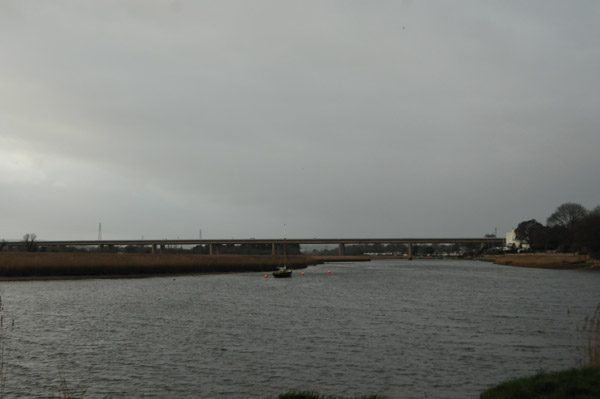
This is the gull-count view. Birds tend to mass over and behind the bridge in the background, before moving down the river at anything between 1 and 100m height.
The gulls tend to come downriver in a particular pattern. First of all, there are always a couple of hundred birds loafing around the river when we arrive; mainly Black-headed Gulls, with a smattering of Common and Herring Gulls here and there and perhaps the occasional Great Black-back. Looking upriver past the M5 road bridge which spans the floodplain, you can see a gathering mass of Black-headed Gulls floating and swirling around the Countess Wear sewage works. The first flocks of Black-headeds start to make their way purposefully down past us, initially twenties and thirties, but soon building to a constant stream of birds. The first birds come through low down, perhaps 10-20m above the water, but the bulk of them drop down from somewhere above 100m height, slight black silhouettes against the evening's grey skies. Common Gulls are sprinkled sparingly throughout the flocks; it's tricky, but feasible, to pick out their slightly more rakish shape amongst the Black-headeds which are by now sleeting past us.


Eventually the Herring Gulls put in an appearance. At first just singles and twos amidst the smaller gulls, soon they are the bulk of the flight, many of them dropping down from even higher than the Black-headed Gulls. The numbers of Black-headed and Common Gulls dries up rapidly, leaving us with a stream of Herring Gulls floating down in gathering darkness until they too peter out. A last quarter hour of patience is rewarded with a late flock of about a hundred Black-headed Gulls suddenly hurtling past, bellies almost touching the water, and a couple of groups of Herring Gulls, necks stretched and calling as they sail past.

Spot the Common Gull.

So, limbs numbed with the lack of movement in a biting northwesterly wind, and brains slightly numbed with counting gulls past in fifteen-minute blocks, we end up with a total count that is - once again - slightly lower than the previous year. One day we'll perhaps be able to find out why the number of gulls roosting on the river is dropping, but for now we're happy to guess that it might be a combination of climatic changes across Europe, population declines of some species (especially Herring Gulls) and/or changes in food supply and availability in the catchment of the Exe.
Either the sun just came through below the cloud, or Haldon Forest has just been taken out with a tactical nuke. I favour the former personally, as though it does make counting tricky for a while, at least it means dinner will still happen.

Today (Sunday), for variety's sake we took a pleasant mid-day walk down the river Otter; Na, Sabina and myself. We started out from Budleigh Salterton and wandered upriver to the footbridge across the river, then back down the eastern bank. Despite the continued presence of the same stiff north-west wind as yesterday's gull count, the weather was pleasant enough to find an increasing presence of spring flowers: hazel catkins are out in some numbers - yellow tassels bobbing and flapping in the wind, spreading pollen on the air; Red Campion and Herb-robert shining pink-red from the longer vegetation on the side of the path; Hogweed and Cow-parsley taller still with white umbels swaying in the gusts; and a small patch of White Deadnettle by the river, with their hooded creamy-white flowers looking richly succulent amongst a spray of vivid green leaves.

White Deadnettle

The rivermouth was alive with gulls (sorry!) using the fresh water of the ebbing tide to bathe and drink. The vast majority were Herring and Black-headed Gulls, with a trio of Great Black-backed Gulls hulking in the middle and a solitary Common Gull floating serenely downriver on the breeze. Further upriver, whilst Sabina settled into her lunch, a Dipper was peacefully hunting the edge of the water, ducking into the water and pulling out what looked like water-snails, then calmly battering them on a handy rock before swallowing them. We ended the walk - throughout which Sabina remained resolutely asleep - with a coffee on the beach, relaxing out of the wind in the afternoon sunshine. Couldn't really be much better than this, I guess...
Sabina relaxes and blows some bubbles after a tiring day being carried around in her sling.

The afternoon sunshine, looking westwards along the coast towards Ladram Bay.

Tuesday, 3 January 2012

More New Year Cheer

(First of all, an apology - not only is this a bit of a beast of a blog, but there's no photos to relieve the monotony!)

Nice to get a new year off to a good birdy start... Pre-dawn, the peace was shattered by a Tawny Owl (according to Na - I was fast asleep and missed all the excitement), with a January dawn chorus filling the air a couple of hours later: the local Robins ensuring their territories are still secure, reminding themselves where their neighbours are - and sneakily checking to see whether next door made it through the night, and if their patch of land could in fact be annexed.

As it's been a rather mild winter so far, in stark contrast to the last two, there is a bit more to our January chorus. Dunnocks have been adding their silvery little warble to the mix for a couple of weeks now and a Song Thrush started some proper song about 10 days ago. The Blackbirds haven't yet got into full-throated melody, but a male has recently been singing to himself at the bottom of the garden; perhaps getting in tune for some early breeding, should the weather hold mild.

A little later - once there is some proper light in the sky - the Woodpigeons begin their raspy growls and the nearest Mistle Thrush can be heard shouting a simple strident series of notes into the air. Throw in some chirpy House Sparrows and there's a not-too-bad early morning chorus going on. There is something particularly satisfying about New Year's Day - there is so little traffic on the road in the early morning that the birds sound especially clear and crisp - we will have to wait until sunrise is about 4.30 in the morning before the dawn chorus is that peaceful again now.

We managed to get out before the hangover-cure walkers staggered along the river, adding a smattering of the local woodland birds to the new year's tally. The pair of Mandarin Ducks is still present and looking mighty furtive - perhaps they will settle in and breed successfully in the woods this year. Would be nice to see them more often (not something you can often say about non-native species, but there doesn't seem to be a negative impact associated with Mandarins, though I may have missed something in the literature somewhere) as they really brighten up a dull winter's day! Another early sign of spring - or perhaps a winter territory being reinforced - a couple of the local Dippers were in full song on bankside rocks, one interspersing his mix of chirps and jangles with a bit of mimicry of Grey Wagtail song.

Buoyed by a fine start to the day we returned home, collected my in-laws and  headed on out to the Exe. Although there isn't a lot of water around the marshes yet this winter, there was sufficient shallow flooding to have ducks peppered across the fields and pools. The bulk of the birds were Wigeon; males calling out their slightly suggestive whistle whilst the females growled and chattered amongst themselves as they waddle busily across the grass. On the shallowest water fringes, pairs and small groups of Teal were feeding and calling their 'preep' calls; males occasionally breaking off from feeding to surround a female and swim in excited circles, head-feathers raised to prove they really do have a neat crest.

Further onto the water again were pairs of Shoveler, powering across the pools with heads submerged, then occasionally lifting their heads clear so we could see their bright golden eyes and outsize rubbery-looking bills. Finally, deepest of all, were a pair of Pintail, supremely indifferent to the hustle and bustle of the rest of the duck, upending calmly and quietly in the depths the others couldn't reach.

Surrounding the ducks was a rustling, chattering, squalling mass of Starlings, who were swirling around a mix of Lapwings, Black-tailed Godwits and Curlew, all busily probing in the wet grass for invertebrates. Every so often something would spook this whole crowd of birds, so there would be a rush of wings, a cacophony of calls and the duck would suddenly be mid-pool, whilst the waders and Starlings swirled and dived in the air above. Opposite all this fuss and palaver, a small group of Canada Geese fed with the complacency of birds which know they are too big to be bothered by most things here - and with them, a rather fine Glossy Ibis.

We eased our way down to the Turf Locks Hotel, where hot chocolate and tea beckoned. The ebb tide had fallen enough for a broad scatter of waders busying themselves across the mud (including the Dutch-ringed Redshank C73). Avocets, Grey Plovers, Redshank and Dunlin were busily feeding in every direction, and the first gulls came drifting downriver like confetti in the breeze, to settle in to their roost on the river; which seemed a suitable cue to take for us to head home too, leaving the birds to follow the edge of the tide into the gathering dusk.

Wednesday, 15 June 2011

Surprise, surprise surprise surprise

Yesterday I was helping to run some training for colleagues. During the indoor session I noticed a Wren dashing rapidly back and forth, as if it was visiting a nest - and when we took our lunch-break, I had a look. There, sure enough was a Wren carrying food up to the edge of the office. More interestingly it was carrying it to an open-fronted nestbox. 'Aha,' thought I, 'this is an opportunity to have a quick butchers at the contents of a Wren's nest without disturbing the nest itself' - wrens tend to build a mossy globe of a nest which you can't check for eggs/nestlings without damaging; something no responsible person wants to do. But, a nest in a nestbox offers a chance to peek in through the front without touching...

Wren (Troglodytes troglodytes) at open-fronted nestbox


...so...

today I remembered to go and check the nest. I scrambled up the ladder with a colleague at the bottom, waiting to watch and laugh catch me if I fell, and to have a quick look at the nest herself. Typically the ladder was a tad too short, so I was balanced a little precariously near the top when I got my line of sight over the rim of the nestbox...

...and....

Big enough to swallow a poor wren!

WHAM! A huge orange gape came lunging out of the nest. At this point I nearly did fall off the ladder - partly though shock, partly through excitement: we have a baby cuckoo which has taken over the Wren's nest on the office! Interestingly, the Wrens seem to have taken over the box from something else themselves - the biter bit, you might say - but it seems to be the Cuckoo which will have the last laugh. I apologise for the shocking pictures, but it's so dark up there as to be almost unworkable, and trying to manually focus a lens whilst balancing on the top of a ladder is not for the faint-hearted, I can assure you.

With a little care and balancing, it was eased out of the nest, ringed, and  returned to the mossy comforts of it's home, where the poor wrens lost no time in resuming their feeding - they'll be worn to a frazzle by the end of this season.

Juvenile - pullus, in fact - Cuckoo. Interesting to note the number of white feathers on the head.

A timely pointer also to some on-going research on the behaviour of Cuckoos: we know next-to-nothing about their migration routes or wintering grounds, so the BTO have begun a project which has satellite-tagged 5 male Cuckoos in East Anglia and is following them through their breeding - and their post-breeding seasons, with some unexpected results already... well worth a look. You can follow - and sponsor - each individual cuckoo if you so wish.

A final point of some vague interest is that this is the second Cuckoo chick we've found on site this year, both attended by wrens - presumably the same female Cuckoo's work. Comfy nest to grow up in, mind.

Sunday, 5 June 2011

TO...YP

It's turned noisy in the garden now. The air is filled with a shrill insistent demanding whine, as recently-fledged Blue, Great and Coal Tits work a determined line along the trees and through the veg. The potatoes seem to be particularly favoured at the moment, which leads me to suppose that there is some sort of insect food to be had there - perhaps the aphids have found the potatoes themselves and are now being snacked on by the growing birds.

Moving out to the edge of the moors, and the situation is similar, though the number of birds out in the scrub is greater still. The addition of broods of Marsh, Long-tailed and Willow Tits, and the first fledgling Chiffchaffs, as well as a smattering of Robins makes the willow scrub echo with begging calls first thing in the morning. The grass has grown appreciably in the last month, and the first flowers of Creeping Soft-grass - Holcus mollis - are showing. Ragged-robin and Yellow Flag-iris raise patches of shocking pink and yellow flowers up above the green on occasion; the former is something of a magnet for Small Pearl-bordered Fritillary butterflies at the moment, creating an outrageous clash of vivid pink and orange which somehow seems to look perfect.

Small Pearl-bordered Fritillary amongst Ragged-robin. The butterfly is mid-way between meals, which is why it's not sharp.

Maturing Large Red Damsel. Everything's in the throes of growing up and/or breeding at present. It's a fabulous time of year.

The Pied Flycatchers are also fledging in the woods. One, or perhaps two, more visits and we'll be finished with them for the year - it's frightening how quickly the season goes in many respects. Nice to see that we've again had a good breeding season for them this year (so far!) and we can hope for a good number of returning birds next year, all things being equal.

Pied Flycatcher and young. The youngsters at this stage haven't yet got to their full feathered state, so look like a cross between gawky teenager and Sesame Street character.

Male House Sparrow framed amongst the remains of our old kitchen

Friday, 27 May 2011

David and the Owl

A cold and almost frosty morning is a good time to be up at the crack of dawn, especially at this time of year. The world is devoid of human life, at least in our neck of the woods, and the only sounds are birds getting on with the business of the season, which is - well - doing the business.

The latest visit to our shared ringing site paid off with a spectacularly unexpected Tawny Owl in the net. He seemed a little out of sorts, as was only to be expected, but that's all part of the fun of it. Interestingly I've been seeing day-active Tawnies a lot recently, perhaps because food's been hard to come by for them and they have a growing family to feed.


More exciting still than the owl, though, was an unexpected mist-net catch: a Narrow-bordered Bee Hawkmoth. Despite being well tangled in the net, we eventually extracted it without major harm - some scales rubbed off the abdomen - brought it back for a quick photoshoot and watched it warm up, and head off into the blue.


Despite the lack of rain in this part of the UK - seems more like the southeast than the southwest - there is plenty going on. Our 'lawn' has come out with a spectacular show of Yellow Rattle. This is a semi-parasitic plant which is often found in good quality hay-meadows, and was a component of the green hay we spread across scarified ground last autumn, hoping for something a bit more interesting than the dog-muck-fertilised Perennial Rye-grass that we then had. The lack of rain hasn't helped much, but a bit of diligent watering and some luck has produced a nice selection of species, including Hairy Tare, Black Knapweed and a handful of eyebrights.


Since this last ringing trip I've been out on the moors doing site assessments, which haven't necessarily resulted in a lot of interesting things to write about. A draggled-looking Pale Tussock caterpillar (I think) on some Soft Rush was a nice find, though I have a sneaking suspicion that it is in fact dead...


...some spectacularly warty lichens growing on the granite...


and some atmospheric Hare's-tail Cottongrass waving in the wind.

Tuesday, 26 April 2011

Signs of things like spring

As things seem to have been a little quiet of late, here are a few of the bright points of spring in our part of the world. For almost the last two months we've been pretty much rain-free, which is unusual, and it's starting to be a little worrisome for the sake of our garden veg. That's beside the point though...

The sun hits the back of our house full-on, so early on in the year the plants get a good boost of warmth and get on with flowering. We're then visited by a variety of invertebrates, bumblebees and honey-bees first, then overwintering butterflies and an increasingly varied crop of flies, bees, wasps, moths and beetles. As it stands, we've not got a great deal in the way of early-flowering plants to offer them nectar, but the bank of grape-hyacinth behind the door is particularly popular with the bees.

Honey-bee at grape-hyacinth.

Soon the birds get in on the act. Song swells from the odd Robin and Great Tit, then they're joined by Mistle Thrush, Woodpigeon, Song Thrush, Dunnock, Wren, Blackbird... and it's not long before we're seeing Blackbirds and Robins hurtling through the garden with beaks full of nest material, looking like some kind of surreal handlebar moustache.

Blackbird nest. This one in a particularly vulnerable place, next to a track and almost on the ground - in fact no more than 20cm off.

The variety of flowers on offer in the garden also starts to increase, and the bees are quick to take advantage. From the early few Bombus terrestris, we're now seeing a nice variety of bumblebees, including the ambulatory ginger-snap which is Bombus pascuorum.

Bombus pascuorum.


By this time there are plenty of other species beginning to emerge in the woods and lanes around the house, and working out of the Yarner NNR office has its advantages when there is a wealth of wildlife around to enliven lunch-breaks...

Pearl-bordered Fritillary. A species which emerges early in the season, and has benefited from the last few years of warm dry springs down here in Devon.


Woodpigeon. The half-murmured growling coo of Woodpigeons is one of my favourite sounds, always associated with hot, lazy, sunny afternoons, redolent with the hum of bees and hoverflies and the scent of green things growing.

And now, by the end of April, we've got the first brood of Robins squalling for food just beyond the fence - dicing with death at the hands of the neighbours' cats. Given that about 90% of young birds die in their first year, their chances aren't good, but for the moment the weather at least is doing them a favour. Shame I can't say the same for the local cats...

Robin. One of the early broods to come out - much squealing and agitation when mum or dad hove into view with a juicy morsel.
Finally, I was lucky enough to see what looks like a Large Tortoiseshell butterfly in my in-laws' garden on Saturday:


Large Tortoiseshell - believe it or not. A species probably now extinct in Britain and only occurring as an escape, a deliberate release or as a wandering vagrant on easterly winds. Given the state of this one, I'm going for the latter!

Wednesday, 29 December 2010

Frozen cold

Some winter cheer - best wishes to anyone who's reading that you have a happy and successful 2011.

You may have heard that the UK's been suffering the coldest December for a century: it's certainly been an interesting one down here in Devon! A bit of chilly weather in mid-December, whilst the rest of the country was gripped by ice and snow, left some of us feeling smug and happy that we lived in the 'soft south'...

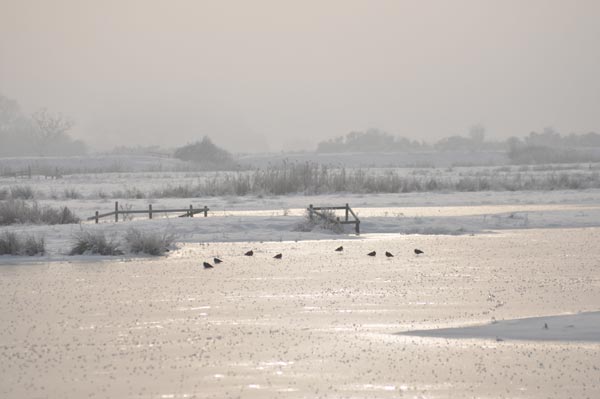
Pre-snow, Exminster Marshes in the first hint of the cold weather: the pools all frozen and almost every bird on or around the main storage lagoon on the site. Picturesque, though.

A pale and watery sunrise,  reminiscent of Turner's work. Only in England...

Reed Bunting

However, a short while later a 20cm layer of snow appeared overnight, wiping the smile off my face. A nice selection of interesting birds promptly appeared in the garden, including the expected Brambling, Redwing and Fieldfare, and a thoroughly unexpected Moorhen, walking down the neighbours' hedge!

Chaffinches were confused by the depth of the snow

A poor and grotty photo of a nice bird in the garden: Redwing

Even the squirrels were out making snowmen

Moorhen wondering what on Earth is going on.

And of course, a sunny day makes a perfect opportunity for a walk and a chance to take some pictures.

The river Bovey, as it ripples and roils downstream to join the Teign

Dipper

Holly in the Bovey

Holly in the Bovey. Again.

Snow, snow, snow...

Freezing fog dusts a lone oak on the edge of the Parke estate

The river Bovey between Bovey Tracey and Lustleigh, steaming in the early morning sunshine

Frozen birch

More frozen frosty snowy trees. You know the score.

Yarner woods looking monochromatic and chaotic

The clear skies and even layer of snow also made a very nice combination to take the camera for a walk when we headed over to my parents' place for Christmas.

Haldon Belvedere in the evening sun

Nice male Brambling. Through the parents' double-glazing.

Blue Tit

The lure of a handful of apples was enough to bring in plenty of Blackbirds and Starlings, with Song Thrush, Redwing and Fieldfare thrown in for good measure. One female Blackbird in particular was extremely aggressive, chasing everything - even Fieldfares - off 'her' apples.

Blackbird vs Song Thrush

Blackbird makes victory salute after a first round KO

Apples: they've got tough skins...

...takes some effort to get...

...that...little...

...bit of...(aargh)...

skin off!

Just as a thaw was predicted, the temperatures tumbled lower: Boxing Day morning saw a rather nippy -7C at my parents' house, close to Exeter (I know it's nothing compared to many others, but cold enough for us, thankyou very much!) - a walk around Exminster Marshes that morning was particularly interesting.

To begin with, the canal was frozen solid. A small hole in the ice was kept free by a group of Coot, with a pair of Gadwall and a single Little Grebe - all moving rather sluggishly in the cold.

The Exeter ship canal, sans ships.

Coot freezing into the canal

Spot the Gadwall

Coots still freezing in the ice. Little Grebe huddling in for warmth.

A little further along the canal, a small seep of flowing water into a ditch was providing a life-line for a Water Rail; normally a bird which is extremely wary - this one was presumably so close to the edge that it let us wander past a few metres away without running for cover.

Water Rail, on the edge

At the Turf Locks hotel, a disconsolate group of Black-tailed Godwit, Lapwing and Oystercatcher huddled on the frosty grass, whilst Dunlin and Black-tailed Godwit flew up and down river, searching for the earliest opportunity to get onto fresh mud before it froze solid.

Black-tailed Godwit - looking odd because its legs are tucked in to its belly, rather than flapping along behind - they look oddly chesty in this pose.

Turf locks jetty

Lapwing heading over to check whether the marshes are snow-free yet. Nope.

Crystals on the fringes of the snow

To cap it all, ice floes were floating down the river Exe on the ebbing tide, with cargoes of Lapwing and Dunlin. Quite, quite surreal!

Lapwing and Dunlin drift downriver on ice-floe.

Reed-heads in the growing sunlight

Lapwings looking mournful in the snow

Lapwing on ice

Cheers... to a successful 2011!