Showing posts with label birding. Show all posts

Wednesday, 29 July 2015

Inselaffe am See - part II

Onwards!

The weather continued to suggest that we'd be best off sticking to well-wooded and sheltered areas - so that's exactly what we did. We collected Bina from her morning activity (making a jamjar aquarium) and sped off to Blankenfoerde, where we had a picnic lunch in a carpark sheltered by tall trees and watched the clouds race by overhead. As the clouds broke up and the sun warmed us, insects responded by appearing apparently from nowhere. Large and Small Skippers bounced jazzily across the glistening grass heads, competing for the best spots near the tastiest bramble blossom. A sparklingly-fresh Comma played grandmothers' footseps with the girls, allowing approach to oh-so-close before abruptly moving on another couple of metres. More exotic, a Pearly Heath or two skittered past like Gatekeepers with go-faster stripes, whilst a Mazarine Blue slurped liquid from some bare soil on the path.

Our short round walk took us through another re-wetted area. This time the intent has been to restore the natural floodplain of the river Havel, as far as possible, so a series of small lakes amidst extensive conifer plantation are becoming increasingly large and increasingly less dominated by the conifers. The largest of the lakes that we came to was indeed quite spectacular: dead stumps liberally scattered through a mouth-wateringly diverse wetland plastered with sedges, rushes and interesting herbs, none of which was really quite accessible to explore. Never mind: there was plenty to see, including a fine couple of male Red-backed Shrikes hawking for dragonflies when the sun gathered enough strength.


Re-wet my floodplain. Death by drowning for the conifers, life through light and water for the rest.

A wonderful wet mix of marsh and swamp vegetation

A small, but rather beautiful, micro-moth in the margins of the re-wetted areas near Blankenfoerde

By the next day, 10th July, the rain had settled out and we were left with a fresh breeze and some lengthy spells of sunshine. A good day to give the girls a break from all the wildlife and let them play. I took Lissa for a walk around the nearest fields out of Boek so that she could have a proper afternoon sleep, I could get some exercise and the other two could spend some time doing more exciting things for small children, like a carriage ride and playing in the playground.
Setting off, Lissa snuggled down and went to sleep within about two minutes - result! I set myself into a gentle amble and did some mobile birding, botanising and general wildlife-watching on the hoof.

The walk took me out of Boek to the northeast, along the edge of the national park and round to Amalienhof before returning to Boek along the road. As soon as I left the houses, a large dark eagle flew over. Heart leaping at the prospect of finally seeing Lesser Spotted Eagle in Europe, I raised my bins to see it flying off steadily, trailing falconers' jesses. It didn't even have the decency to be a LSE, looking more like a Steppe Eagle. Perhaps I was fortunate though - it would have been a terrible view with a sleeping baby strapped to my chest! Another White-tailed Eagle drifted over to compensate me slightly. The rest of the walk was rather uneventful after that. More Red-backed Shrikes, a Glanville Fritillary and piles more Heath Fritillary. A single Middle-spotted Woodpecker was nice, but hardly exceptional. Back to Boek, where a very flavoursome icecream was just the job to refresh us all.


Thrift +

Beetle of obvious striking appearance on Thrift flower.
Another day, another trip! We hired bicycles again for the day, strapped the children into their seats and headed off for the high point of the park. This is the tree-topping Kaeflingsbergturm, an observation tower which is definitely not for the faint-hearted. The journey there took us through Boek, then into the pinewoods and along the eastern side of the Priesterbaekersee before joining the closed road which runs between Amalienhof and Speck. The tower is reached via a half-kilometre walk from the road. The ride there was uneventful, the walk up from the road pleasantly enlivened by finding Pine Marten scats along the way, as well as the sound of a distant Gruffalo (unmistakeable once you know it).

The tower is a solid steel beast which reaches an impressive 30m into the sky - some 171 steps if you include the four concrete ones at the base. The view from the top is undeniably big, and more impressively for a Brit, the landscape is one of forest, punctuated by a scatter of lakes and the very occasional open patch. The most prominent of these is where the Russian troops stationed in the area used to do a lot of training, denuding that patch of land of vegetation. This is now apparently a quite superb patch of open heath and acid grassland, in a completely closed zone (another distinction from the UK - a wildlife-rich area which no-one is allowed into! Imagine the outrage!) and being left to its own devices to do as it will.

A White-tailed Eagle drifted by.

We returned to the outskirts of Boek, where we found a nice sunny meadow to eat our lunch and generally allow the girls to wander, botanise and harrass grasshoppers. The spaces between grass stems were liberally filled with small orb-spiders patiently awaiting a flying meal. The air was filled with Black-tailed Skimmers and Ruddy Darters. Grasshoppers sizzled in the grass. A Grass Snake slithered up, saw us and rapidly departed, much to everyones dismay. An hour or so when life feels just fine, thankyou so much...

A fine orb-web spider

Grass Snake basking in a rotting treestump

One of many blue damelflies which almost without exception turned out to be Azure Damselfly, Coenagrion puella

A young Speckled Bush-cricket on White Campion

That Blue Featherlegs again

Willow Emerald damselfly

White Melilot, which grows along with Ribbed Melilot, all over the place


Botanising on Tansy in the Acker-ecke

Look what we found, Papa! A chilly beetle has no option but to be childhandled, unfortunately.


We rounded off the trip with two more nice woodland walks. The first, from the Gruenower See to Goldenbaum and back, took us out through more high-quality Beech forest in the eastern park of the National Park. The path wound along the edge of some marshily overgrown lakes lying between the Gruenower See and the Muehlenteich, redolent with the song of both Reed and Marsh Warblers still, before diverting into a small shallow valley which felt rather like a proper rural idyll. Flowery verges, patient cattle, sheltered-looking and pastoral. No traffic... We consoled ourselves with the view that it was probably bleak as anything in the depths of winter and walked back to the car. The second was a short wander around the Sehsee, lost in the middle of the forest near Zwenzow. One of those walks where you amble along, enjoying the sunshine and feeling yourself relax. We were treated to the sight of a large female Sand Lizard sunning herself in a powerline wayleave, where the children also found themselves running in circles chasing grasshoppers. The walk back through the woods was enlivened by regular encounters with the most enormous slugs - and a brief meeting with a Large Chequered Skipper butterfly.

Large Chequered Skipper - a final surprise butterfly on a very quiet walk around te Sehsee
The whole National Park is rather fine. The premise that the park be left to return itself to a more-or-less natural state is a bold one, especially when viewed from this side of the water, but undeniably worthwhile. The area remains hugely popular with visitors, yet feels rather unhampered by infrastructure and relatively quiet (though our being there the week before the locals schools broke for summer may have contributed). The birdlife is good: although we were there at a very quiet time of year, we still managed to see/hear a number of species which would be well-received by most (e.g. Red-necked Grebe, Bittern, Black and Middle-spotted Woodpecker, White-tailed Eagle, White Stork, Marsh Warbler, Great Reed Warbler, Red-breasted Flycatcher, Golden Oriole) and ended up with a trip list of somewhere just over 100 species. There was rarely a day we didn't see or hear Cranes - they are everywhere - and Ospreys are abundant, even nesting on poles in the middle of arable fields.

The plant-life is also very diverse - certainly more so than we could appreciate with two small children to entertain, yet even so we managed to record just over 300 species of plants. A more determined effort would have added significantly more! Perhaps my only disappointment was that despite the vast variety of dragonflies and damselflies on offer (some 51 species recorded in all) we only managed to see about 16 species. A combination of the weather and family constraints was the main reason, plus perhaps being just a couple of weeks to late for the best of it, but it's not much to grumble about!

I think we'll return, perhaps at a more bird-rich time of year, and see what else we can find... So, just maybe - 'to be continued'.

Friday, 24 July 2015

Inselaffe am See - part I

It should really be Inselaffen am See,  I suppose, as we were all involved. So be it.

Four a.m. starts with small children are not wholly recommended as a matter of course, but once in a while is OK.

Birmingham airport is also OK once in a while - I wouldn't want to make a habit of it.

Arriving in Berlin in temperatures of 39C in the shade with two very tired small children, to discover that Flybe have mislaid your car-seat en route and that your car-hire company has no record of your having booked one car seat, let alone wanting two, and oh, I'm so sorry, we don't actually have any car-seats anyway... well.

To be wholly fair to everyone involved, the lady at the Enterprise desk was very polite, her colleague found two car-seats from a rival company and the children were really as good as gold.

So, our visit to Mueritz National Park, about 90 minutes northwest of Berlin, didn't get off to the most auspicious of starts. Be that as it may, wending our way gently through the summer countryside under cloudless skies, watching Black Kites glide elegantly across the stubbles behind gigantic combine harvesters, the children sleeping soundly in the back of the car, it certainly felt like it was shaping up to be a nice summer holiday.

We eventually arrived at Mueritzparadies, a small collection of wooden chalets next to Germany's biggest lake (Constance doesn't count, as it borders Austria and Switzerland too), where the girls gratefully spent the next couple of hours splashing in the waters of the lake and revelling in some playtime. Another Black Kite drifted over to remind us we weren't at home any more - as if we needed that, with Tree Sparrows flustering in the bushes, and temperatures which would probably be melting the tarmac in Devon. The main drawback was that the house had been shut for most of the day, so the bedrooms - upstairs - were sweltering. The only solution was to put the youngest daughter in the downstairs loo to sleep, the elder daughter adjacent and sleep on the livingroom floor ourselves. Needless to say that was great fun for all concerned (!) and sleep proved a little elusive for a while...

A family of Hooded Crows - another sign we're not in Devon - sweltering in the heat atop a birch

The next day dawned bright and fair, and promised to be nearly as hot as the previous, so the sensible decision was taken to stay in the lake as much as possible. The heat was well into the mid-30s, so the wildlife was doing just as the humans - staying in the shade and not making too much fuss. The odd Red Kite and Black Kite floated over, a Red-crested Pochard flew by offshore and the distant trumpeting of Cranes provided a staccato background chorus every so often. All very relaxing. Time to take stock of our surroundings a little better...

Mueritzparadies lies just outside the edge of Mueritz National Park. The countryside is predominantly arable farming - with lots of arable 'weeds' like cornflower, poppies, fumitories &c evident in fallow plots and crops - interspersed with wooded land: lots of planted conifer in the main. There are marshy hollows here and there with willow, alder and aspen carr, reedswamps and luxuriant tall-herb fens. In spring the area must teem with migrant birds and echo to the sound of returning breeders, but in the heat of midsummer the song is mainly over and the air is filled with the buzz and rustle of insect wings and the soughing of the wind through the leaves instead. The lake itself is shallow, so the water is warm and tempting, even to non-swimmers.

Cornflowers, bluer than the eyes of flaxen-haired maidens in some romantic poet's vision. The mist of blue across the gold of the ripening barley is stunning, poets aside.

The nearby field corner - it became known as the 'Acker-ecke' (sorry, just means 'field corner') - was a riot of colour and invertebrates. Clearly someone's forgoten to glyphosate this part of the world. Can't be having that.

Even such goodies as Consolida regalis in there!

There are also - just next door - some very extensive fishing ponds: the Boeker Fischteiche, which are well-known as a good birding spot (we saw one other couple birding, which is pretty high-intensity stuff). We thought we'd branch out a little, drag the children away from the lake for the next morning and see what the ponds had to offer. Two hides and a viewing screen attest to the birding interest in the site (I suspect in spring and autumn it is actually quite busy) and we were duly welcomed to the site by an Osprey fishing slap-bang in front of us, far too close to bother with things like binoculars to enhance the view. If you'd tried, you'd probably have had nightmares about the bird's feather-lice. A backdrop of Marsh Harriers and both kite species held Bina's attention and she duly got very excited about pointing out every soaring raptor that came over, soon learning to pick out the kites from the rest with their forked tails an easy clue. Just to cap it all, a young White-tailed Eagle drifted leisurely over us at treetop height, mobbed by a pair of Red Kites. 'Wow', said Bina, 'das ist gross'. Not wrong. [Na points out that I may be inadvertantly confusing English readers who lack basic German. To set the record straight, it means 'that's big'. Nothing yucky.]

Although the wind picked up strongly, there was calm enough water for us to be treated also to a couple of pairs of Red-necked Grebes feeding semi-stripy young. Perhaps the nicest thing of all, though, was walking along the boundary between a hayfield and woodland, feet drifting Heath Fritillaries with every step. Scattered amongst them were the more familiar fare of Meadow Browns, Ringlets and skippers, as well as ghostly-pale Blue Featherlegs sliding mysteriously between the leaves. Even the walk through the arable fields was worthwhile to a farmland-bird-starved Devonian: Corn Bunntings and Yellowhammers singing everywhere.

The cooling trend continued the next day - the wind stayed fresh and the temperature was down to the mid-20s. We met up with one of the park staff, Volker, who took us on a short bike tour within the national park to the Specker See and back. We passed initially through tracts of conifer, gradually returning naturally to broadleaf woodland (look Britain, no gardening!) before getting into areas where a mosaic of acid grassland, alder woodland and swamp intermingled. Climbing an observation tower, we were treated to the sight of a vast bed of Great Fen Sedge stretching out to the Binnenmueritz - a stretch of fen reminiscent of Biebrza, albeit not on quite the same scale. Volker told us about the work that had happened since the park was designated: the re-wetting of drained agricultural land, the restoration of lake, swamp and fen hydrology, the natural recovery of broadleaf trees amongst the conifers. We cycled and stopped, talked, looked and listened - a River Warbler briefly piped up, followed by a couple of Grasshopper Warblers; the occasional Willow Warbler fluted in the scrub. Another White-tailed Eagle passed by overhead. It's a tough life sometimes.

Cladium mariscus swamp. Mmm...

Re-wetting isn't to the taste of everything. There are plenty of trees which find the whole process just too, well, wet. The skeletal remains of conifers dot the wet grassland and swamps, making ideal perches for resting Ospreys.

All good things come to an end, and our stomachs insisted that lunch should now be a priority, so we said goodbye to Volker and occupied one end of a spacious hide overlooking lake Mueritz to eat some food. We were immediately joined by a large touring group who abandoned bicycles outside and came in for a lecture from their guide about the national park and the lake. As this progressed, a wasp flew in and hung around us. It was soon joined by another, and then a few more. None of them seemed interested in our food (fortunately), but all of them seemed somewhat bemused, and before long we had about 50 wasps droning gently up and down the hide, to the mild consternation of some of the people sharing the space. The guide was obviously not to be fazed by a bunch of stripy insects and finished his talk. As the group filed out, the wasps - with an almost audible sigh of relief - found their route to their nest, lovingly built between two backboards, unobstructed once more and resumed their normal commute. Those of us left in the hide also breathed a sigh of relief and set to their food with enthusiasm.


The following day was forecast to be windy, cool and with occasional sharp showers - what better excuse to head for the UNESCO-listed beechwoods around Serrahn. This area is a peculiarity of Mueritz National Park: the park itself is in two separate parts; the one is the vast forest-bog-swamp-grassland complex around Lake Mueritz, the other an area of forest, swamps, bogs and lakes surrounding some undeniably fabulous ancient beech forest a short way east of the small town of Neustrelitz. We walked from the Zinow entrance along a small trail winding initially through open pinewoods. The floor of the woodland being liberally carpeted with bilberries, the children both soon had purple faces and wide grins.

Caterpillar on Deschampsia flexuosa

Common Heath moths - Ematurga atomaria - were abundant throughout the pinewoods near Serrahn

As the path wound down towards a lake, the clouds closed in and the pines gave way to beech woodland. The rain was soon pelting down, so we scurried for the shelter of an observation tower overlooking the lake. The rain generously eased as we reached the shelter, so the families already in residence decamped and allowed us in. A wide soughing swamp of Harestail cottongrass gave way to reed, then open water. On the opposite bank a family of Ospreys did some vigorous exercise to rid their wings of water and get their muscles in fettle for their maiden flight. We admired, then headed on towards Serrahn for some lunch. The rain began again.

The view from the observation tower near Serrahn. Eriophorum vaginatum swamps merge into Phragmites - the conifer line retreats from both sides of the lake and the alders march in

Fir Clubmoss, Huperzia selago, by the foot of the observation tower

We squelched on for the last kilometre, then came to a most spectacular boardwalk through an arm of bog. The rain was pelting down steadily, so no photos, but the path wound gently through perhaps the richest bog I've ever been privileged to see, with copious information boards about the plants to be seen - all of them carefully placed next to the plant in question: milk-parsley, bladderwort, round-leaved sundew, tufted loosestrife, marsh cinquefoil, bogbean, water-violet... the list went on. Everything was underlain by a thick, luxuriant carpet of Sphagnum. On a still and sunny day it would have been rustling and buzzing with dragonflies and damselflies, moths, flies and mosquitos - as it was, the gentle patter of raindrops made an appropriately liquid soundscape.

Lunch was taken sans rain (to our relief) and the walk back along the sandy cyclepath was less interesting, though a smart Red-breasted Flycatcher livened the start up. On a nicer day - and perhaps earlier in the morning - it would likely have been a very productive trip to make. Next time, maybe.

More soon...
Platycnemis pennipes - the Blue Featherlegs - displaying his fine and shapely tibias.

Ajuga genevensis growing willy-nilly outside the house

Tuesday, 26 May 2015

Seabird sounds

Seabirds are really quite special. Birds in general are special, but there's something about seabirds which appeals to the romantic in one's soul (should such a thing exist). Quite apart from their supremely tough lives and amazing duarbility, you generally see them as little specks far out on the waves, bobbing in and out of view; or as purposeful figures flying past some coastal watchpoint.

Every so often, however, there is the chance to get to their breeding grounds. There they transform from silent and fairly solitary beings into a swelling mass of noise and activity. The sea is speckled with groups of auks preening, bathing, sorting out who's who, whilst the white shapes of gulls and Fulmars drift overhead.

Spot the Puffin...


On the cliffs the Guillemots huddle in dense masses like football fans on the terraces, shoulder to shoulder with one another. Despite being crammed onto the sheerest of cliff faces, with seemigly minimal toe-holds, every so often you see a bird with an egg, a relatively huge egg, which may be cream or white or blue, blotched and bespattered with a Pollock-esque marbling of black - each one apparently uniquely marked. There is a constant coming and going from the ledges, accompanied by a growling yarring which rises in waves up the cliffs with the updraught- and the fishy smell of seabird guano.

Guillemots loafing below the busy nesting cliffs

More precarious even than the Guillemots are the Kittiwake nests: lovingly constructed bowls of seaweed and guano, cemented to the thinnest of ledges on the sheerest of cliffs. Each nest is attended by both partners, who tend to sit bill to bill, alternately nuzzling one another and reaching out to scream abuse at passing birds.

Around the fringes, where the cliff face breaks into boulder-strewn chaos, Razorbills sit calmly, often in pairs and often with a studied distance between each pair. They seem more placid than the Guillemots, merely stretching a neck out and opening their bills to reveal a startling yellow palate whenever another bird encroaches on their patch. You have to be close indeed to hear the rattle of their call, like a stick over a washboard.

Razorbills

A little further away from the boulders, the cliff edge breaks into deep terraces of rabbit-tunneled thrift, deep green at the base and crowned with a wash of pastel pink. Here, the Puffins trot busily in and out of holes on bright orange feet, multicoloured bills to the fore. Where they are abundant enough, you can hear them singing to one another with gentle groan, sounding somewhat like a creaking cupboard door. Every so often one hurls itself off the cliff on absurdly whirring wings to drop down to the sea below, where it bobs buoyantly amongst the other auks. If you are lucky, you might see a pair clattering their bills together: the sound of clifftop castanets.

Fulmar glide past constantly on stiff unbending wings - they are the masters of the updraught, adroitly riding the air currents up the cliffs until they appear about to crash into the rocks, when they suddenly twirl on a sixpence to drop back to the base, or in the right spot just hang, legs splayed and tail twisting, peerlessly riding the wind. Their mates sit in the deeper hollows towards the top of the cliffs, calmly waiting until their partner joins them, when they can greet each other with swaying necks, cackling and wheezing all the while.

Fulmar

Stay a little later - or come back at dusk - and as the light fades and the noise of the gulls subsides as they settle to sleep, the best bit of the day begins. Once the light is all but gone and the sea is just visible below as a wash of white surf around the outlying rocks, a weird and slightly hair-raising cry echoes around the cliffs. After a while another bird calls, and as the darkness becomes complete, the slopes begin to echo with the sound of Manx Shearwaters calling to their mates underground. Soon the first birds approach the cliffs: the air ripped beside your ear makes you duck instinctively, whilst you glimpse a gleam of white from the corner of your eye.

Soon, if you're lucky, you might hear a quiet thud nearby on the grass, and perhaps see a dark shape huddled quietly - waiting to be sure there is no predator around before heading for the nest burrow. Once in, there is a prolonged and noisy duet with the partner before the sitting bird heads off to sea to feed itself. It can be somewhat disconcerting to hear such a noisy concert going on below your feet!

Sunday, 6 October 2013

In France...

It wasn't quite the Frank Zappa experience (not work-friendly lyrics, I warn you): an altogether sedate and pleasant week in Brittany with wife and child - a combination of sunshine (mainly) and warm weather - just what we needed.

The beach and the cliffs at Kerloc'h.

The trip started well, when about 40 minutes out of Plymouth on ferry, a Minke Whale surfaced a couple of times - the closest to Devon I've ever seen one. The remainder of the crossing was rather anticlimactic though, with just a few dozen Gannets and a handful of Great Skuas to see. Having left a grey and murky England, it was a pleasure to arrive in France in bright sunshine and the journey south to Camaret-sur-Mer was accomplished with the minimum of fuss. We found our house, we unpacked, we stretched out our legs and chilled out, starting as we intended to go on.

There's nothing better than a snack found in a pile of rotting Goose Barnacles, provided you're a Turnstone...

Our days quickly developed a routine: a morning's gentle walk with Bina, giving plenty of time to do such important things as pick up gravel to drop on the plants at the edge of the path, sniff flowers, try to catch grasshoppers and watch butterflies, then a break for an hour or two back at the house whilst she slept, usually followed by an afternoon on one of the local beaches, combining some sandcastle-building, football, rockpooling, sand art and splashing in the surf, as well as a short swim for Na. Not exactly high-powered, but with sufficient interest for us all to enjoy the day properly.

The beach at Kerloc'h, at low tide. The most sticky sand I've yet come across on a beach - superb for making sandcastles!

A rather phallic slab of rock at Kerloc'h, which abuts the start of the cliffs proper.

The coastal area immediately to the west of Camaret is a nice combination of coastal heath with some interesting calcareous flushes, odd scraps of scrub and some rabbit-mown fixed-dune grassland. The general impression is of scenery combining western Cornwall and the Isles of Scilly, though the flora and fauna have a flavour of the exotic: not only are Choughs all over the shop, and immensely tame to boot, but Grey Bush-crickets are ten-a-penny, even in suburban gardens, Dartford Warblers wheeze their indignation from clumps of gorse, and there are Vestal Moths lurking in the heath, Swallowtail caterpillars munching Fennel, Crested Tits purring in the cypresses...

Grey Bush-cricket

Swallowtail caterpillar

The flushes are dominated by Black Bog-rush Schoenus nigricans, with a scatter of things like Yellow-wort Blackstonia perforata, Devil's-bit Scabious Succisa pratensis (I wonder if there are also Marsh Fritillaries in season? Didn't find any larval webs, though) and Carline Thistle Carlina vulgaris, gradually merging back into heather-dominated heath full of Ling Calluna vulgaris, Bell Heather Erica ciliaris and Cornish Heath E. vagans, and three (apparently) species of gorse: Common Ulex europaeus, Western U. gallii and Dwarf U. minor.

The fixed-dune grassland also holds some nice flora: Rock Stonecrop Sedum forsterianum is widespread and no doubt there are some nice winter and spring annuals to be found, in season. Even found a couple of thalli of what looked suspiciously like Scrambled-egg lichen Fulgensia fulgens. This area is a Chough playground par excellence. A dozen or so birds seem to spend the bulk of their time around here, frequently bounding over with their sneezy-wheezy calls - so distinctive that Bina quickly learned to imitate them!

Choughs, swooping and looping around me.

A bit of Sedum forsterianum

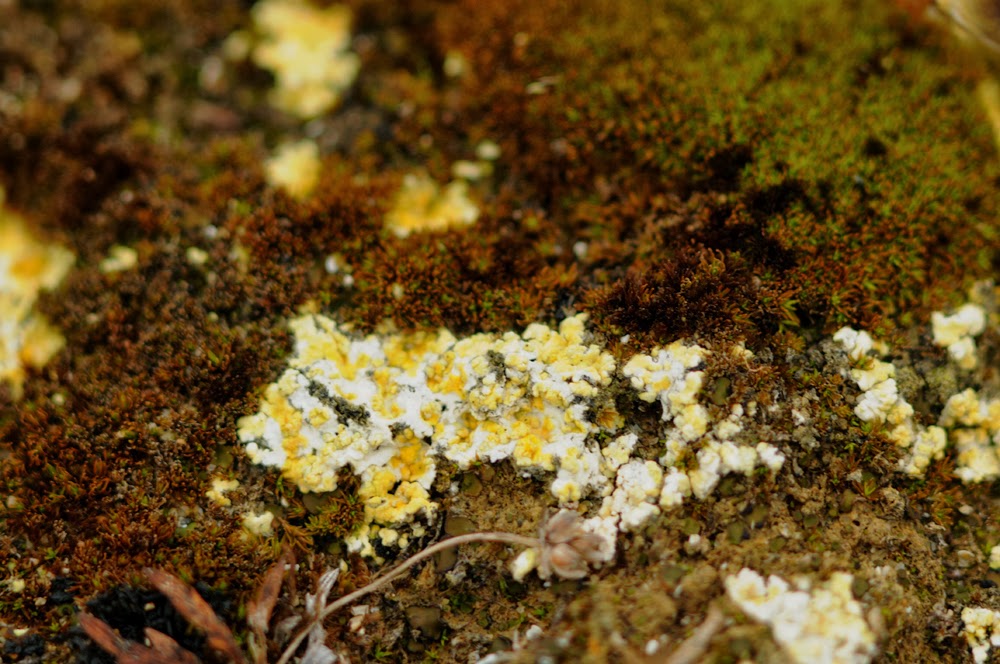
Fulgensia fulgens, I think.

Looking west to the end of Pointe Toulinguet, across nice maritime grassland and coastal heath.

Fixed-dune grassland near Pointe Toulinguet.

The coastal heath stretches round south and east to Kerloc'h and beyond, and north to Pointe d'Spagnol. Inland is a very Cornish-looking landscape of mixed farmland and low-canopy scrubby woodland, which looks nice for birds, but is rather difficult to work effectively. Nevertheless, we found a welcome daily trickle of Chiffchaffs and Firecrests amongst the resident Robins, Blue Tits and Great Tits, along with the odd Willow Warbler, Whitethroat and Blackcap - quite home-from-home in a way!

The two small lakes we visited were rather unexciting - the more interesting-looking Etang de Kerloc'h couldn't be approached closely, and the lake at Le Fret seemed to be covered in Coot, but I'm sure both have more interest at a better time of year. Etang de Kerloc'h in particular seemed nice: lots of swampy reedbed and a nice heathland transition area on one shore. Water Rail calling in the depths of the swamp were nice, but better were the distant calls of a Black Woodpecker: first of all the landing call, which sounds somewhat akin to the squeak you can get out of blowing grass-blade between your hands, then those 'krr-krr-krr' flight calls. Always a pleasure!

Finally, the beaches... most of them were lovely, gentle sand or sand+shingle beaches, generally with water warm enough to swim with pleasure, but the stand-out beach has to be just east of Pointe de Penn Hir: not only wide, gentle and mainly sandy, the western end has a superb selection of rock-pools, tailor-made for entertaining a toddler (and her father!) for as long as is possible. The pools range from several square metres to just a couple of hand's-widths, ankle- to knee-deep and with variously sandy, stony or weedy appearance. Some are clearly ephemeral, changing size - or even existence - tide by tide, some are more reliably configured, and there are even a few perfect aquariums where small hollows have been scooped out of the rocks to be left with their own microcosms as each tide departs.

The beach at Pointe de Penn Hir.

Looking seaward from Pointe de Penn Hir

Within each there seems to be a cohort of prawns, translucent creatures with chocolate bands, stalked eyeballs and immensely long antennae, picking their way fastidiously through the sand and the seaweed with tiny pincer-like claws. They move rather deliberately across the pool until they meet something they're not keen on, at which point they curl their tails under their abdomens and pulse backwards away from the threat with little darting jerks.

One of the omnipresent cohort of prawns, delicately sifting the detritus of the last tide for tasty snacks.

A large and colourful starfish is always a good start to the rockpooling session, and persuades one's daughter that her father is not quite insane yet.

The other very mobile feature of the pools is the fish: approach a rocky or sandy pool and almost certainly you will see a flurry of movement as various blennies dart away to the shelter of rocky overhangs. Wait patiently (or for the younger, capture one and temporarily house it in a bucket of seawater) and you can see that there are a couple of species (at least) involved: one rather dark brown with an array of pale-blue spots down the body, the other mainly transparent, but with a freckling of salt-and-pepper dots down it. Unsurprisingly, the darker species tend to be found in the rockier areas and the paler ones on the sandy parts of the pools. There are also occasional shoals of small sprat-like silvery fish engaged in what look like complex courtship rituals over the sandbanks of some of the largest pools.

A blenny of one or another species. This is the darker of the two abundant ones, which seem to prefer the rockier areas.

Now you see me...

...now you don't. Almost. The paler species of blenny, showing how well it's adapted for a life on a sandy substrate!

Surrounding all this activity are the more sedate denizens of the shore: a black rippling carpet of mussels, crusted with barnacles and garnished with multicoloured periwinkles and stripy top shells all sat tight, awaiting the return of the sea, dotted here and there with the tenacious cones of limpets. Here and there lie jelly-like red blobs of Beadlet Anemones, turned in on themselves where they've been abandoned by the water, or tentatively waving a tentacle or two if still submerged - and in the more permanent rocky pools the beautiful, yet somehow faintly threatening-looking, tangles of Snakelocks Anemones gently swirl their tentacles around. We did find a couple of anemones which appeared somewhat different: one a large bright orange species with an electric-blue fringe around the base of the body (it never opened up to show us its tentacles); the other a translucent species with banded tentacles - maybe more detail if I ever get them identified.
Some rather - interesting - looking sponges (I think). Linnaeus would have loved them!


More sponges, looking somewhat like a bunch of yellow pigs trying to pretend they're not there...

Anemones, apparently, but not as I know 'em. Very fine but not a species I am familiar with.

Occasional clumps of eggs on the rocks - but whose are they, and are the pinker ones closer to laying, or to hatching?

One of my favourites - the lurid Snakelocks Anemone

The highlights of the trip, in no particular order, were probably the rockpools and rockpooling, the Choughs, and the pair of hornets which were wrestling on the edge of the road in Morgat, which we watched for a good 10 minutes - both apparently furiously intent on dispatching the other, but neither of them able to get the upper hand...

Hornets. Wrestling.