Showing posts with label holiday birding. Show all posts

Friday, 24 July 2015

Inselaffe am See - part I

It should really be Inselaffen am See,  I suppose, as we were all involved. So be it.

Four a.m. starts with small children are not wholly recommended as a matter of course, but once in a while is OK.

Birmingham airport is also OK once in a while - I wouldn't want to make a habit of it.

Arriving in Berlin in temperatures of 39C in the shade with two very tired small children, to discover that Flybe have mislaid your car-seat en route and that your car-hire company has no record of your having booked one car seat, let alone wanting two, and oh, I'm so sorry, we don't actually have any car-seats anyway... well.

To be wholly fair to everyone involved, the lady at the Enterprise desk was very polite, her colleague found two car-seats from a rival company and the children were really as good as gold.

So, our visit to Mueritz National Park, about 90 minutes northwest of Berlin, didn't get off to the most auspicious of starts. Be that as it may, wending our way gently through the summer countryside under cloudless skies, watching Black Kites glide elegantly across the stubbles behind gigantic combine harvesters, the children sleeping soundly in the back of the car, it certainly felt like it was shaping up to be a nice summer holiday.

We eventually arrived at Mueritzparadies, a small collection of wooden chalets next to Germany's biggest lake (Constance doesn't count, as it borders Austria and Switzerland too), where the girls gratefully spent the next couple of hours splashing in the waters of the lake and revelling in some playtime. Another Black Kite drifted over to remind us we weren't at home any more - as if we needed that, with Tree Sparrows flustering in the bushes, and temperatures which would probably be melting the tarmac in Devon. The main drawback was that the house had been shut for most of the day, so the bedrooms - upstairs - were sweltering. The only solution was to put the youngest daughter in the downstairs loo to sleep, the elder daughter adjacent and sleep on the livingroom floor ourselves. Needless to say that was great fun for all concerned (!) and sleep proved a little elusive for a while...

A family of Hooded Crows - another sign we're not in Devon - sweltering in the heat atop a birch

The next day dawned bright and fair, and promised to be nearly as hot as the previous, so the sensible decision was taken to stay in the lake as much as possible. The heat was well into the mid-30s, so the wildlife was doing just as the humans - staying in the shade and not making too much fuss. The odd Red Kite and Black Kite floated over, a Red-crested Pochard flew by offshore and the distant trumpeting of Cranes provided a staccato background chorus every so often. All very relaxing. Time to take stock of our surroundings a little better...

Mueritzparadies lies just outside the edge of Mueritz National Park. The countryside is predominantly arable farming - with lots of arable 'weeds' like cornflower, poppies, fumitories &c evident in fallow plots and crops - interspersed with wooded land: lots of planted conifer in the main. There are marshy hollows here and there with willow, alder and aspen carr, reedswamps and luxuriant tall-herb fens. In spring the area must teem with migrant birds and echo to the sound of returning breeders, but in the heat of midsummer the song is mainly over and the air is filled with the buzz and rustle of insect wings and the soughing of the wind through the leaves instead. The lake itself is shallow, so the water is warm and tempting, even to non-swimmers.

Cornflowers, bluer than the eyes of flaxen-haired maidens in some romantic poet's vision. The mist of blue across the gold of the ripening barley is stunning, poets aside.

The nearby field corner - it became known as the 'Acker-ecke' (sorry, just means 'field corner') - was a riot of colour and invertebrates. Clearly someone's forgoten to glyphosate this part of the world. Can't be having that.

Even such goodies as Consolida regalis in there!

There are also - just next door - some very extensive fishing ponds: the Boeker Fischteiche, which are well-known as a good birding spot (we saw one other couple birding, which is pretty high-intensity stuff). We thought we'd branch out a little, drag the children away from the lake for the next morning and see what the ponds had to offer. Two hides and a viewing screen attest to the birding interest in the site (I suspect in spring and autumn it is actually quite busy) and we were duly welcomed to the site by an Osprey fishing slap-bang in front of us, far too close to bother with things like binoculars to enhance the view. If you'd tried, you'd probably have had nightmares about the bird's feather-lice. A backdrop of Marsh Harriers and both kite species held Bina's attention and she duly got very excited about pointing out every soaring raptor that came over, soon learning to pick out the kites from the rest with their forked tails an easy clue. Just to cap it all, a young White-tailed Eagle drifted leisurely over us at treetop height, mobbed by a pair of Red Kites. 'Wow', said Bina, 'das ist gross'. Not wrong. [Na points out that I may be inadvertantly confusing English readers who lack basic German. To set the record straight, it means 'that's big'. Nothing yucky.]

Although the wind picked up strongly, there was calm enough water for us to be treated also to a couple of pairs of Red-necked Grebes feeding semi-stripy young. Perhaps the nicest thing of all, though, was walking along the boundary between a hayfield and woodland, feet drifting Heath Fritillaries with every step. Scattered amongst them were the more familiar fare of Meadow Browns, Ringlets and skippers, as well as ghostly-pale Blue Featherlegs sliding mysteriously between the leaves. Even the walk through the arable fields was worthwhile to a farmland-bird-starved Devonian: Corn Bunntings and Yellowhammers singing everywhere.

The cooling trend continued the next day - the wind stayed fresh and the temperature was down to the mid-20s. We met up with one of the park staff, Volker, who took us on a short bike tour within the national park to the Specker See and back. We passed initially through tracts of conifer, gradually returning naturally to broadleaf woodland (look Britain, no gardening!) before getting into areas where a mosaic of acid grassland, alder woodland and swamp intermingled. Climbing an observation tower, we were treated to the sight of a vast bed of Great Fen Sedge stretching out to the Binnenmueritz - a stretch of fen reminiscent of Biebrza, albeit not on quite the same scale. Volker told us about the work that had happened since the park was designated: the re-wetting of drained agricultural land, the restoration of lake, swamp and fen hydrology, the natural recovery of broadleaf trees amongst the conifers. We cycled and stopped, talked, looked and listened - a River Warbler briefly piped up, followed by a couple of Grasshopper Warblers; the occasional Willow Warbler fluted in the scrub. Another White-tailed Eagle passed by overhead. It's a tough life sometimes.

Cladium mariscus swamp. Mmm...

Re-wetting isn't to the taste of everything. There are plenty of trees which find the whole process just too, well, wet. The skeletal remains of conifers dot the wet grassland and swamps, making ideal perches for resting Ospreys.

All good things come to an end, and our stomachs insisted that lunch should now be a priority, so we said goodbye to Volker and occupied one end of a spacious hide overlooking lake Mueritz to eat some food. We were immediately joined by a large touring group who abandoned bicycles outside and came in for a lecture from their guide about the national park and the lake. As this progressed, a wasp flew in and hung around us. It was soon joined by another, and then a few more. None of them seemed interested in our food (fortunately), but all of them seemed somewhat bemused, and before long we had about 50 wasps droning gently up and down the hide, to the mild consternation of some of the people sharing the space. The guide was obviously not to be fazed by a bunch of stripy insects and finished his talk. As the group filed out, the wasps - with an almost audible sigh of relief - found their route to their nest, lovingly built between two backboards, unobstructed once more and resumed their normal commute. Those of us left in the hide also breathed a sigh of relief and set to their food with enthusiasm.


The following day was forecast to be windy, cool and with occasional sharp showers - what better excuse to head for the UNESCO-listed beechwoods around Serrahn. This area is a peculiarity of Mueritz National Park: the park itself is in two separate parts; the one is the vast forest-bog-swamp-grassland complex around Lake Mueritz, the other an area of forest, swamps, bogs and lakes surrounding some undeniably fabulous ancient beech forest a short way east of the small town of Neustrelitz. We walked from the Zinow entrance along a small trail winding initially through open pinewoods. The floor of the woodland being liberally carpeted with bilberries, the children both soon had purple faces and wide grins.

Caterpillar on Deschampsia flexuosa

Common Heath moths - Ematurga atomaria - were abundant throughout the pinewoods near Serrahn

As the path wound down towards a lake, the clouds closed in and the pines gave way to beech woodland. The rain was soon pelting down, so we scurried for the shelter of an observation tower overlooking the lake. The rain generously eased as we reached the shelter, so the families already in residence decamped and allowed us in. A wide soughing swamp of Harestail cottongrass gave way to reed, then open water. On the opposite bank a family of Ospreys did some vigorous exercise to rid their wings of water and get their muscles in fettle for their maiden flight. We admired, then headed on towards Serrahn for some lunch. The rain began again.

The view from the observation tower near Serrahn. Eriophorum vaginatum swamps merge into Phragmites - the conifer line retreats from both sides of the lake and the alders march in

Fir Clubmoss, Huperzia selago, by the foot of the observation tower

We squelched on for the last kilometre, then came to a most spectacular boardwalk through an arm of bog. The rain was pelting down steadily, so no photos, but the path wound gently through perhaps the richest bog I've ever been privileged to see, with copious information boards about the plants to be seen - all of them carefully placed next to the plant in question: milk-parsley, bladderwort, round-leaved sundew, tufted loosestrife, marsh cinquefoil, bogbean, water-violet... the list went on. Everything was underlain by a thick, luxuriant carpet of Sphagnum. On a still and sunny day it would have been rustling and buzzing with dragonflies and damselflies, moths, flies and mosquitos - as it was, the gentle patter of raindrops made an appropriately liquid soundscape.

Lunch was taken sans rain (to our relief) and the walk back along the sandy cyclepath was less interesting, though a smart Red-breasted Flycatcher livened the start up. On a nicer day - and perhaps earlier in the morning - it would likely have been a very productive trip to make. Next time, maybe.

More soon...
Platycnemis pennipes - the Blue Featherlegs - displaying his fine and shapely tibias.

Ajuga genevensis growing willy-nilly outside the house

Sunday, 14 April 2013

East Anglia again

Here we are in EA once again, doing the visiting-and-sightseeing thing. Not the most auspicious start to the trip, as we'd got no more than 10 minutes down the road when S was copiously sick in the back seat: a cascade of porridge and raspberries descending across the car-seat, her (of course) fresh clean clothes and everything in between. Poor girl looked pretty shell-shocked after that, unsurprisingly, but soon fell asleep for the next stage of the journey, whilst we negotiated the rain, spray and wind past Bristol and along the M4. By the time we'd passed Swindon the weather was sufficiently dry and bright for the odd Red Kite to be out and about, easing their way through the gusts and the swirling mix of Rooks which rose to mob them with an elegant aplomb.

Our first port of call was Saffron Waldon, where we dropped in on friends who have recently had a baby and are coming to terms with the sleepless phase. Few opportunities for any serious out-and-abouting, added to which the weather was foul - blasting easterly wind and temperature around zero, even before wind-chill is taken into account. In fact, all we really noted was that the Rooks were undaunted by the weather and have begun sitting on their nests. And that Saffron Waldon is actually quite a pretty town...

We moved on to Norwich, where we descended on another couple of friends. No improvement in the weather, but nothing ventured & so on, so we headed out to Holkham to see what we could see on Sunday. The wind was so cold and so strong that S kept her head down the entire time we were out, sleep or wake, snuggled as far inside my coats as possible. Puddles and damp hollows in the pastures were rimed with ice created by the wind-chill. Birds were scattered sparsely around the site - a pair of Wigeon here and there on the pastures, a scatter of Lapwings disconsolate amongst the tussocks. In the occasional shelter of the pines, the sun was warm and spring-like, but move back into the wind and all such thoughts were put aside. We rounded the eastern end of the pines near Wells and turned west along the beach. The sand moved past us at a rate of knots, making a dun knee-high mist which obscured the ankles and shins of walkers and indeed almost totally obscured some of their dogs. The few birds on the beach were hunkered down tight against the surface, all to the seaward side of the blasting sand - a handful of Herring and Great Black-backed Gulls, a few Sanderling, a couple of Dunlin, Knot, Bar-tailed Godwit and a solitary Redshank. By the time we returned to the car we were breathless with the cold, ears ringing to the sound of pounding surf, howling wind and whispering sand. The only one who seemed entirely at ease was S, who'd woken not long before...

Holkham beach. We just don't have that extent of sand in Devon.

It was windy. Very windy. Jake (the dog) must have been grateful to have a tail to keep the wind out.

It was windy. Very windy... All day.

The afternoon's visit to Titchwell, just a little further west along the coast, was - if anything - even more windy. So much so that we took a quick walk along to the sea and back without stopping for much at all - a hunting Barn Owl in the lee of the woods, a pair of Pintail dabbling languidly in the shelter of a saltmarsh island, a female Red-crested Pochard (where did she come from, I wonder?)... and a vast flock of gulls (mainly Common) sheltering on the pools away from the sea. We soon headed back to the car and hit the road for Norwich.

On, then, early in the morning, to the wild and woolly hinterlands of Suffolk for a few days with Na's aunt and uncle. The weather finally began to perk up, S began to perk up as well, and Na came down with her tummy upset: timing! We managed to relax a little though, spending some time stacking wood and digging over the veg beds for the spring, unearthing vast quantities of bindweed root and taking the opportunity to wander round Minsmere and Walberswick. The wind abated a smidgen, but only a smidgen, and we were rewarded with a fine Short-eared Owl hunting the coastal marshes at Walberswick and another Barn Owl on the heaths, and a handful of Smew, an adult Little Gull and a trio of Whooper Swans at Minsmere. Hardly the stuff of epic, but nice enough for a  southwest birding family.

A Lapwing eyes us suspiciously from the rabbit-nibbled grassland at Minsmere. Or maybe it's watching the rabbit in the background.


And now here we are with some warmer weather - Swallows, Sand Martins and House Martins are trickling in through the local ponds and it seems as if spring might finally have sprung upon us. Here's to it!

Hazel catkins - and a couple of flowers to go with them.


Male Chaffinch. Not in song in East Anglia when we were there, but now they're hitting their stride here.


Wednesday, 7 December 2011

Australia: a final tranche

A final internal flight; a closing of the loop. We returned to Sydney, where we were met by my uncle, who whisked us off to Lindfield where we spent the final few days of our Australian adventure. Unfortunately, the poor weather which dogged our final day in Tassie followed us up, so that most of the last week was a mish-mash of rainy spells and overcast skies, with a cool onshore wind.

Our first full day in the city began with a gentle tour of the northern suburbs and fringe, up as far as Palm Beach, courtesy of my aunt. A decidedly chill wind kept us from walking much as we explored the local surrounds, and a bout of heavy rain around lunchtime dissuaded us from exploring the Lindfield area at first. However, a bit of cabin fever threatened to set in, and the prospect of a good walk sent us scurrying out onto the Great North Walk route. The trail led us along the forested banks of the local river, serenaded by Rainbow Lorikeets, Sulphur-crested Cockatoos and Galahs - quite an overpowering racket at times. As soon as the rain eased, the wildlife began to emerge: we suddenly found ourselves in the midst of  a mixed flock of fantails, scrubwrens and honeyeaters, with White-throated Treecreepers and Variegated Fairy-wrens tagging along for variety's sake.

Having recovered and reinvigorated ourselves, we headed into the city first thing the next morning, to do the obligatory tourist thing and ogle the opera house, look at the harbour bridge and shop for some bring-home souvenirs. The harbour bridge was duly stared at and photographed; the opera house ogled and perambulated (it's much smaller than I'd imagined, and the roof has a rather nice pattern in it), but the overcast skies meant that it wasn't a great day for photos. Moody lighting, in the main.

Can you guess what it is yet?

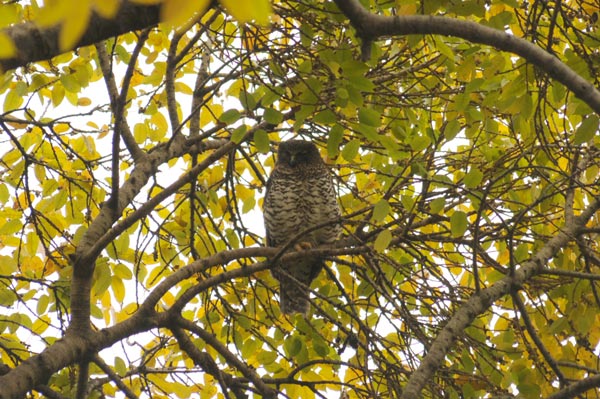
We continued into the botanic gardens - immediately next door to the opera house - and spent some time admiring the Grey-headed Flying-foxes roosting over the information centre. Serendipity struck: when I went to ask about the bats, there was a photo of a Powerful Owl on the wall, so I asked - jokingly - if they knew where it roosted, to be told 'we'll take you over there if you like'. So we had an impromptu tour across the gardens, taking in some of the more interesting trees, the history and context of the gardens - straight over to the roost of the owl, which looked at us with some horror, then over to see a fine Tawny Frogmouth at it's nest and finishing with a visit to the memorial to the children deported from Britain under the 'Child Migrants Programme' - a practice which ended not long before I was born.

Badly-furled umbrellas. Grey-headed Flying-foxes.

Powerful Owl in the Sydney Botanic Gardens. Ask at the information centre: they tend to know where he is, or where he may be.

After this, a visit to Lady Macquaries Chair was a little bit of a let-down, but we struggled on manfully. By this time we'd had about enough of wandering, so a 30-minute ferry trip across the harbour to Manly and a wander out to see the sea seemed like a good idea. It was a good idea, but for various reasons we were flagging a bit by this stage. We made it out to the lookout at the end of the harbour, where we viewed with some disdain yet another couple of Humpback Whales sporting in the surf. As the wind freshened yet further and the rain began to spit in earnest, we headed for the nearest bus-stop and retraced our route into the city to buy gifts for our homecoming.

Making the opera house look much larger than it is.

We decided we had enough puff to head across the city the next day, to the world's second-oldest National Park: Royal NP. We hopped off the train at Engadine and headed into the park, following the walking tracks towards Heathcote through yet more dry sclerophyll forest. By the time we got to the park it was mid-morning, so the birds were getting few and far between: the best of them at first perhaps being a confiding party of Yellow-tailed Black-cockatoos stripping branches to get at sap. We then started following a trail towards Audley, which in retrospect could have been a bit of a mistake! The track led through increasingly rugged countryside - and as we trailed down into the base of a small valley we disturbed a large Red-bellied Black Snake, which uncoiled with alarming rapidity and headed straight for my feet. I executed a strategic retreat in quick time, and watched with some relief as it headed quietly into the hole under the stone I'd been standing on. Soon after this, the day improved even further with a brief burst of song from a Superb Lyrebird (if you don't know this bird, you should: watch this YouTube clip. Ours didn't have quite as varied a repertoire, but just as fine a songster).

Yellow-tailed Black-cockatoo

We finally found ourselves traipsing down to a picnic area: to an eager audience of Purple Swamphens, Dusky Moorhens, kookaburras and Sulphur-crested Cockatoos: all waiting for a scrap of food. We disappointed them by only having a couple of apples to eat, though the swamphens were quick to take the cores off us and dispose of them tidily. By this stage, however, we weren't quite sure where we were, nor how long it was going to take us to get back to the railway. There was a road opposite with regular traffic, but which way led out? Fortunately there was a small boat-hire shop open just across the creek, so we trotted over the bridge and asked, to be told that it was about 20 minutes to Loftus, headed 'that way' along the road. Hooray, we thought. Twenty minutes later we were still climbing the hill out of the valley, and began to think that the owner of the boat shop might not have suspected we were travelling on foot. Ten minutes later we reached the National Park offices, in the carpark of which a kindly man put us right, pointing us to a traffic-free path to Loftus and explaining that it was about half an hour further to the railway line. We eventually trudged into the station - after taking our lives in our hands by crossing the Princes Highway on foot - dog-tired and in the perfect state for a chunk of restorative mud-pie from the bakery across the road. Perhaps the best piece of cake I've had in ages: hunger is by far the best sauce around.

Purple Swamphen poses for a photograph...

...then gets down to some essential apple-core recycling.


Our final day in the country was spent taking a short walk around part of Garigal National Park; another of Sydney's urban national parks. We were dropped at one end of a little trail, meandered through along the riverside and eventually ran out of energy and enthusiasm somewhere in East Lindfield. Although relatively quiet and non-wildlify, we still managed to see a final new species for the trip: a pair of Dollarbirds which appeared with startling suddenness on top of a dead tree whilst we had a drinks-break. This walk was perhaps most memorable for the incredibly confiding Eastern Water-dragon who basked in the path in front of us, and then refused to be intimidated by us, posing for some beautiful portraits of what is, unarguably, a stunning lizard.

Sulphur-crested Fiend-in-feathered-form.

Unidentified, but rather fine, flower

Eastern Water-dragon auditioning for The Return of the Son of the Mask of Zorro.

Eastern Water Skink. I think.

Unfortunately, that's the end of our Australian adventure. I suspect we won't be going anywhere exotic for a little while now, but you never know what life may throw you. Watch this space...

Thursday, 24 November 2011

Tasmania: the Tasman Peninsula

Tasmania dawned bright and cheery, with a stiff south-east breeze (brr!) and glaring southern sunshine (mmm!). The roads were pretty quiet, so we headed off towards the Tasman Peninsula with light hearts. The countryside reminded us of parts of Scotland and south-west England, with rolling hills, open pasture and rugged rocky coasts; though the patches of Eucalypt woodland aren't so familiar-feeling.


The Tasman Peninsula from the Devil's Kitchen


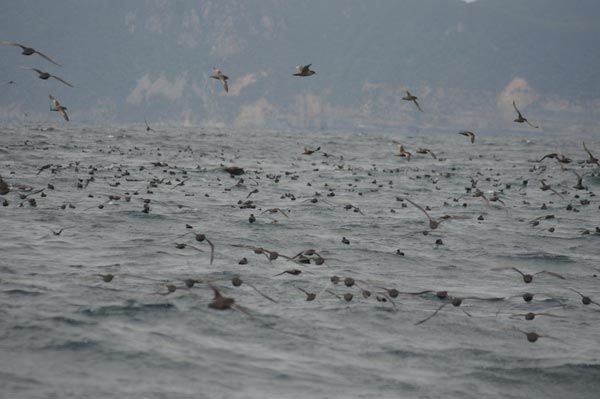
The drive to the Tasman Peninsula was pretty uneventful, and in due course we arrived at the beautifully-named (and beautiful) Eaglehawk Neck in time for a restorative ice-cream. The view from the lookout near the carpark treated us to our first Black-faced Cormorants, a couple of Kelp Gulls and a flock of shearwaters offshore which proved on closer inspection to be mainly Short-tailed, with a handful of Sooty and Flesh-footeds mixed in. The telescope revealed that rather than the apparent couple of thousand birds milling around, there was a constant mass of birds as far as the eye could see - easily tens of thousands, constantly wheeling up and down the face of the waves; all apparently just killing time before heading in to their next burrows after dark.


Dry sclerophyll forest

A walk in the woods was clearly in order, so we set off south. Passing the spectacular crevice of the Devil's Kitchen, we headed along the track towards Waterfall Bay. Coastal heath, not unlike that in Queensland, dominated at first. The air was occasionally pierced by the shrill squeaks of Brown and Tasmanian Thornbills, Tasmanian Scrubwrens and Eastern Spinebills - a honeyeater which looks and behaves somewhat like a hummingbird. Gradually the woods closed in. The occasional pair of Green Rosellas bounded past to sit high in the treetops and regard us suspiciously. Black Currawongs carolled and warbled in the trees above us and a variety of lizards waddled or scurried away through the dead leaves, depending on their relative size.


Pygmy Sundew (Drosera pygmaea)

Again, almost no-one around to share this walk with us; it was half shocking and half pleasant: here in Britain the track would have been heaving with people, but then again, there would probably have been less wildlife to see too. We finally reached a stream and campsite where the track led off to the lookout over the bay. Just as we rounded the corner, we almost fell over a small ball of woolly-looking fur and spines, huddled against a treestump. Clearly it was an echidna, but it wasn't going to show us any glimpse of it's face. We left it in peace and walked to the viewpoint, settled down for a bite to eat and enjoyed a fine view - complete once again with Humpback Whales breaching.


Echidna


Heading back up the track, the echidna had emerged from it's stump and was bumbling around the forest floor near another rotting treestump. This time we were able to stand and watch it as it stomped around, pausing periodically to shove its beak deep into the soil; presumably sniffing for or licking up ants. Every so often an exploratory sniff must have yielded something worth pursuing, as the front feet were used with formidable force for such a relatively small creature to rip out a hollow about 10cm deep. Eventually it swaggered off around the stump and we regretfully picked up our bags and continued on our way.


Echidna, emerging

We stayed at the Norfolk Bay Convict Station, a friendly and characterful bed and breakfast with enthusiastic and knowledgeable owners.


Norfolk Bay Convict Station: now a pleasant B&B

The next day saw us head out along the Mount Raoul peninsula, in order for a proper walk to do. A drive out to the end of the road took us through increasingly Dartmoor-esque countryside, complete with clumps of Juncus, conifer plantations, rough grazing - and European Gorse. Although adding a touch of homeliness for the European traveller, this is - in this part of the world - a hideously invasive species. By the time we arrived at the end of the road, it seemed so much like Britain that the sight of a pair of Chestnut Teal on the nearby pond threw me completely for a moment. Fortunately a kookaburra began laughing and put me back in my senses.

Wet sclerophyll forest


The walk proved to be through more mature forest than the previous day. Dry sclerophyll gave way to wet sclerophyll, and in both the range of flora was superb. Perhaps a highlight of the walk out to the cape was the sight of a large Black Tiger Snake, which uncoiled from it's basking spot and slid smoothly and calmly away across the path in front of us. As we dropped over the side of Mount Raoul, the vegetation suddenly changed to a mixture of head-high heath and whispering groves of sheoaks. Like the conifer plantations here that they resemble so well, there was little wildlife within these groves, although a Tasmanian Pademelon startled us both by bounding away from the edge of the path suddenly.

Coastal heath flowers

More unidentified flowers...

Pink powder-puff-type flower

Tasmanian Pademelon

We finally reached the end of the path at Cape Raoul, where we settled don for lunch, admiring a young White-bellied Sea-eagle, the Pig-face flowers at our feet and the abundance of Brown Cutworm moths littering the ground; not to mention the spectacular columnar cliffs.


Cape Raoul

Coastal heath on Cape Raoul


Brown Cut-worm

Native Pig-face (Carpobrotus sp)
White-bellied Sea-eagle
When we rose to go, we realised we weren't alone: another family had joined us and were busily exploring the small pond for frogs - the children informed us with some importance thet there was a little echidna around that bush, which we might see if we were lucky. We wandered around that bush, and there it was, head-down in the scrub.

I wandered in to try for a couple of close-ups, but there was too much vegetation in the way - and then it decided that it was coming out, so I moved off to give it space to go where it would, and in the hope of a picture uncluttered by twigs. Crouching back on my heels, I was surprised when it headed towards me - and more surprised still when it walked straight up to me and dug its beak into the ground under my instep! As is of course the rule, Na's camera was in the bag on my back. It then moved over to investigate the ground under my other foot - and then seemed to settle down to sleep, tucked in close between my ankles.


Eventually I could see myself being there all day, so I levered myself carefully up and stepped back, at which point it looked up at me, perhaps in some bemusement, and decided to wander off in the opposite direction. Strangely, the walk back to the car was rather uneventful in comparison.


Echidna, en route to my ankles


Echidna, shortly after vacating the space between my ankles

The lone echidna, wandering off across the heath

Our final day on the Tasman Peninsula was taken up with a trip around the peninsula on a Tasman Eco-tours boat, steered by the chirpy and chatty duo of Damo and Damo. A brisk southwest breeze had built up a decent swell for the first part of the trip, so the initial 40 minutes were a rather rollercoaster-like series of runs across the Tasman Sea. An inshore fare of Black-faced Cormorants and Kelp Gulls was rudely interrupted when a Shy Albatross glided impassively past, in true clichéd fashion, not beating a wing as it slid effortlessly over the waves.

Black-faced Cormorant
Soon we were rounding Tasman Island, where a small hangout of young male Brown Fur-seals (a.k.a. Australian Fur-seal) took great exception to the boat-load of tourists pointing cameras at them, and flopped
inelegantly into the water to escape.

Brown Fur-seal
We then turned our attention to the open waters, partly to look for Humpback Whales, and partly to enjoy
what was becoming an awe-inspiring flock of shearwaters. In all, there must have been close to half a million birds in the general area. Mainly Short-tailed Shearwaters, but with a smattering of Sooty Shearwaters and the occasional Shy Albatross to dwarf them both, the whole sea seemed to be in constant flux, as parties of birds took off, wheeled away and settled again nearby. As far as the eye could see, there were shearwaters. Had this been a fishing trip or a bird trip, we could happily have stayed out there for hours, searching for a little more variety in the flock, enjoying the sheer mass of birds present in the area; but unfortunately we were on a scheduled tourist trip, so carried along steadily until we came close enough to shore for the birds to peter out. A final wildlife-moment, as we stopped off to admire some New Zealand Fur-seals - the polar opposite of their Brown cousins in their laid-back attitude, and we were soon bumping gently at the jetty at Eaglehawk Neck...

New Zealand Fur-seal

Short-tailed Shearwaters.

Short-tailed Shearwaters

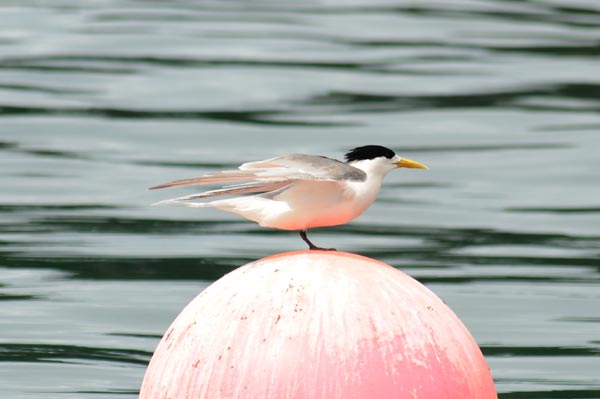
Crested Tern at Eaglehawk Neck