Showing posts with label Tasmania. Show all posts

Monday, 5 December 2011

Tasmania - part two.

Our journey took us north to the central east coast of Tasmania: the Freycinet Peninsula. The landscape during the journey continued to resemble Europe - for a short while we even drove along an avenue lined with plane trees and hawthorn (at least, that's what it looked like to us!) with pasture and gently rolling hills rising to wooded heights, interspersed with the occasional sea-inlet fringed with saltmarsh and rushy pasture to our right.

Our immediate aim was a walk to stretch our legs. We left the bed and breakfast and headed along the little local beach, where Hooded Plovers lurked, looking rather like delegates at a hangman's convention. A scatter of loafing Pacific Gulls also added a touch of elegant menace, with something of a thuggish swagger to their appearance.

Hooded Plover

Red-capped Plover.

Pacific Gulls in the hood

The next morning dawned clear and sunny, so we headed without further ado into the nearby Freycinet National Park to explore the much-lauded delights of Wineglass Bay. This is an extremely popular walk, as we quickly discovered: the carpark was showing signs of creaking at the seams at 8.30 in the morning. Nevertheless, we signed in to the walkers' book and headed off, determined to make a round trip to Hazards Bay. The initial climb was a short sharp one, tracking up a wide gravelled path dotted with tourists. We took our time (how should we do otherwise?) and eventually reached the lookout over Wineglass Bay, where we joined a gaggle of other tourists admiring the view - admittedly very nice. We pressed on with some enthusiasm, looking for somewhere a little quieter where we might see some of the wildlife, and were almost immediately rewarded: a Bassian Thrush foraging beside the path, a pair of Eastern Spinebills flitting through the canopy, a Flame Robin glowing in the understorey - and then a pair of Wedge-tailed Eagles drifting serenely overhead, chocolate-brown against a Prussian-blue sky.

Skink skulking by path

Soon after this, we noticed a pair of Grey Fantails making a hell of a racket in the trees a few metres away. A pair of Scarlet Robins joined them, dashing down towards a branch, then up into the neighbouring branches or the nearby trees: classic mobbing behaviour. A careful scan of the branch showed us the culprit: a sizable  Black Tiger Snake slowly picking its way down the tree, about 2.5 metres off the ground. Clearly the birds were taking no unnecessary risks whilst alerting their neighbours that the predator was around, and letting the snake know exactly what they though of it! We left them to it and plodded on down to the bay.

The view from the beach was, to be honest, a little disappointing. A bit like the view from above, but without the perspective. The path towards Hazards Bay beckoned; enticingly free of walkers... The woods here opened out somewhat, with wattlebirds and Green Rosellas making a noisy entrance for the day. To our left we began to get glimpses of Hazards Lagoon, a large reed and sedge-scattered body of water which appears to be quite shallow. The view across to the hills to the south was placidly stunning, making up for rather a lack of birdlife on the water (a pair of Black Swans and a pair of Mallard), whilst the aptly-named Banjo Frogs plonked a charismatic chorus around the edge of the water (imagine a handful of rubber-bands being stretched to different lengths and then plucked at irregular intervals, rather like you used to do at school and you;ll get the gist of it).

Hazards Lagoon

The path led us on along a couple of boardwalks, where we admired the glinting beauty of Ringtail damselflies, then over a little sand dune and there was Hazards Bay in all its glory. White sand stretched away in either direction; the sea was a rich medley of blues, ripening from near-shore turquoise to a vivid ultramarine in the distance; the sheoaks along the dunes drooped grey-green sibilant-hissing needles towards the sand. All very tourist brochure really...

Metallic Ringtail damselfly

Hazards Bay

Hazards Bay colours

We wandered - paddled - up the waters'-edge to the point where the rocks started and the path led us inland again, then stopped for a well-deserved lunch-break. The rest of the walk became little bit of a slog, to be honest: the path undulated along between the sheoaks, the sun beat down in its usual fashion, and the view north to Cole's Bay apeared intermittently through the trees. The rather basic map of the route was a little misleading, and we were grateful to eventually reach the carpark, where we were greeted by a couple of optimistic Red-necked Wallabies looking for handouts.

Red-necked (Bennett's) Wallaby.

We continued on to the nearby lighthouse, where we sat in what was rapidly becoming a rather biting westerly wind, relaxed and looked through another steady stream of Short-tailed Shearwaters, trying in vain to pick out something different amongst them. A couple of whales teased us into thinking they might be Southern Right Whales, but eventually proved to be Humpbacks - what's it coming to when I'm disappointed to see a Humpback?!

The following day, our final full day in Tassie, was spent exploring a little of the nearby Douglas-Apsley National Park. The park seems to be somewhat the poor relation of Freycinet as far as tourists go, but this was only to our liking. We trailed through the forest peacefully, watching Black Currawongs, Olive Whistlers and Superb Fairy-wrens until we eventually reached the end of the trail at the riverside. We waited patiently until the walkers who'd arrived before us decided where they were going, then headed off down the riverbed to get back to the car. The riverbed walk wasn't something you'd even entertain in the rain, but on a fine bright day with a nice low river it was great fun. We scrambled up and down along sweeping curves of rock worn smooth by the river, balanced and hopped our way across the smaller boulders and scrunched through the pebbles and gravels of the slower stretches, under the watchful gaze of a family party of Yellow-tailed Black Cockatoos and a pair of Brown Falcons.

Orchid (Caledenia fuscata)

End of the riverbed walk in Douglas-Apsley NP. Also the start of the walk if you wish.

Riverbed walk in the Douglas-Apsley NP

Riverbed walk in the Douglas-Apsley NP

A vertical sundew: Drosera peltata

Returning to the car, we headed back along the road towards Freycinet, stopping off in the nearby town of Bicheno for dinner and a gentle seaside walk. Our final paying highlight of Tasmania was a visit to a nearby colony of Little Penguins (a.k.a. Fairy Penguins or Little Blue Penguins). We joined a small group of people at the local surf shop, hopped aboard the bus to the colony and set out on a guided walk which was both informative and enthusing. Our guide gathered us all from the bus and introduced himself, then explained that photographing penguins at colonies was now prohibited under Australian law (bang went my plan of trying to get some sneaky photos without flash!) and that there were some basic ground-rules to observe - which boiled down to keep behind me, don't make any more noise than necessary, and don't tread on the wildlife! All pretty easy to obey really...


Female Superb Fairy-wren. A blurred male in the background.

We wandered down the track to a small grove of trees as the light faded, waiting for the birds to arrive and learning some facts about penguin ecology and behaviour. A handful of artificial nest-burrows were tucked against a nearby shed, testament to several years of patient work by volunteers (timber cases) and local schools (concrete over chickenwire). Soon the pale light of the torch revealed a small group of penguins huddled near the rocks close to the waters' edge. More patient waiting - and a degree of quiet jostling for position - and the first birds came waddling up the path in front of us, pausing for their second breather about 10 metres away. The whole group of people were quietly spellbound, watching the birds stretching, preening and generally getting their courage and strength together for the final plod to the nest, where they would replace their partners for incubation duty. We were soon asked to follow on a little further, to the next point where another group of about 30 birds were taking their rest. We stood in a quiet half-circle along the path and waited whilst this group filtered between our feet - over feet in some cases - and towards their burrows. A chorus of mellow braying calls split the air around us as pairs reunited, reaffirming their bonds and ensuring that the bird about to take over control of the burrow was indeed the correct one.

Our final day in Tasmania was a relatively straightforward journey to the airport at Hobart. Unfortunately it began in driving rain, which rather disrupted our original plans of a walk. Instead we chickened out and sat in the car to see what we could see at the local Moulting Lagoon Ramsar site. Despite the rain coming straight at us, making it difficult to see much out of the windows without either losing visibility to rain or getting drenched, we enjoyed a peaceful half hour or so at a saltmarsh, complete with Black Swans, White-faced Chats, Pied Oystercatchers and Skylarks (yes, the common-or-garden Skylark was introduced to Tasmania, along with Blackbird, Goldfinch and Greenfinch).


White Kunzea on the Bicheno coast

Thursday, 24 November 2011

Tasmania: the Tasman Peninsula

Tasmania dawned bright and cheery, with a stiff south-east breeze (brr!) and glaring southern sunshine (mmm!). The roads were pretty quiet, so we headed off towards the Tasman Peninsula with light hearts. The countryside reminded us of parts of Scotland and south-west England, with rolling hills, open pasture and rugged rocky coasts; though the patches of Eucalypt woodland aren't so familiar-feeling.


The Tasman Peninsula from the Devil's Kitchen


The drive to the Tasman Peninsula was pretty uneventful, and in due course we arrived at the beautifully-named (and beautiful) Eaglehawk Neck in time for a restorative ice-cream. The view from the lookout near the carpark treated us to our first Black-faced Cormorants, a couple of Kelp Gulls and a flock of shearwaters offshore which proved on closer inspection to be mainly Short-tailed, with a handful of Sooty and Flesh-footeds mixed in. The telescope revealed that rather than the apparent couple of thousand birds milling around, there was a constant mass of birds as far as the eye could see - easily tens of thousands, constantly wheeling up and down the face of the waves; all apparently just killing time before heading in to their next burrows after dark.


Dry sclerophyll forest

A walk in the woods was clearly in order, so we set off south. Passing the spectacular crevice of the Devil's Kitchen, we headed along the track towards Waterfall Bay. Coastal heath, not unlike that in Queensland, dominated at first. The air was occasionally pierced by the shrill squeaks of Brown and Tasmanian Thornbills, Tasmanian Scrubwrens and Eastern Spinebills - a honeyeater which looks and behaves somewhat like a hummingbird. Gradually the woods closed in. The occasional pair of Green Rosellas bounded past to sit high in the treetops and regard us suspiciously. Black Currawongs carolled and warbled in the trees above us and a variety of lizards waddled or scurried away through the dead leaves, depending on their relative size.


Pygmy Sundew (Drosera pygmaea)

Again, almost no-one around to share this walk with us; it was half shocking and half pleasant: here in Britain the track would have been heaving with people, but then again, there would probably have been less wildlife to see too. We finally reached a stream and campsite where the track led off to the lookout over the bay. Just as we rounded the corner, we almost fell over a small ball of woolly-looking fur and spines, huddled against a treestump. Clearly it was an echidna, but it wasn't going to show us any glimpse of it's face. We left it in peace and walked to the viewpoint, settled down for a bite to eat and enjoyed a fine view - complete once again with Humpback Whales breaching.


Echidna


Heading back up the track, the echidna had emerged from it's stump and was bumbling around the forest floor near another rotting treestump. This time we were able to stand and watch it as it stomped around, pausing periodically to shove its beak deep into the soil; presumably sniffing for or licking up ants. Every so often an exploratory sniff must have yielded something worth pursuing, as the front feet were used with formidable force for such a relatively small creature to rip out a hollow about 10cm deep. Eventually it swaggered off around the stump and we regretfully picked up our bags and continued on our way.


Echidna, emerging

We stayed at the Norfolk Bay Convict Station, a friendly and characterful bed and breakfast with enthusiastic and knowledgeable owners.


Norfolk Bay Convict Station: now a pleasant B&B

The next day saw us head out along the Mount Raoul peninsula, in order for a proper walk to do. A drive out to the end of the road took us through increasingly Dartmoor-esque countryside, complete with clumps of Juncus, conifer plantations, rough grazing - and European Gorse. Although adding a touch of homeliness for the European traveller, this is - in this part of the world - a hideously invasive species. By the time we arrived at the end of the road, it seemed so much like Britain that the sight of a pair of Chestnut Teal on the nearby pond threw me completely for a moment. Fortunately a kookaburra began laughing and put me back in my senses.

Wet sclerophyll forest


The walk proved to be through more mature forest than the previous day. Dry sclerophyll gave way to wet sclerophyll, and in both the range of flora was superb. Perhaps a highlight of the walk out to the cape was the sight of a large Black Tiger Snake, which uncoiled from it's basking spot and slid smoothly and calmly away across the path in front of us. As we dropped over the side of Mount Raoul, the vegetation suddenly changed to a mixture of head-high heath and whispering groves of sheoaks. Like the conifer plantations here that they resemble so well, there was little wildlife within these groves, although a Tasmanian Pademelon startled us both by bounding away from the edge of the path suddenly.

Coastal heath flowers

More unidentified flowers...

Pink powder-puff-type flower

Tasmanian Pademelon

We finally reached the end of the path at Cape Raoul, where we settled don for lunch, admiring a young White-bellied Sea-eagle, the Pig-face flowers at our feet and the abundance of Brown Cutworm moths littering the ground; not to mention the spectacular columnar cliffs.


Cape Raoul

Coastal heath on Cape Raoul


Brown Cut-worm

Native Pig-face (Carpobrotus sp)
White-bellied Sea-eagle
When we rose to go, we realised we weren't alone: another family had joined us and were busily exploring the small pond for frogs - the children informed us with some importance thet there was a little echidna around that bush, which we might see if we were lucky. We wandered around that bush, and there it was, head-down in the scrub.

I wandered in to try for a couple of close-ups, but there was too much vegetation in the way - and then it decided that it was coming out, so I moved off to give it space to go where it would, and in the hope of a picture uncluttered by twigs. Crouching back on my heels, I was surprised when it headed towards me - and more surprised still when it walked straight up to me and dug its beak into the ground under my instep! As is of course the rule, Na's camera was in the bag on my back. It then moved over to investigate the ground under my other foot - and then seemed to settle down to sleep, tucked in close between my ankles.


Eventually I could see myself being there all day, so I levered myself carefully up and stepped back, at which point it looked up at me, perhaps in some bemusement, and decided to wander off in the opposite direction. Strangely, the walk back to the car was rather uneventful in comparison.


Echidna, en route to my ankles


Echidna, shortly after vacating the space between my ankles

The lone echidna, wandering off across the heath

Our final day on the Tasman Peninsula was taken up with a trip around the peninsula on a Tasman Eco-tours boat, steered by the chirpy and chatty duo of Damo and Damo. A brisk southwest breeze had built up a decent swell for the first part of the trip, so the initial 40 minutes were a rather rollercoaster-like series of runs across the Tasman Sea. An inshore fare of Black-faced Cormorants and Kelp Gulls was rudely interrupted when a Shy Albatross glided impassively past, in true clichéd fashion, not beating a wing as it slid effortlessly over the waves.

Black-faced Cormorant
Soon we were rounding Tasman Island, where a small hangout of young male Brown Fur-seals (a.k.a. Australian Fur-seal) took great exception to the boat-load of tourists pointing cameras at them, and flopped
inelegantly into the water to escape.

Brown Fur-seal
We then turned our attention to the open waters, partly to look for Humpback Whales, and partly to enjoy
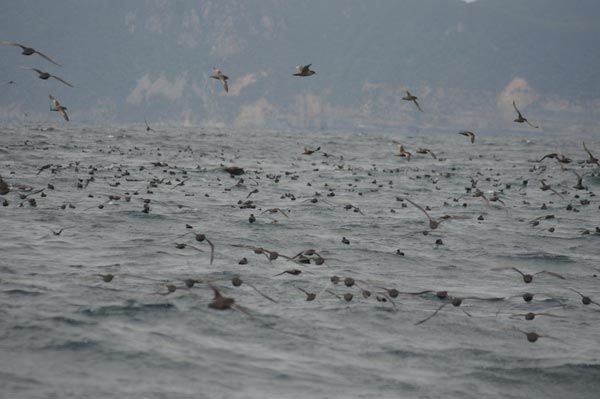
what was becoming an awe-inspiring flock of shearwaters. In all, there must have been close to half a million birds in the general area. Mainly Short-tailed Shearwaters, but with a smattering of Sooty Shearwaters and the occasional Shy Albatross to dwarf them both, the whole sea seemed to be in constant flux, as parties of birds took off, wheeled away and settled again nearby. As far as the eye could see, there were shearwaters. Had this been a fishing trip or a bird trip, we could happily have stayed out there for hours, searching for a little more variety in the flock, enjoying the sheer mass of birds present in the area; but unfortunately we were on a scheduled tourist trip, so carried along steadily until we came close enough to shore for the birds to peter out. A final wildlife-moment, as we stopped off to admire some New Zealand Fur-seals - the polar opposite of their Brown cousins in their laid-back attitude, and we were soon bumping gently at the jetty at Eaglehawk Neck...

New Zealand Fur-seal

Short-tailed Shearwaters.

Short-tailed Shearwaters

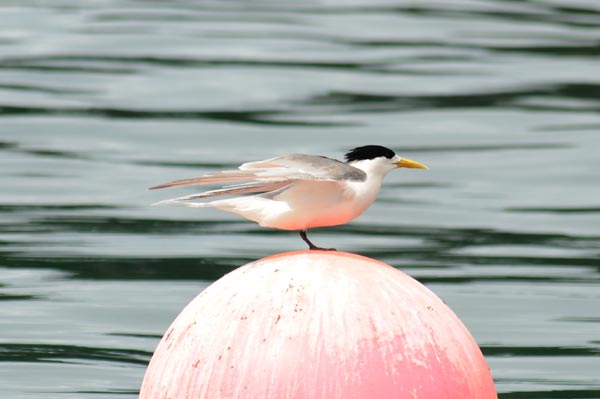
Crested Tern at Eaglehawk Neck