Showing posts with label Birding Devon. Show all posts

Monday, 17 February 2014

Oldcrest and carr

Back out to do some ringing - it seems like forever since the last session, though in fact it's only (only!) a month. My glamorous assistant cried off late on Saturday evening, so I had the site to myself - and as wife and child are living it up in Germany for a couple of days, I had the luxury of no guilty conscience at work by the end of the session...

Having only filled feeders the morning before, I had little expectation of being overrun by birds and this proved to be the case. Sure, Blue Tit and Coal Tit made up the bulk of the catch, but there was plenty to appreciate. For instance: a Song Thrush. We only catch one or two each year on site, and have as yet had no recaptures or recoveries. The site is very edge-of-range - on the fringe of the high moors - but there are always a few pairs breeding in the adjacent conifers. What will happen when the conifers are felled and replaced by (presumably) native broadleaves? That will be interesting!
Old Coal Tit. Given the text in the Helm family guide (Tits, Nuthatches and Treecreepers), this ought to be a male, with such an extensive bib. We just don't catch them in the breeding season to be able to confirm!

For the first time, a Sparrowhawk managed to stay in the net. We've had a couple of near-misses with this species in the past: a male low in the net last autumn managed to extricate himself before we could reach the net, and the year before that one left its dinner in the bottom of a net, in the shape of a freshly-plucked and trimmed Woodpigeon pullus. Yesterday, however, I turned the corner to a net and there was a male Sparrowhawk, neatly cushioned in the bottom shelf and glaring balefully up at me. I carefully disentangled him and took him back to the car to be ringed, measured and weighed - I wonder if he's the same bird as previously escaped?
Sparrowhawk. Talons safely the other side of my mitt.

The Willow Tits at the southern end of the site appear to have paired up. Both were in the net together and flew off together when weighed and released. It would be nice if they managed to breed successfully this year - last year's nest failed. The male was originally caught in October 2010, so is now a very experienced bird within his territory.

Yesterday produced a handful of experienced individuals: two Coal Tits which were originally caught in January 2011 and a Goldcrest first caught in September 2011. The latter is always somewhat impressive: that a bird which weighs in the same as a sheet of A4 paper, or a 2p piece should survive year-round on Dartmoor is somewhat admirable. The longevity record for Goldcrest in the UK is a whole 4 years, 2 months 24 days, so this one's got a while to go before he reaches the record, but he's doing well nonetheless!

With it being a quiet day, there was also opportunity to admire the lichens and mosses on the trees around the car, to seek out the tiny red stars of Hazel flowers and to relish the willow carr - such an under-appreciated habitat. There are patches of carr woodland on site which are breathtakingly rainforest-like. Walk into them and the air is redolent with the fresh damp greenness of the carr. Old fallen willow stems snake across the ground, starring out from the original tree's base with linear thickets of young poles growing vertically from them. The old stems are felted with a luxuriance of mosses and lichens, whilst the young stems remain grey and smooth. The boggy ground between the wood is a verdant carpet of plants bewildering in its complexity of form and colour so that the eye just sees green at first, but has to then pull back, refocus and concentrate to appreciate the subtle beauty. Drips and drops fall all around and everything seems to pulse with moistness: whatever you touch, wherever you step, wherever your hand lands...
Hazel flower.

Masses of elf-cups, Cladonia pyxidata (I think) reach up from old willow stems in the carr

Another Cladonia lichen, this time coniocraea amidst a mat of Hypnum mosses

Drips and drops - decomposition is rife within the carr. This seemed a better picture than the remains of the frog.

Peltigera lichens and the moss Kindbergia praelonga grow over one another on the ground.

Thursday, 28 November 2013

Redpoll redux

Way back in the mists of 2011, we ringed a shed-load of Lesser Redpolls up on the edge of the moors. Somewhere around 250 of them over the course of the autumn. OK, it's hardly the stuff to make an observatory staff quake in their boots, but for our first full season at the site, it was something pretty special. Within that mix were a couple of local retraps - all from round about the moor's edge and none of them from more than 10km away - and that seemed to be about that... Then, the following spring, we received news that one of our birds had been caught in someone's house in northern France - always an exciting moment when one of 'your' birds is traced to another country, and this autumn we've discovered that another of 'our' class of 2011 has been recaptured twice by a local ringer on the south-west side of the moor, this time a bird on a breeding territory. So we know that some of the birds we ringed that autumn most likely came from the local area, whilst some presumably originated elsewhere in Europe...

Since that autumn, we've caught rather fewer Lesser Redpolls: in fact fewer than 10 each season. None of those we caught in 2011 have been recaptured on site either, though there are generally a few Lesser Redpoll around throughout the year.

Then, a couple of weekends back, we caught half a dozen Lesser Redpolls on one day... and this:

It's big...

...it's got a socking great pale rump...

...(just like the linked blog above, you can see some wear on the tail and primary tips which help age it as a bird of the year)...

...no brown on the flanks...

....it's grey (this photo © Judith Read)...

...it's still got no brown on the flanks (this photo © Judith Read)...

...and it's got white wing-bars (this photo also © Judith Read). Note also the two visible retained juvenile greater coverts. Award yourself an extra mark if you didn't have to look the feather tract up.
'It' is, of course (roll eyes and sigh, go on) a Common Redpoll, Carduelis flammea - one of those northern birds so controversially (?) split out during some taxonomic reorganisation back in the late 90s-early 2000s. You can see most everything you ought to want to to identify this one as a Common: white wing-bars, pale rump, cold brown and grey tones overall. You can't hear it, because I haven't got the kit to record it, but rest assured it even sounded a little deeper-voiced when it called.

The description's in the post to the county recorder...

Sunday, 14 July 2013

Hot in the shade, hotter on the moors

I joined a couple of friends on Dartmoor yesterday to help them mop up the last few of their nest records for the summer. As they've found some 200 nests over the course of the season on about five square kilometres of moorland you'd be forgiven for thinking there was little left to find there, but that's never quite the case.

We started out by watching a Tree Pipit which was behaving as if there might be a nest nearby, but eventually decided that it was just guarding fledged young from a nest that had already been recorded, so we moved on up the slope to the area my friends wanted to concentrate on.

We weren't hugely successful in the grand scheme of things: finding only a new Whinchat nest with a full clutch of five eggs and a second brood of Stonechats with seven pulli (this pair had lost their first clutch), but we also checked on a number of nests that had been found previously: a brood of Skylarks had apparently fledged successfully, a female Linnet sitting on a now-complete clutch and another pair of Whichats which had - for the third time this season - had  their eggs predated (probably by a fox, as the nest had been pulled out and left on the ground nearby).

Despite it being a rather quiet day in terms of nests, the site was alive with wildlife, a sign of how useful this recent spell of decent weather has been. The air resounded with a constant 'tchirrp' of Meadow Pipits warning their young to stay out of sight, mingled with the melodious bubbling song of Skylarks above us. A male Reed Bunting rattled out his song from a patch of low Western Gorse whilst Linnets chirruped to and fro over him. Everywhere were Blackbirds shuttling between the open moorland and the adjacent scrub where their second broods sat waiting for more and more food.

It wasn't just birds, though they were perhaps the most obvious part of the day. Butterflies were out early with the rapidly warming air: Small Heaths and Meadow Browns bouncing erratically up and down over tufts of grass, whirring up into spiralling chases when another of their species approached too close, though whether fighting or attempting to impress a potential mate is impossible for me to tell. Field Grasshoppers sizzled staccato bursts from the tussocks and a Goldenring or two drifted casually through the cloud of flies and midges, snacking at will. As we walked through the grass, moths shot away from us (I could only pick out Emerald and Brown Silver-lines as we went, but there were many others too), Common Lizards rustled off, a tell-tale sliver of brown wriggling between the stems, and a brief glint of rich orange drifting through the air resolved into a fine fresh Dark Green Fritillary... Let's see how long this weather lasts!
Dark Green Fritillary (Argynnis aglaja) - a flake of orange gliding across the open moors, or down on the coastal heaths and dunes, often proves to be this species.

Goldenring (Cordulegaster boltonii) - this one resting up and digesting between flies.

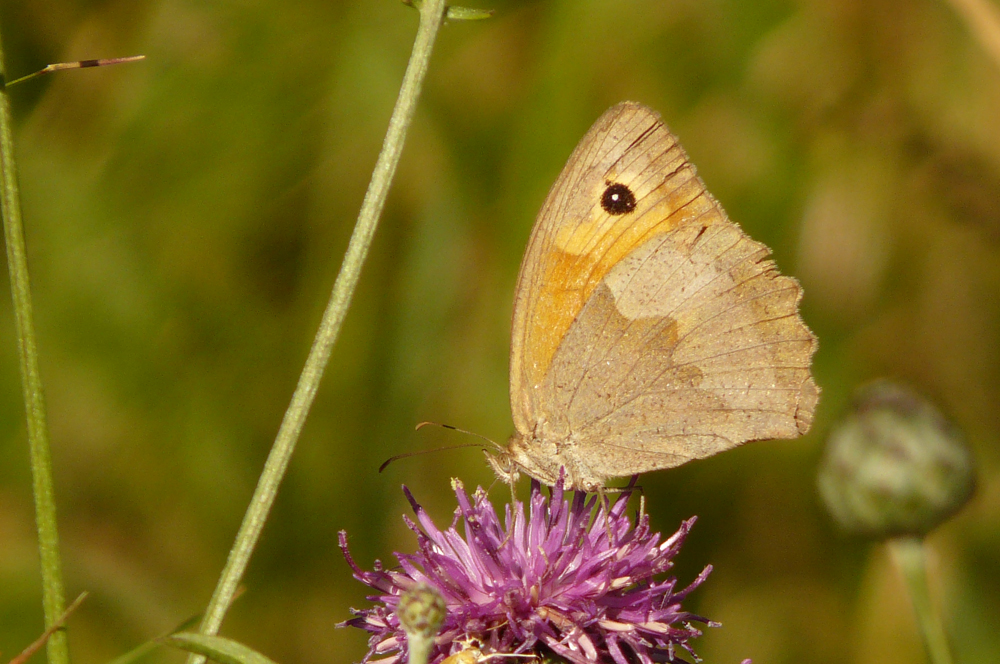
Meadow Brown (Maniola jurtina) taking a drink to refuel between those energetic spiralling aeriel encounters.

Common Lizard (Zootoca vivipara), sunning itself

Sunday, 30 June 2013

Flamin' June

A rather random collection of sightings this month. I've been out to do some bird surveys (for work, even: makes a pleasant change!) so some blisteringly early starts on occasion. Amazing how much quicker the drive to North Devon is at 4 a.m. though... Unsurprisingly, nothing out of the ordinary on any of the sites I've looked at - the pick of the bunch being a handful of Spotted Flycatchers and a single Pied Flycatcher which was gone by the second visit to the site. Still, last visit was heaving with fledglings, which was very nice: the trees packed out on occasion by groups of Blue, Great and Coal Tits wheezing and squeaking through the leaves in hot pursuit of their frazzled parents, Robins and Wrens shrilling insistently from the undergrowth throughout. At one point I obviously passed too close to a family of Wrens for the adult's liking: a short 'tchrr' from a bramble was followed by a starburst of tiny, dumpy, almost tailless brown bodies rocketing into the surrounding plants.

Despite the number of babies around, it's clearly not been a brilliant breeding season. Our boxes at the Willow Tit site on the fringe of the moor were not well used this year: four broods of Blue Tits and two of Marsh Tits in the 27 boxes. Of these, one brood of four Blue Tits died before fledging and one of the Marsh Tit boxes produced just one youngster from a clutch of three eggs. Perhaps a young pair breeding for the first time? On a brighter note though, the (a) pair of Treecreepers used the same gap behind a Marsh Tit nest tat was used last year, and seem to have fledged a full brood of five - last year the chicks all drowned in a torrential downpour (otherwise known as June 2012).

This June's been slightly better, though we had more sunshine in May, and nearly as much in April... The general invertebrate interest in the garden has continued to improve, with the exception of butterflies which are having a very poor year here. We've started to note an increased variety of micro-moths - nothing particularly rare, I don't think, but a bit more of the 'small is beautiful' line again. The pond has obviously settled in nicely, with Large Red Damselflies emerging from the nymphs we saw last year, the newts now breeding successfully (a tiny eft the other day was proof of that) and a bit of interest from the odd hoverfly, backswimmers and a smart male Azure Damselfly. I've turned the old kitchen sink into a tiny pond to go in the back garden as well, so we'll see what takes an interest there - it's currently only about 1/3 full though, as I'm leaving it to the rain to fill it. Maybe not the best move!
Anthophila fabriciana - the Nettle-tap - which is abundant around the nettles in the neighbouring scrub. We've only seen it a couple of times in the garden, but then I'm not out there looking often enough.

I think this is Caloptilia cuculipenella. It seems to fit the description in the book and is (was) hanging around near the ash trees on the edge of the garden.

Easy: nice male Azure Damselfly, Coenagrion puella.

And a bright and breezy hoverfly: Helophilus pendulus, which has taken a liking to the front pond.