Sunday, 30 June 2013

Flamin' June

A rather random collection of sightings this month. I've been out to do some bird surveys (for work, even: makes a pleasant change!) so some blisteringly early starts on occasion. Amazing how much quicker the drive to North Devon is at 4 a.m. though... Unsurprisingly, nothing out of the ordinary on any of the sites I've looked at - the pick of the bunch being a handful of Spotted Flycatchers and a single Pied Flycatcher which was gone by the second visit to the site. Still, last visit was heaving with fledglings, which was very nice: the trees packed out on occasion by groups of Blue, Great and Coal Tits wheezing and squeaking through the leaves in hot pursuit of their frazzled parents, Robins and Wrens shrilling insistently from the undergrowth throughout. At one point I obviously passed too close to a family of Wrens for the adult's liking: a short 'tchrr' from a bramble was followed by a starburst of tiny, dumpy, almost tailless brown bodies rocketing into the surrounding plants.

Despite the number of babies around, it's clearly not been a brilliant breeding season. Our boxes at the Willow Tit site on the fringe of the moor were not well used this year: four broods of Blue Tits and two of Marsh Tits in the 27 boxes. Of these, one brood of four Blue Tits died before fledging and one of the Marsh Tit boxes produced just one youngster from a clutch of three eggs. Perhaps a young pair breeding for the first time? On a brighter note though, the (a) pair of Treecreepers used the same gap behind a Marsh Tit nest tat was used last year, and seem to have fledged a full brood of five - last year the chicks all drowned in a torrential downpour (otherwise known as June 2012).

This June's been slightly better, though we had more sunshine in May, and nearly as much in April... The general invertebrate interest in the garden has continued to improve, with the exception of butterflies which are having a very poor year here. We've started to note an increased variety of micro-moths - nothing particularly rare, I don't think, but a bit more of the 'small is beautiful' line again. The pond has obviously settled in nicely, with Large Red Damselflies emerging from the nymphs we saw last year, the newts now breeding successfully (a tiny eft the other day was proof of that) and a bit of interest from the odd hoverfly, backswimmers and a smart male Azure Damselfly. I've turned the old kitchen sink into a tiny pond to go in the back garden as well, so we'll see what takes an interest there - it's currently only about 1/3 full though, as I'm leaving it to the rain to fill it. Maybe not the best move!
Anthophila fabriciana - the Nettle-tap - which is abundant around the nettles in the neighbouring scrub. We've only seen it a couple of times in the garden, but then I'm not out there looking often enough.

I think this is Caloptilia cuculipenella. It seems to fit the description in the book and is (was) hanging around near the ash trees on the edge of the garden.

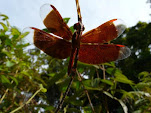
Easy: nice male Azure Damselfly, Coenagrion puella.

And a bright and breezy hoverfly: Helophilus pendulus, which has taken a liking to the front pond.


Thursday, 23 May 2013

Small is beautiful

Having a small person in the house now means that some things have changed radically. Our time outdoors is constrained by sleep patterns (to some degree) and time spent with the camera is now precious. That said, the recent spell of (whisper it) fine weather here has given me an opportunity to get out into the garden and appreciate what's lurking in the vegetation there.

Some background... when we moved in, the back garden was effectively a wasteland only recently reclaimed from a seething mass of bramble, with a small patch of dog-fouled perennial rye grass at the bottom. We began by digging out bramble roots and pulling up ash seedlings which sprout like weeds in this area, but aren't really suited to a tiny garden, and mulled over the possibilities inherent in the grass patch. I hesitate to call it a lawn... Both being of a somewhat wildlife-friendly bent, we decided that chucking a bit of species-rich hay around might be quite fun, so we asked a friend of ours for a couple of bags of hay next time he cut his patch - and duly got about 15 sacks of clippings (thanks David!!). We raked over the rye-grass until there were some sizable bare patches amongst it, strewed the clippings, and jumped up and down on them for a while, just to make sure.

The next spring, we began to see the fruits of our labours - well, the flowers. Germander Speedwell, Ribwort Plantain, Meadow Buttercup, Sweet Vernal-grass all came up with some vigour, and a handful of Yellow-rattle plants emerged too, to our pleasure. In the autumn we repeated the grass-strewing over the bare patches, and were rewarded with Centaury, Common Knapweed and Bird's-foot Trefoil joining the party.

This year I've noticed that we seem to have an abundance of invertebrates, when compared with my memories of previous years. OK, last year was nothing to shout about for most wildlife (except bryophytes and molluscs, perhaps) but this spring hasn't exactly been brilliant weather either. However, looking over the back garden now during a sunny spell and the air is full of a myriad shining wings - mainly small hoverflies and other flies. This intrigued me, so I thought I'd take the camera out and have a look... and what's pictured below might not yet be identified - and indeed may not be identifiable - but it gives a flavour of what's going on in the garden.

One of a number of slender hoverflies which cruises the garden - this one a rather black/bottle-green animal.

A small, yet perfectly-formed longhorn beetle of some description, working its way over the raspberries (the raspberry canes have proved to be a fertile hunting ground for photos this year - nearly as good as the hazel-honeysuckle tangle nearby). Edit: thanks to Tim Worfolk, below, a name: Pogonocherus hispidus

One of the flesh-flies, as far as I can tell. Edit: TW suggests perhaps Graphomyia sp (Muscid)

Leaf-mining flies (Liriomyza sp.) doing their stuff on the comfrey. Perhaps not identifiable to species, but they bear a passing resemblance to L. pusilla - and as the name suggests, they're small! About 2mm long, snout to tail-tip.

A more conventional hoverfly, brilliant in black and yellow. Edit: Eupiodes c.f. luniger is suggested

A tiny teardrop-shaped spider which feasts on aphids. Go to it...

Yet another fly - there is a startling diversity in the garden... Edit: this one appears to be perhaps Beris c.f. chalybata, a Stratiomyid fly.

A solitary bee, one of the Andrena species. This one seems to have a particular liking for our dandelions.

Apropos of which, dandelion clocks too are worth a closer look. Their geometry is pleasing when the clocks are whole...

...and there is also beauty to be found in the detail of the seeds when they are exposed.

Even plain old Ribwort Plantain takes on a new dimension at this scale: I hadn't realised that the anthers seem to be swollen bags of pollen. These release their pollen on the wind, but if you see them on a still day when the rain is falling gently, you can see little puffs of pollen clouding up, for all the world like miniature cannon-smoke drifting across the grass...

Another small fly which enjoys hanging out around the honeysuckle growing through the hazel. Notable particularly for its antennae... Edit: Dolichopodid fly: Syntormon sp.

A scorpion-fly, I think. Edit: an Empid of some species - anyone feel like raising the bar?!

Micropterix calthella - a tiny micro-moth, about 4-5mm long, which has decided our raspberry canes make a great place to lure in some of the opposite sex. They spend a lot of time wandering up and down their few cms of stalk, waving their antennae around, looking left and right and occasionally scrapping over the right to use a particularly choice spot.

Another hoverfly, this one with powder-blue markings on the dorsal side of the abdomen, and a rich ochre stripe along the sides. Edit: Platycheirus sp. (female); thanks to 'Ophrys' on i-spot for that one.
Final edit: Many thanks indeed to Tim Worfolk (two bird theory blog - visit: it's great!) and 'Ophrys' on I-Spot for their help with identifications so far...

Wednesday, 8 May 2013

Tasty. Tystie.

Sunshine and light winds and a contented baby mean this is the ideal time to introduce my daughter to the delights of Peel, on the west coast of the Isle of Man. We haul up and over the island's central hills, pausing briefly for a couple of pairs of distant Hen Harriers, then drop steeply down to the narrow western coastal plain, swinging south past Kirk Michael, through green fields dotted with sheep and the occasional patch of grubby snow left-over from the March snows, then wind down through the higgledy-piggledy multifarious houses of Peel to the harbour. Lunch is a bacon and egg roll with coffee (or a kipper roll with tea for the ladies), eyed up by a troop of ever-hopeful House Sparrows and a couple of cocksure swaggering Jackdaws, all of whom descend with delight upon the crumbs and fragments thrown around by S.

After this, there's only one thing to be done: head around the harbour walls and find our way to Davison's ice-cream parlour, who pride themselves on selling the best Manx ice-cream there is. I've not been able to contradict them yet... We wander back over to the beach where S discovers the pleasure of being able to sit on the sand and play without being wrapped up to the shape of a football, we devour our ice-creams (blackcurrant & liquorice with ginger for me: a surprisingly good combination) and we are watched with unblinking fascination by some of the locals, just in case we drop anything... A couple of Sandwich Terns on the edge of the tide parade up and down, heads tilted back and tails cocked, trying to impress a female who looks as if she'd actually rather just digest that last fish, thank you so very much.

Herring Gull. This young bird was the first in - bold enough to settle a few metres away from us, but not enough to come and get the fragment of cone I threw it...

...and as soon as there was any sign of food, in came an adult. Immediate display of dominance and the younger bird sensibly retreated before any damage was done.

Finally we walk back around the harbour and upriver a little to pay our respects to the inhabitants of the harbour walls: old (blocked) drainage holes have proved the ideal size for the Tysties which live round the coast, giving what must be a rat-proof and collapse-proof residence. Sure enough, two birds were present with heads jutting from the holes and occasionally reaching out and twittering in a most un-auk-like fashion. The spring's late this year and they aren't yet nesting, so our interest proves a little too much for their nerve and they flutter out onto the water below, scarlet legs akimbo and white wing-patches gleaming against their otherwise velvet-black plumage, where they float downriver on the current and pretend they were never interested in those holes anyway.

Another black bird I'm admiring. Starting to think there's a pattern developing.

But those red legs lend a touch of the exotic.

Tuesday, 7 May 2013

Unentailed

A blowsy, blustery day with the sort of brisk northwest wind that billows round you and leaps out at you from gaps in the gorse to leave you breathlessly exhilarated. We walked along Maughold Head to have a look for Puffins, but no sign of any today - just Fulmars whirling along the cliff edge in effortless loops, Tysties trilling on the water below and a big bull Grey Seal porpoising through the chop towards Ramsey.

We followed the coast path to the Cormorant colony, where paired and single birds sat darkly ungainly on the bright green turf. They look rather uninterestingly black from a distance in the cloud-shadow, though white patches at thigh and chin catch the eye, but creep closer to them and as soon as the sun strikes through you are faced with a surprisingly attractive bird.
Despite their antics, with the sun in, Cormorants are - well, frankly, a little dull-looking...

The black feathers prove glossy with hints of purple and green as the light catches them from different angles, white feathers grizzle the black on the back of their heads and their wings are a coppery bronze, each feather edged neatly with black. Closer still you can appreciate the ice-cold jade eyes, which regard you with wariness, a mild concern at your approach.
...but with the sun on them it's a different story.

Lie down in the bracken debris and watch, and their stretched necks relax back into a curve, the tufty crest on their nape settles down a little and they return to the important business of preening, pair-bonding and rearranging any nest material which has been brought in. No eggs yet this year - late, but not surprising in view of the cold late spring - but birds were flying in now and then, trailing vegetation in their bills, so the breeding season's getting well under way at last.

We strolled back to the car with the wind at our backs, pushing past the clumps of coconut-scented gorse, with Choughs bouncing through the air above us, filling the sky with wheezy 'ciao's. It's nice to be back on the Isle of Man!

Moss rolls down ivy stems and across the drystone walls on Maughold Head.

North Barrule from Maughold Head

Looking south along the east coast of the Isle of Man.

Sunday, 14 April 2013

East Anglia again

Here we are in EA once again, doing the visiting-and-sightseeing thing. Not the most auspicious start to the trip, as we'd got no more than 10 minutes down the road when S was copiously sick in the back seat: a cascade of porridge and raspberries descending across the car-seat, her (of course) fresh clean clothes and everything in between. Poor girl looked pretty shell-shocked after that, unsurprisingly, but soon fell asleep for the next stage of the journey, whilst we negotiated the rain, spray and wind past Bristol and along the M4. By the time we'd passed Swindon the weather was sufficiently dry and bright for the odd Red Kite to be out and about, easing their way through the gusts and the swirling mix of Rooks which rose to mob them with an elegant aplomb.

Our first port of call was Saffron Waldon, where we dropped in on friends who have recently had a baby and are coming to terms with the sleepless phase. Few opportunities for any serious out-and-abouting, added to which the weather was foul - blasting easterly wind and temperature around zero, even before wind-chill is taken into account. In fact, all we really noted was that the Rooks were undaunted by the weather and have begun sitting on their nests. And that Saffron Waldon is actually quite a pretty town...

We moved on to Norwich, where we descended on another couple of friends. No improvement in the weather, but nothing ventured & so on, so we headed out to Holkham to see what we could see on Sunday. The wind was so cold and so strong that S kept her head down the entire time we were out, sleep or wake, snuggled as far inside my coats as possible. Puddles and damp hollows in the pastures were rimed with ice created by the wind-chill. Birds were scattered sparsely around the site - a pair of Wigeon here and there on the pastures, a scatter of Lapwings disconsolate amongst the tussocks. In the occasional shelter of the pines, the sun was warm and spring-like, but move back into the wind and all such thoughts were put aside. We rounded the eastern end of the pines near Wells and turned west along the beach. The sand moved past us at a rate of knots, making a dun knee-high mist which obscured the ankles and shins of walkers and indeed almost totally obscured some of their dogs. The few birds on the beach were hunkered down tight against the surface, all to the seaward side of the blasting sand - a handful of Herring and Great Black-backed Gulls, a few Sanderling, a couple of Dunlin, Knot, Bar-tailed Godwit and a solitary Redshank. By the time we returned to the car we were breathless with the cold, ears ringing to the sound of pounding surf, howling wind and whispering sand. The only one who seemed entirely at ease was S, who'd woken not long before...

Holkham beach. We just don't have that extent of sand in Devon.

It was windy. Very windy. Jake (the dog) must have been grateful to have a tail to keep the wind out.

It was windy. Very windy... All day.

The afternoon's visit to Titchwell, just a little further west along the coast, was - if anything - even more windy. So much so that we took a quick walk along to the sea and back without stopping for much at all - a hunting Barn Owl in the lee of the woods, a pair of Pintail dabbling languidly in the shelter of a saltmarsh island, a female Red-crested Pochard (where did she come from, I wonder?)... and a vast flock of gulls (mainly Common) sheltering on the pools away from the sea. We soon headed back to the car and hit the road for Norwich.

On, then, early in the morning, to the wild and woolly hinterlands of Suffolk for a few days with Na's aunt and uncle. The weather finally began to perk up, S began to perk up as well, and Na came down with her tummy upset: timing! We managed to relax a little though, spending some time stacking wood and digging over the veg beds for the spring, unearthing vast quantities of bindweed root and taking the opportunity to wander round Minsmere and Walberswick. The wind abated a smidgen, but only a smidgen, and we were rewarded with a fine Short-eared Owl hunting the coastal marshes at Walberswick and another Barn Owl on the heaths, and a handful of Smew, an adult Little Gull and a trio of Whooper Swans at Minsmere. Hardly the stuff of epic, but nice enough for a  southwest birding family.

A Lapwing eyes us suspiciously from the rabbit-nibbled grassland at Minsmere. Or maybe it's watching the rabbit in the background.


And now here we are with some warmer weather - Swallows, Sand Martins and House Martins are trickling in through the local ponds and it seems as if spring might finally have sprung upon us. Here's to it!

Hazel catkins - and a couple of flowers to go with them.


Male Chaffinch. Not in song in East Anglia when we were there, but now they're hitting their stride here.


Friday, 1 March 2013

Grey skies

Somewhat like the plants in our garden, words burst into tentative life on the blog - apologies for the protracted silence! Just a short selection of things going on and observations to start with...

It seems as if we've had a permanent veil over the sky since October. We haven't, because our solar panels have been registering a regular spike in output every week or so (!), but it does feel like an eternally grey winter. Nevertheless, there are some signs that spring's on the way. The plants in both woods and garden have pushed out some perhaps optimistic shoots: Elder, Pignut and Perennial Dog's-mercury in the woods, Snowdrop, crocus, daffodils and Rhubarb in the garden. The latter  in particular seems to have been stalled by the past week's dip in temperature, so the ruby-red stalks and crinkly green leaves are still only half-way extended. We'll have a while to wait until we can have rhubarb crumble again!

The birds are hinting - and more than hinting - at a change in season too. Blackbirds have been tuning up for a few days now, with Robins, Dunnocks and both Song and Mistle Thrush going at it hammer and tongs in the morning. Cycling to Yarner recently added Chaffinch, Nuthatch and Green Woodpecker to the years' new songsters as well, so perhaps there will be blue skies again sometime soon. A pair of Blue Tits have been busily investigating the nestboxes we've provided on the extension (meant for sparrows, but we don't mind who uses them really), so hopefully we'll have a successful nest this year.

We were privileged last weekend to have a small flock of Waxwings at the end of the garden. A fabulous bird to have on the garden list when you live this far southwest. They spent a lot of their time sat in the oaks just across from our kitchen, making sallies into someone's back garden where they'd found a supply of red berries of some description; they would drop down, spend a few minutes stocking up and then sail back to the top of an oak, often with berry in bill, to sit and digest for a few minutes. They also spent some time picking at the buds at the top of the trees, though it was impossible to see what was of interest - any fragments were too small to be identified even through the telescope, so whether insects (most likely) or sap, or leafbud, will remain a mystery.

I'm also slightly intrigued that they seem to show so little interest in mistletoe when they're here in Britain. In Austria, where there is admittedly a far higher density of mistletoe than around here, I've seen flocks of Waxwings up to several hundred strong busily engaged in stripping mistletoe (causing apoplectic fury in the Mistle Thrushes), yet they seem wedded to red berries here - or apples.

Roll on summertime...!

Bohemian Waxwings. Slightly fuzzy due to being photographed through the 'scope at 1/30th of a second and on high ISO. Told you it was dark & grey...

Thursday, 25 October 2012

Octoberlings

I'm taking time out to be a full-time father (as if there was any other way to be a father anyway!) - my wife has returned to work, so we've taken advantage of the opportunity for me to take the last three months of her maternity leave - in effect unpaid leave to look after our daughter. It's fun! Rhythms are pretty baby-tuned now, so there are brief bursts of activity whilst she sleeps, punctuated by bursts of feeding and playing - but best of all we've been able to take the opportunity to go out and walk together most days.

Today was a kind of soft-focus day. We visited Yarner Woods NNR for a midday walk. It's mild muggy weather at the moment (a Saharan air-stream appears to be to blame) and the cloud base was around 180m, so we spent the entire walk in or just below the cloud, but at this time of year there's something very right about it: the leaves are turning, the spider-webs and grasses are pearled with water and everything seems rather hushed. As we walked round the woods, the only loud noises were a handful of Jays rasping their disgust at our intrusion; otherwise there was little to be heard apart from the random drip of water falling from saturated leaves and branches above us, and the sibilant calls of Goldcrests searching for insects.

As we walked down one track, there was a flurry of excitement: Blackbirds and Robins hopping off the track, then a burr of wings in a dozen different directions as a small flock of Redwings emerged from beneath the Bilberries where they had been fossicking in the fallen oak leaves. Semi-whispered 'tseet' calls between them - and then they were gone, deep into the tangle of branches and leaves in the valley below us. A Brambling flew over, only its wheezy call betraying its presence, and then we were down at the hides, where a constant stream of Coal Tits arrived and departed, rooting for overlooked seeds below the feeders, occasioning great interest from Sabina, who seemed fascinated by the abrupt appearance and equally rapid disappearance of each bird from our limited field of vision. Nothing remarkable, nothing surprising, but comfortingly appropriate for the time of year.