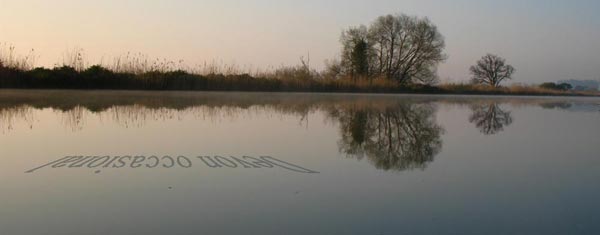
As we've taken the decision to leave the UK, it seems a little too occasional to maintain a Devon Occasional blog full-time, so I'm taking the chance to make a new start. You can find out where we've gone (tricky guess) and a bit more about the local area at http://inselaffe-abroad.blogspot.de/ - and if you needed a clue, it's right there in the address.
It's been - generally - a pleasure jotting down my various thoughts and posting my hotch-potch of pictures. Look forward to seeing you on the other side of the virtual Channel...
Ciao!
Sunday 20 November 2016


Sunday 18 September 2016
Dripping towards a close
We should have learned from the experiences of the last couple of days: never trust the forecast. Mainly sunny, but perhaps with the occasional shower, they said. Let's go to a lake where we can splash around, look at wildlife, hire a boat and generally enjoy the sun, we said. Fortunately it wasn't far. The sun was shining. The air was warm. There were frogs making that particularly joyous racket that only green frogs can (if you've only every heard a British amphibian chorus, I urge you to try out the continental green frog chorus. Like Lemmy said: if it's too loud, you're too old). Hey, look: there aren't any boats to hire anyway. Never mind, splashing in the moderately warm and delightfully chocolate-soup coloured splash zone is too much fun anyway. Hey, look: loads of orchids and damselflies and things to poke around at, pick up, taste, smell, chuck. This is fun! Oh: check out the big black cloud that's heading... oh. Oh well. Let's go home and ride the ponies instead.
It was fun while it lasted.
We also thought we'd try a walk along a gentle valley which runs east-west between Oberammergau and Ettal. Reports of nice things (Three-toed and White-backed Woodpeckers, for instance) and a favourable view or three on Google Earth made it seductively interesting. The misty clouds rolling around the scarps made it romantically interesting. The pair of Black Woodpeckers calling in the trees above us made it sound exotically interesting. The drizzle - and then increasingly steady rain - made it, frankly, untenable. I strapped Lissa into the sling and promised to meet the other two at the Ettaler Weidmoos for lunch, then headed east back down the valley for the walk. Rain aside, it was absolutely lovely.
We ended up at the bog, all arriving fortuitously together and had a drizzled-upon lunch, but then - horrors - the clouds began to roll back and a fragment of blue poked through. That was enough for us: we set out to explore a little of the bog, the girls rejuvenated by the sight of sunshine and the heat on our skin. Indeed it got so warm that Lissa stripped off completely to rush about and chase butterflies. For butterflies there most certainly were. First of all we were visited by a Chequered Skipper, which sunned itself teasingly on various items of clothing. This was then joined by a Mazarine Blue, equally at home on our abandoned pullovers and jackets. The competition spurred the skipper to new heights of daring, landing with increasing confidence on legs, then hands and working round the whole family. Finally, fritillaries put in an appearance - singletons gliding jerkily past us and then several at a time batting around over the flowers. Closer examination proved intriguing: not a species I recognised... but fortunately the trusty field guide put me out of my misery: Bog Fritillary. How appropriate.
Somehow, we managed to save the best for last. Even though it wasn't meant to be the most exciting day - in fact was really only a chance to use our travel cards one more time and ride another cable-car. We drove to Oberammergau for our last full day, to take the Laberbergbahn to the top of the mountain. The day was spectacularly good: blue skies, calm, warm. Just what we'd come to the Alps for in the first place! The journey to the top was smooth, peaceful and sufficiently hair-raising for Na and the view from the top was - frankly - gorgeous. We walked back down to the car through meadows of brilliant flowers, then woods that deserved much more scrutiny than we were able to give them. A place to return to in the fullness of time, I think.
It was fun while it lasted.
 |
| Whoever thought this was a good spot for a bench was absolutely correct. |
We also thought we'd try a walk along a gentle valley which runs east-west between Oberammergau and Ettal. Reports of nice things (Three-toed and White-backed Woodpeckers, for instance) and a favourable view or three on Google Earth made it seductively interesting. The misty clouds rolling around the scarps made it romantically interesting. The pair of Black Woodpeckers calling in the trees above us made it sound exotically interesting. The drizzle - and then increasingly steady rain - made it, frankly, untenable. I strapped Lissa into the sling and promised to meet the other two at the Ettaler Weidmoos for lunch, then headed east back down the valley for the walk. Rain aside, it was absolutely lovely.
 |
| It just gets wetter. And wetter. |
 |
| And wetter. |
 |
| Tree Lungwort Lobaria pulmonaria |
 |
| Romantically mist-clad slopes over the meadows |
We ended up at the bog, all arriving fortuitously together and had a drizzled-upon lunch, but then - horrors - the clouds began to roll back and a fragment of blue poked through. That was enough for us: we set out to explore a little of the bog, the girls rejuvenated by the sight of sunshine and the heat on our skin. Indeed it got so warm that Lissa stripped off completely to rush about and chase butterflies. For butterflies there most certainly were. First of all we were visited by a Chequered Skipper, which sunned itself teasingly on various items of clothing. This was then joined by a Mazarine Blue, equally at home on our abandoned pullovers and jackets. The competition spurred the skipper to new heights of daring, landing with increasing confidence on legs, then hands and working round the whole family. Finally, fritillaries put in an appearance - singletons gliding jerkily past us and then several at a time batting around over the flowers. Closer examination proved intriguing: not a species I recognised... but fortunately the trusty field guide put me out of my misery: Bog Fritillary. How appropriate.
 |
| Pretty. Soggy. |
 |
| Mazarine Blue Cyaniris semiargus |
 |
| Mazarine Blue |
 |
| Chequered Skipper Carterocephalus palaemon |
 |
| Skipper raises the stakes |
 |
| Bog Fritillary Proclossiana eunomia from below |
 |
| Bog Fritillary from above. |
 |
| Dactylorhiza c.f. traunsteineri. I think. |
 |
| Statuesque plant (False Helleborine Veratrum album). Amazing spider! (No, I don't know what it is - yet) |
 |
| Alpine Bartsia Bartsia alpina |
 |
| Primula farinosa is an ever-present feature of the bog. |
 |
| It's beautiful when it's not raining! |
Somehow, we managed to save the best for last. Even though it wasn't meant to be the most exciting day - in fact was really only a chance to use our travel cards one more time and ride another cable-car. We drove to Oberammergau for our last full day, to take the Laberbergbahn to the top of the mountain. The day was spectacularly good: blue skies, calm, warm. Just what we'd come to the Alps for in the first place! The journey to the top was smooth, peaceful and sufficiently hair-raising for Na and the view from the top was - frankly - gorgeous. We walked back down to the car through meadows of brilliant flowers, then woods that deserved much more scrutiny than we were able to give them. A place to return to in the fullness of time, I think.
 |
| Snowbells were still flowering on the north-facing slopes - the ballerina of the alpine flora |
 |
| Check out the sedges! There's the odd gentian and Bear's-ear to get past first, of course. |
 |
| One-flowered Fleabane: common as muck. |
 |
| A parting view: the path down from the Laber summit leads through the valley running up and right across the middle of the picture. Not too shabby at all. |
Monday 4 July 2016
Alps - Partnachklamm and Zugspitze
As the weather forecast was a bit iffy, we thought we ought to go somewhere with the option of some shelter. We drove off towards Garmisch Partenkirchen via Oberammergau - in retrospect something of a mistake. Everything went swimmingly until somewhere between Ettal and Garmisch, where we found a group of workmen repairing the crash-barriers. This in itself was not a problem, but the traffic coming uphill was: particularly the inability of articulated lorries to overtake cyclists along a single track section. Despite being no distance to the traffic lights, it took over half an hour to cover a couple of hundred metres. Situation not improved by desperate cries of need for a toilet from the back seat. Hey ho. Would have been worse if she'd meant it!
We finally arrived at the winter Olympic stadium and found somewhere to park, then set off in the drizzle towards the Partnachklamm. The meadows on the way up were predictably beautiful with Wood Cranesbill making a strong contribution and little subtleties like Astrantia to be found with a little patience. Before we got to the gorge we found that Lissa wanted to have a nap, so she was tucked into the sling on my front and we ambled slightly more rapidly along the ever-narrowing valley. As the sides of the valley grew steeper and rockier the air became more humid and the sound of the river was magnified until it drowned out almost everything else. Yellow wood-violets and saxifrages appeared, and the proportion of mosses and liverworts grew higher, with mats of Conocephus conicum looking particularly impressive.
We made our way into the gorge for free (thanks Koenigskarten) and were immediately walking under an overhang with veils of water cascading over - and onto - us. The path crept along the side of the river, and to Bina's delight soon began to dip in and out of tunnels through the cliff as the gorge narrowed further. The river was squeezed into a thunderous torrent, the recent rain adding depth and power. The river surged through the narrow walls of the gorge, roiling and tumbling over boulders. Cascades of water fell from the walls, the more permanent of them onto small roofs placed there to shelter walkers; others fell gently over us as we walked. Lissa was so interested that she forgot to either fall asleep or howl with tiredness.
After a steady last climb through a long tunnel we suddenly emerged into startling sunshine with the river tumbling merrily along below and steep forested slopes above us to both sides. As Lissa was by now asleep, I carried on up the valley for a while and the other two returned to get their lunch. The routes away from the gorge proved to be less than popular with most of the walkers, so I had a very peaceful time ambling along and trying to botanise without disturbing a sleeping child: surprisingly effective considering the constraints!
The walk back to meet the others was enlivened by the discovery, most of the way down, that Lissa had lost her cuddly monkey, popularly known as Mau-Mau. Despite a return march to the entrance of the gorge and asking at the kiosk, there was no sign and we had to explain that Mau-Mau was now on her way home as she was fed up with the weather.
The following day was a complete write-off. The rain was persistent and made everything really quite difficult. Must have been because the forecast was relatively good and - perhaps also - because we went back to the Murnauer Moos.
The third of June, however, was an entirely different kettle of ferrets. The air had the feel of a day which might just be ok, so we grabbed our chance and headed back south past Garmisch to Eibsee and the cable at ascent of Germany's highest mountain. The peak of the Zugspitze was lurking ominously in cloud when we arrived, but there were areas of blue sky to be seen, so we headed confidently into the building. The price seemed steeper than the ascent at €53 per adult, but at least the girls travelled for free. We got into the car with two other couples and set smoothly off.
The ascent was so quiet and smooth that it seemed to take no time at all - we sailed over the forest, into cloud, then suddenly out into sunshine drifting past sheer cliffs and patches of snow. A solitary Alpine Chough whirled past below us: the sole bird of the journey. We disembarked into a rather incongruous medley of older folk from a tour group and wandered out into the sunshine to admire the view, play with the piles of snow in the corners of the platforms and generally enjoy ourselves. Easily done!
The view across the summits was spectacular and the walking direct from the summit would have been great, except that it was soft snow and clearly not going to be worth the attempt for people who are shorter than the snow is deep. Though we seemed to be well above the vascular plant line, tucked into the cracks in the paving slabs were a smooth green mat of moss - looking like Bryum argenteum, though I don't know whether that species is recorded at this altitude - evidence that bryophytes have got what it takes.
The return journey was through the rather more sedate medium of the toothed railway, which was also quite rapid, but spent a lot of time in a long tunnel through the mountain. We emerged into high conifer forest which looked very interesting botanically and was scattered with butterflies, but alas were unable to get out and explore... Another time maybe. The rest of the day was spent ambling around the Eibsee.
We finally arrived at the winter Olympic stadium and found somewhere to park, then set off in the drizzle towards the Partnachklamm. The meadows on the way up were predictably beautiful with Wood Cranesbill making a strong contribution and little subtleties like Astrantia to be found with a little patience. Before we got to the gorge we found that Lissa wanted to have a nap, so she was tucked into the sling on my front and we ambled slightly more rapidly along the ever-narrowing valley. As the sides of the valley grew steeper and rockier the air became more humid and the sound of the river was magnified until it drowned out almost everything else. Yellow wood-violets and saxifrages appeared, and the proportion of mosses and liverworts grew higher, with mats of Conocephus conicum looking particularly impressive.
 |
| Wood Cranesbill |
 |
| Astrantia and gratuitous wire fencing |
We made our way into the gorge for free (thanks Koenigskarten) and were immediately walking under an overhang with veils of water cascading over - and onto - us. The path crept along the side of the river, and to Bina's delight soon began to dip in and out of tunnels through the cliff as the gorge narrowed further. The river was squeezed into a thunderous torrent, the recent rain adding depth and power. The river surged through the narrow walls of the gorge, roiling and tumbling over boulders. Cascades of water fell from the walls, the more permanent of them onto small roofs placed there to shelter walkers; others fell gently over us as we walked. Lissa was so interested that she forgot to either fall asleep or howl with tiredness.
After a steady last climb through a long tunnel we suddenly emerged into startling sunshine with the river tumbling merrily along below and steep forested slopes above us to both sides. As Lissa was by now asleep, I carried on up the valley for a while and the other two returned to get their lunch. The routes away from the gorge proved to be less than popular with most of the walkers, so I had a very peaceful time ambling along and trying to botanise without disturbing a sleeping child: surprisingly effective considering the constraints!
 |
| An unexpected bonus: Lobaria pulmonaria looking fabulously healthy. |
 |
| A large and spectacular burdock/heliotrope-esque plant |
 |
| Aposeris foetida - so good I can't find an English name. Easily recognisable even with a sleeping child strapped to one's front. |
The walk back to meet the others was enlivened by the discovery, most of the way down, that Lissa had lost her cuddly monkey, popularly known as Mau-Mau. Despite a return march to the entrance of the gorge and asking at the kiosk, there was no sign and we had to explain that Mau-Mau was now on her way home as she was fed up with the weather.
The following day was a complete write-off. The rain was persistent and made everything really quite difficult. Must have been because the forecast was relatively good and - perhaps also - because we went back to the Murnauer Moos.
 |
| Perhaps these appreciate the weather better than most. A constant source of fascination for the girls to see a snail that is as long as Papa's palm. They were strangely reluctant to pick them up though...! |
 |
| A bit of meadow-rue makes the day brighter... |
The third of June, however, was an entirely different kettle of ferrets. The air had the feel of a day which might just be ok, so we grabbed our chance and headed back south past Garmisch to Eibsee and the cable at ascent of Germany's highest mountain. The peak of the Zugspitze was lurking ominously in cloud when we arrived, but there were areas of blue sky to be seen, so we headed confidently into the building. The price seemed steeper than the ascent at €53 per adult, but at least the girls travelled for free. We got into the car with two other couples and set smoothly off.
The ascent was so quiet and smooth that it seemed to take no time at all - we sailed over the forest, into cloud, then suddenly out into sunshine drifting past sheer cliffs and patches of snow. A solitary Alpine Chough whirled past below us: the sole bird of the journey. We disembarked into a rather incongruous medley of older folk from a tour group and wandered out into the sunshine to admire the view, play with the piles of snow in the corners of the platforms and generally enjoy ourselves. Easily done!
 |
| Going up. Bina gets to ride in the operator's seat! |
 |
| And at the summit, it's clear that the weather in Austria is actually no better than in Germany at present. |
 |
| But what a fine-looking mountain. |
 |
| The black dot in the cloud lower right is the cable car coming up. The Eibsee is by the base of the cable car line... |
 |
| Budding graffiti artist? ... |
 |
| ...stroking Chamois in Austria... |
 |
| ...and just playing with all that snow! |
The view across the summits was spectacular and the walking direct from the summit would have been great, except that it was soft snow and clearly not going to be worth the attempt for people who are shorter than the snow is deep. Though we seemed to be well above the vascular plant line, tucked into the cracks in the paving slabs were a smooth green mat of moss - looking like Bryum argenteum, though I don't know whether that species is recorded at this altitude - evidence that bryophytes have got what it takes.
The return journey was through the rather more sedate medium of the toothed railway, which was also quite rapid, but spent a lot of time in a long tunnel through the mountain. We emerged into high conifer forest which looked very interesting botanically and was scattered with butterflies, but alas were unable to get out and explore... Another time maybe. The rest of the day was spent ambling around the Eibsee.
 |
| The Eibsee - from ground level - looking northeast. |
 |
| Wild child of the woods |
 |
| Amongst many other very nice things to see, Herb Paris is a particular treat for a Devonian |
 |
| A tiny fraction of countless tadpoles in a small lake to the side of the Eibsee: a four-metre wide band of tadpoles around the entire waterbody, so several hundred metres long in total, constantly circling the pool like wildebeeste traversing the Serengeti... |
Friday 24 June 2016
Alps, day two...
A nice thing happened at the beginning of Sunday: having arrived relatively late on Saturday, we made a brief trip to stock up on food at the airport Edeka on the basis that one of the local supermarkets in Murnau was open on Sunday morning. I duly headed down to Murnau on the Sunday morning to make a dent in our shopping list and, sure enough, the doors to the Fenemann were indeed open: even people inside. The shop looked dimpsy, but sometimes that's life. I duly headed in, grabbed a basket and began to look for some fruit and veg, only to hear a rather frantic 'Entschuldigung!' from behind me. Oh.
I turned, and the lady explained - very nicely - that the shop is not in fact open, just the bakery at the front of store. Oh. So, putting on my best confused foreigner display (not hard, you might unkindly say!) I explained that we'd just arrived the night before, had seen on the internet that the shop was open and had no idea it was just the bakery - was there anywhere in town where I could get food for two small children and their parents? Bless her, she was kind enough to take me round the supermarket, find me enough to get us through the next three meals and ring it all up on a side till - I cannot imagine that I would ever have been treated so generously in the UK...
So - partly because of this semi-aborted shopping trip - we headed to Murnau for Monday morning to finish off the shopping, find out what there is to do when you have small children in these parts, and let the girls let off some more steam at a playground. The tourist office were very helpful and the playground was great: a ride-on rocking motorbike a particular hit. We then walked down to the Staffelsee to see whether there might be some wildlife, some views and some more space to play. The verges on the way past the railway underpass were casually stunning: Meadow Clary, Nottingham Catchfly and Viper's-bugloss rubbed shoulders (leaves?) amongst the grasses, set off by Bird's-foot Trefoil and poppies.
The lake offered all three opportunities: the girls fished with twigs, ran riotous games of tag and cooed over ducklings. A small family of Coot were also entertaining: the parents delicately feeding their half dozen offspring with fragments of water plants and then disciplining the more insistent with a brief shake whenever they got too excited. A family of mallards with larger young were tolerated when they passed through, but a pair of Red-crested Pochard were driven off with great enthusiasm whenever they got within ten metres: no apparent reason - perhaps the Coot just didn't like the male's flamboyant hairdo?
We thought we might try and have a look at the Murnauer Moos in the afternoon as the background reading and info we had seen looked amazing. We discovered that nearly thirty square kilometres of valley bog are indeed fabulous, just not when you have a long walk through boring conifers to overcome first, and most particularly not when it's steadily raining and one child is steadily howling. Perhaps another time.
Another day, another thing to try. The weather forecast was ok and so we thought we could try something a little more flexible. We trundled down to the Staffelsee again, and hopped on the boat to Uffing, gliding across a glassily calm lake under a mist-shrouded hillside. The boat company provide blankets for the trip and these were eagerly snapped up by the passengers. As everyone migrated for the cafe at Uffing, we made the most of the chance to explore.
Lissa soon wanted to have a nap, so was strapped into the sling. Na wandered off ahead and Bina and I ambled along behind. Initially we walked along a fairly standard piece of lakeside fen which rose up to some fairly undistinguished farmland - the occasional pair of Canada geese honking forlornly in the damp areas - and the gentle burble of Marsh Warblers from the fen. Taller trees hosted a plethora of Fieldfares fussing over well-grown young and a couple of Icterine Warblers spinning out a reel of frenetic mimicry as an aural backdrop.
After skirting a campsite and working our way through a small woodland - nothing more interesting there than a Grey-headed Woodpecker - we dropped back to the lower-lying fenny land near the lake and, my word, but it was impressive. The wet meadows were studded with orchids, mainly broad-leaved marsh, but also the occasional twayblade skulking in the sedges. Pale pink spikes of Bistort rose through the longer vegetation, towered over by vivid purple irises. Splashes of blue proved to be rampion flowers, and a closer look revealed an abundance of spike-rush, sedges and butterworts. Drier land was a riot of yellow composites, Oxeye Daisy and buttercups - all in all a feast for the eyes. To cap it all, the most abundant butterfly was Marsh Fritillary. Very satisfying!
With the cloud lowering across the Hoernle, we made it back to the cafe for lunch in time to hear some ominous rumbles of thunder across the lake. The boat arrived promptly when due, and we hurried on board to travel serenely back to Murnau. Fortunate perhaps that we got back when we did: the rain began to fall and as we arrived, the captain announced that this was to be the last boat of the day as the weather conditions precluded further trips! What about the poor souls waiting at Uffing, we wondered - presumably there is an alternative bus service, but how would they ever know that the next boat was not in fact coming?!
I turned, and the lady explained - very nicely - that the shop is not in fact open, just the bakery at the front of store. Oh. So, putting on my best confused foreigner display (not hard, you might unkindly say!) I explained that we'd just arrived the night before, had seen on the internet that the shop was open and had no idea it was just the bakery - was there anywhere in town where I could get food for two small children and their parents? Bless her, she was kind enough to take me round the supermarket, find me enough to get us through the next three meals and ring it all up on a side till - I cannot imagine that I would ever have been treated so generously in the UK...
So - partly because of this semi-aborted shopping trip - we headed to Murnau for Monday morning to finish off the shopping, find out what there is to do when you have small children in these parts, and let the girls let off some more steam at a playground. The tourist office were very helpful and the playground was great: a ride-on rocking motorbike a particular hit. We then walked down to the Staffelsee to see whether there might be some wildlife, some views and some more space to play. The verges on the way past the railway underpass were casually stunning: Meadow Clary, Nottingham Catchfly and Viper's-bugloss rubbed shoulders (leaves?) amongst the grasses, set off by Bird's-foot Trefoil and poppies.
The lake offered all three opportunities: the girls fished with twigs, ran riotous games of tag and cooed over ducklings. A small family of Coot were also entertaining: the parents delicately feeding their half dozen offspring with fragments of water plants and then disciplining the more insistent with a brief shake whenever they got too excited. A family of mallards with larger young were tolerated when they passed through, but a pair of Red-crested Pochard were driven off with great enthusiasm whenever they got within ten metres: no apparent reason - perhaps the Coot just didn't like the male's flamboyant hairdo?
 |
| Coot tending offspring |
We thought we might try and have a look at the Murnauer Moos in the afternoon as the background reading and info we had seen looked amazing. We discovered that nearly thirty square kilometres of valley bog are indeed fabulous, just not when you have a long walk through boring conifers to overcome first, and most particularly not when it's steadily raining and one child is steadily howling. Perhaps another time.
 |
| Beautiful flowers of Cranberry - Vaccinium oxycoccos - at the Murnauer Moos. |
Lissa soon wanted to have a nap, so was strapped into the sling. Na wandered off ahead and Bina and I ambled along behind. Initially we walked along a fairly standard piece of lakeside fen which rose up to some fairly undistinguished farmland - the occasional pair of Canada geese honking forlornly in the damp areas - and the gentle burble of Marsh Warblers from the fen. Taller trees hosted a plethora of Fieldfares fussing over well-grown young and a couple of Icterine Warblers spinning out a reel of frenetic mimicry as an aural backdrop.
After skirting a campsite and working our way through a small woodland - nothing more interesting there than a Grey-headed Woodpecker - we dropped back to the lower-lying fenny land near the lake and, my word, but it was impressive. The wet meadows were studded with orchids, mainly broad-leaved marsh, but also the occasional twayblade skulking in the sedges. Pale pink spikes of Bistort rose through the longer vegetation, towered over by vivid purple irises. Splashes of blue proved to be rampion flowers, and a closer look revealed an abundance of spike-rush, sedges and butterworts. Drier land was a riot of yellow composites, Oxeye Daisy and buttercups - all in all a feast for the eyes. To cap it all, the most abundant butterfly was Marsh Fritillary. Very satisfying!
 |
| Looking back down towards the Staffelsee from the road back to Uffing. Note the lowering cloud on the Hoernle behind! |
 |
| Iris germanica - how appropriate. |
 |
| A trio of marsh-orchids |
 |
| Rampion species - Phyteuma orbiculare, I think. |
 |
| Token picture of Marsh Fritillary |
With the cloud lowering across the Hoernle, we made it back to the cafe for lunch in time to hear some ominous rumbles of thunder across the lake. The boat arrived promptly when due, and we hurried on board to travel serenely back to Murnau. Fortunate perhaps that we got back when we did: the rain began to fall and as we arrived, the captain announced that this was to be the last boat of the day as the weather conditions precluded further trips! What about the poor souls waiting at Uffing, we wondered - presumably there is an alternative bus service, but how would they ever know that the next boat was not in fact coming?!
 |
| The cloud closing in over the Hoernle did at least make for some dramatic colours... |
 |
| ...and some moody views |
Thursday 9 June 2016
Voralpen
I feel I should probably rename the blog 'what I did on my holidays' or somesuch nonsense. The winter has been long and wholly lacking in inspiration, the spring has sprung equally uninspiringly and summer once again arrived. Time to get out of this country and see what else there is in this world. So we - temporarily - 'Brexited' (bleagh!) and a couple of hours after leaving Bristol found ourselves in the sizzling sunshine of the foothills of the Alps, on the edge of a small town called Bad Kohlgrub.
The scenery from our holiday flat was suitably grand - traces of snow on the distant mountains, rich green conifer forests on the neighbouring slopes and flower-bedecked hay meadows right outside - more on those later. The air was ringing with the songs of crickets and the mellow clonks of the cow-bells. More on these sounds in a later post.
For the girls, the best point of all was that the railway line between Oberammergau and Murnau ran just below the house, so the hourly train was visible from the neighbouring bench or the edge of the balcony - not only that, but the existence of an unguarded level crossing just down-line meant that the uphill train had the decency to announce itself with a short blast on the horn a minute or two before passing, leading to wild cries of "Zug! Zug!" and an undignified scramble for the nearest viewing point, often up an unsuspecting parent.
We started out on the Sunday morning, not unreasonably, with some exploration of the immediate surroundings. The day had begun with a pair of Spotted Flycatchers zipping and twirling around the balcony catching sundry unfortunate flies, whilst a Black Redstart scratched out his song on the neighbour's satellite dish rim. A Cuckoo threw in a few exploratory notes just to emphasise the fact that we were no longer at home.
We took a walk along the road to see what the immediate surrounds had in store for us - it proved to be flowers. And what flowers! The hay-meadow just along the road was spectacular: a riot of buttercups, dandelions, Goat's-beard, Red Clover, Yellow-rattle and Marsh Hawk's-beard, spattered with Spreading Bellflower and Broad-leaved Marsh Orchid. Getting past that initial impression took a little while, but was worth it: below and between the immediate eyecatchers were Horseshoe-vetch, Yellow Rock-rose, Ragged-robin, Fairy-flax, Shrubby Tormentil, Kidney-vetch, thyme, Germander Speedwell, Hedge Bedstraw, Lady's Bedstraw, Oxe-eye Daisy, Chalk Milkwort, Thyme Broomrape, Salad-burnet and much, much more. That's without even mentioning the grasses, the sedges, the spike-rushes... We definitely weren't in England any more.
After some parental brain burn-out (too many plants!), we split up: Na to take Lissa to the flat for her lunchtime nap, Bina and I to head off along a little loop around the back of the farm and see what else we can see. The flora proved equally diverse and interesting: wet field-edges garlanded with the salmon-pink bells of Water Avens, a dry bank with spreading mats of Mouse-ear Hawkweed and thyme, punctured with Heath Sedge and a solitary frond of Moonwort, a spring-head hazed purple with the spears of marsh-orchids.
The afternoon was spent on the local hill: the Hoernle. We decided to brave the chairlift to take the effort out of the ascent. It certainly made our journey easier, though trying to pin down a wriggling two-year-old who's bored with the journey and wants to get off now, thankyou - never mind the drop, offers challenges of its own.
We were greeted at the top by a brisk breeze several degrees cooler than the valley below (to the surprise of the children), a neat welcome mat of One-flowered Fleabane and Spring Gentian, and a dramatic view across to the snowy summit of the highest peak in Germany, the Zugspitze. Underfoot were exotica like Hybrid Buttercup, Anemone-leaved Buttercup (cruelly white-flowered, so not offering a clue as to whether one might like butter), Monk's-rhubarb and bewilderingly foreign-looking dandelions - the latter offering some comforting sips to a majestic Swallowtail butterfly.
The lure of a refreshing Johannisbeerschorle got the better of us all, so we repaired to the conveniently-located Gasthaus, where we could shelter from the wind, sip our drinks and admire Nutcrackers - the bird, not the implement - at point-blank range. Almost cheating to see such goodies with such ease, but take 'em where you find 'em.
The scenery from our holiday flat was suitably grand - traces of snow on the distant mountains, rich green conifer forests on the neighbouring slopes and flower-bedecked hay meadows right outside - more on those later. The air was ringing with the songs of crickets and the mellow clonks of the cow-bells. More on these sounds in a later post.
 |
| Looking east across the Murnauer Moos (a whacking great valley bog, not a large deer) to the Alps |
For the girls, the best point of all was that the railway line between Oberammergau and Murnau ran just below the house, so the hourly train was visible from the neighbouring bench or the edge of the balcony - not only that, but the existence of an unguarded level crossing just down-line meant that the uphill train had the decency to announce itself with a short blast on the horn a minute or two before passing, leading to wild cries of "Zug! Zug!" and an undignified scramble for the nearest viewing point, often up an unsuspecting parent.
We started out on the Sunday morning, not unreasonably, with some exploration of the immediate surroundings. The day had begun with a pair of Spotted Flycatchers zipping and twirling around the balcony catching sundry unfortunate flies, whilst a Black Redstart scratched out his song on the neighbour's satellite dish rim. A Cuckoo threw in a few exploratory notes just to emphasise the fact that we were no longer at home.
We took a walk along the road to see what the immediate surrounds had in store for us - it proved to be flowers. And what flowers! The hay-meadow just along the road was spectacular: a riot of buttercups, dandelions, Goat's-beard, Red Clover, Yellow-rattle and Marsh Hawk's-beard, spattered with Spreading Bellflower and Broad-leaved Marsh Orchid. Getting past that initial impression took a little while, but was worth it: below and between the immediate eyecatchers were Horseshoe-vetch, Yellow Rock-rose, Ragged-robin, Fairy-flax, Shrubby Tormentil, Kidney-vetch, thyme, Germander Speedwell, Hedge Bedstraw, Lady's Bedstraw, Oxe-eye Daisy, Chalk Milkwort, Thyme Broomrape, Salad-burnet and much, much more. That's without even mentioning the grasses, the sedges, the spike-rushes... We definitely weren't in England any more.
 |
| Lissa realising she has the wrong colour clothes on to blend with her surroundings. Yellow is by far the order of the day. In the background is the Hoernle... more below |
 |
| Moonwort - Botrychium lunaria |
 |
| Water Avens - Geum rivale |
The afternoon was spent on the local hill: the Hoernle. We decided to brave the chairlift to take the effort out of the ascent. It certainly made our journey easier, though trying to pin down a wriggling two-year-old who's bored with the journey and wants to get off now, thankyou - never mind the drop, offers challenges of its own.
We were greeted at the top by a brisk breeze several degrees cooler than the valley below (to the surprise of the children), a neat welcome mat of One-flowered Fleabane and Spring Gentian, and a dramatic view across to the snowy summit of the highest peak in Germany, the Zugspitze. Underfoot were exotica like Hybrid Buttercup, Anemone-leaved Buttercup (cruelly white-flowered, so not offering a clue as to whether one might like butter), Monk's-rhubarb and bewilderingly foreign-looking dandelions - the latter offering some comforting sips to a majestic Swallowtail butterfly.
 |
| Spring Gentian - Gentiana verna |
 |
| Alpine - or Purple - Coltsfoot - Homogyne alpina |
 |
| Who cares about the view of the mountains... |
 |
| ...when this is clambering over your seat! |
The lure of a refreshing Johannisbeerschorle got the better of us all, so we repaired to the conveniently-located Gasthaus, where we could shelter from the wind, sip our drinks and admire Nutcrackers - the bird, not the implement - at point-blank range. Almost cheating to see such goodies with such ease, but take 'em where you find 'em.
 |
| Bina's working her way through the European corvidae: just Alpine Chough and Siberian Jay to go now... |
 |
| Just don't look down, whatever you do... |
Subscribe to:
Posts (Atom)