Friday, 20 April 2012

Bogging sphagtastic

For some reason, I was fool enough to organise a day's outing to the heights of the moor on Saturday, in an effort to learn and improve some identification of Sphagnum mosses - bog-moss; the stuff that makes those fat, hummocky cushions on the bogs that look so invitingly soft, yet mask such decidedly soggy ground.

Accordingly 10 (yes, ten!) of us assembled at Whiteworks, just to the south of Princetown, with the cloud roiling and bubbling up to the south-east and a forecast of possible showers - perhaps a little wintry - to come. We were fortunate enough to have secured the help of Mark, county bryology recorder and Sphagnum enthusiast, and Roy, the other bryophyte expert in the group (the rest of us can probably best be described as anything between enthusiastic amateurs and burgeoning improvers) to guide us through the minefield of mosses.

Setting off over the ridge we were immediately sidetracked by a ruined building which contained a number of interesting (non-Sphagnum) mosses as yet unrecorded in that tetrad, such as Rough-stalked Feather-moss Brachythecium rutabulum. We soon found the enthusiasm to head onwards at a brisk pace, only to hit a patch of wet heath which contained our first Sphagna... a rich, wine-red hummock of Sphagnum rubellum (or S. capillifolium rubellum, depending on who you listen to). This was a nice clear and easy species to get our teeth into: not only red as a glass of port, but with such tight-packed individual plants that it resembled a cauliflower. Less simple was a soft-looking, almost weedy specimen: Sphagnum subnitens. This was much less obvious - more what we were all expecting! A little further down the slope and we bumped into a rather apologetic patch of Sphagnum tenellum, softer and more soggy-looking even than the subnitens. This species almost falls apart in your fingers, but has a characteristic 'lobster-claw' effect to the tips of the branches when you look with a hand-lens.
Sphagnum (capillifolium) rubellum. Like a cauliflower soaked in port. Mmm.

Duly impressed with these three starters, we headed down to the bog itself, across a pale yellow-white mass of last year's growth of Molinia.Almost the moment we hit the flatter ground, we bumped into our fourth species: the depressingly variable Sphagnum denticulatum. This is a fairly key species to know, particularly given its tendency to be found in a wide variety of habitats. A twisty kind of moss with branches that are vaguely reminiscent of cows-horns, the best association I can make to remember it is Desperate Dan's famous cow pies. Even if the Beano was always more my cup of tea as a child... A few paces further and we hit another species again: Sphagnum palustre; brown, long-branched and occurring in great sprawling mats under our feet. At this point we learn that this is typical of a whole tribe of Sphagna, having cells which lift from their leaves, giving a roof-tile effect to the branches when you look at them through a lens.
Sphagnum palustre. Similar to papillosum, but with longer branches. Looks a little less spiky to me, and perhaps - in this case - a bit more ochre.

By this time, the cloud had roiled up sufficiently to start discharging, and a grey hazy veil descended on the hillside to the southeast of us. This approached us steadily until we were caressed by the first gentle drops of rain. Nothing daunted - for are not mosses characteristic of humid habitats in any case? - we pressed on. More Sphagna were found which were treated with some caution by Mark and Roy: these looked as if they might be representatives of Sphagnum inundatum and S. fallax, but Mark's caution won out to the degree that he took samples home to identify with certainty under the microscope. Then another - more definite - species: Sphagnum papillosum. Similar to S. palustre, and with the same roof-tile structure, yet subtly different: shorter, fatter branches, preferring a slightly different habitat.

This is a bit of uncertain Sphagnum. Perhaps there should be a category: Sphagnum confusum, though there's probably already a species with that name. Anyway, this could be fallax, or it could be flexuosum. It doesn't help that it's slightly out of focus too. The darker species is probably S. inundatum, though it could conceivably also be some very denticulatum. Aargh!


Sphagnum papillosum. Short branches, looks pretty spiky in close-up and is quite a brownish-buff plant.


By this time the rain had turned to hail. Hah! Hail. We laugh at hail. We settled down to eat lunches, backs to the wind and hail, watching the hillside opposite gradually turn white. A snifter of coffee later the weather eased, and we gathered our fortitude and set out once again, towards the peak of the bog. We soon encountered Sphagnum capillifolium (or S.c.capillifolium) - a looser and more attenuated moss than rubellum, yet with the same rich wine-red suffusion. Lying in a wet hollow nearby was the next species: S. cuspidatum, which has the unenviable yet memorable look of a drowned kitten when hauled from its watery lair. By this time we were well on a roll, and the return of the hail was little more than a niggly inconvenience. As we tramped across the bog we came to an indicator of good-quality habitat: low hummocks of S. magellanicum, a broad-headed Sphagnum which looks as if it's been dipped in long-dried blood.
Sphagnum (c) capillifolium. Rather longer outer branches to the head (capitulum), but still a wine-red beast.


Sphagnum cuspidatum. Fluffy stuff.

And there are plenty of bryophytes which like to grow on the Sphagnum too: in this case lots of Polytrichum strictum growing on a hummock of S. rubellum

Sphagnum compactum? Or perhaps some papillosum masquerading as compactum?
Our search took us onto the main body of raised bog, where we sought a true Dartmoor rarity: Sphagnum austinii. The only prior record of the species was in 1967, when it was noted as growing in numerous tall hummocks across the northern part of the bog. The hummocks remain, but unfortunately the Sphagnum appears to have long since died out; its mass providing a perfect haven for a number of other species of moss and of liverwort, as well as making a nice dry shelter for voles, judging by the holes dug in the sides. By the time we'd searched across the top of the bog for any trace of austinii the hail had begun to drift several centimeters deep, so reluctantly we gathered ourselves together and trudged back to the cars.
And the final species: a bit of Sphagnum magellanicum poking through the hail.

Growing on the old presumed Sphagnum austinii hummocks were plenty of other interesting bryophytes, including the liverwort Mylia anomala

Tuesday, 10 April 2012

East Anglia

An invitation to a friend's wedding gave us our first major travelling test with Sabina. The wedding was in Norwich and we knew that we had the chance to stay with some relatives and some friends, so it seemed like a good idea. Accordingly, we set out on a (yet another) fine spring morning soon after breakfast and trundled steadily along the M5 to Bristol, then east along the M4. We planned in a couple of breaks to allow for feeds and nappy changes - an immediate change from our usual routine - and motorway service stations being what they are, I planned the stops for some local wildlife trust reserves. So, we took our first break at Clouts Wood & Markham Banks, just south of Swindon.

This turned out to be a narrow valley with steep grassed slopes on the northern side - calcareous no less, so likely to be rather interesting from our point of view, but not much to be seen at this time of year - and a deciduous woodland on the southern slope. A small stream trickled gently along the valley floor, with occasional (and rather dry-looking) mires feeding in to it.

The sun continued to shine, the birds sang - though still no more migrants than we've already been hearing, so Chiffchaff and Blackcap joining the resident Goldfinches, Blackbirds, Robins, Wrens and Woodpigeons, and the woodland flora looked - rather unsurprisingly - much the same as we see round here: Bluebells, Ramsons, Primroses, Dog's-mercury and so on. Despite the relative familiarity of the site's wildlife, it was a near-idyllic spot to stop and break a boring journey. We walked the length of the valley to the scramble up the escarpment, to find a rather disappointing surround of intensive arable and dairy farming, and a newly-planted woodland shielding what looked like a set of industrial units. Can't have it all, I guess.

We headed back to the journey. Several Red Kites later, and a fairly rapid drive around the north side of the M25 and we were headed off up the A12 to the next break: Tiptree Heath, in Essex. By the time we left the car, Sabina was wailing and we were both getting a bit tired. Naomi parked - almost abandoned the car - and we scurried to the shade of a young oak to feed and change the beast. She wasn't really in the mood for food, just bored with lolling in the car-seat, so we walked briefly around part of the reserve - to the tune of a Willow Warbler - and slugged out the last few miles to Stoven for our first stop.

The evening passed in a bit of a haze: much family catch-up, a short walk around the local fields (many many Red-legged Partridges, a couple of Brown Hares and the odd Yellowhammer) and then a slide into sleep.

Next morning was my watershed moment: my first visit to the quintessential RSPB reserve: Minsmere. Naomi blithely promised Bitterns and all sorts of interesting goodies, so I was well primed for the event. The drive there took us along increasingly smaller roads (that looks wrong somehow, but decreasingly smaller really doesn't work. Incrementally? Whatever.) and over a tedious succession of speed-humps. Finally, however, we arrived and fed the baby in the carpark, as flocks of Black-headed Gulls squalled overhead against the blue. Amongst the squeals and squalls were a couple of deeper, more melodic calls: a pair of Mediterranean Gulls wheeling amongst the rest, wings shining-white compared to the duskier underwings of the Black-headed Gulls. Not a bad start.

Minsmere wasn't, to be honest, quite what I was expecting, but was still an interesting site. The main scrape was heaving with Black-headed Gulls, all settling in and pairing up for the breeding season, with a smattering of Avocets also beginning to pair up and a handful of ducks either fuelling up for their return to the north or perhaps thinking of breeding themselves: Shoveler busily patrolling the water with bills just submerged, Wigeon waddling across the grass tugging away at the new spring growth, and a handful of Mallards, Gadwall and a couple of Teal loafing quietly on the water's edge here and there.

The main scrape at Minsmere, from the hide along the shingle ridge.

Black-headed Gulls and a lone Greylag

Just to the south lies Sizewell nuclear power plant - it's amazing how nuclear sites tend to be associated with good birding spots; in part because of the warm water outfalls from the cooling process, but still.

We walked steadily around the reserve, never really hanging around too much as Sabina became fractious if we spent too long in one place. We were fortunate though, in that we managed to bump into not one, but two Bitterns, stealthily emerging from the reed fringe, and a party of Bearded Tits bouncing and pinging erratically in last year's reed growth nearby. Feeding time loomed for us all, so we retreated to the shade of the woodland fringe and spent a contemplative hour watching a pair each of Coal Tits and Great Tits investigating the knotholes in the trees, searching for suitable nest-sites. Spring looming indeed...

Spot the birdie

Creeping out of the reeds

OK, not the most up-close and personal pictures you'll ever see, but with a 105mm lens, I think it's not too bad an effort.

Tuesday, 27 March 2012

Pictures of spring: Bovey Tracey

Comma butterfly. Presumably an overwintering adult - the forewings are looking a bit worn and faded, nectaring on Celandines next to the river Bovey.

River Bovey at Wilford Bridge, looking downstream into Parke.

Nice garden-escape anemone species (it grows in our garden too) amongst Celandines on the banks of the river Bovey

Green Alkanet

Magnolia, or: 'Spot the Robin'

Shining Cranesbill - a common hedgerow plant in this part of the world, but one which I really enjoy. The button-like shocking-pink flowers are outstanding amongst the vivid shining green leaves, and it somehow always looks fresh and clean, even in the height of summer.

Primroses and Celandines, splashing yellow along the foot of the hedges

Common Dog-violet, with Yarrow and Ivy-leaved Speedwell, injecting a tint of blue to the vegetation

Barren Strawberry growing amongst Yarrow on a dry bank

Honeybee on Grape-hyacinth in the garden. These flowers are absolutely heaving with honeybees at the moment, whilst the bumblebees seem to be concentrating on Rosemary flowers. The mass of tulips next to these Grape-hyacinths are attracting a large number of hoverflies and tiny beetles, all of which seem to be eating pollen. Nice to do the wildlife-watching the lazy way and sit on the doorstep!

Gratuitous picture of Sabina, to prove that she's doing very well, thankyou, and enjoying her second bird-ringing session on the moors. And that her sunhat's currently too big.

Wednesday, 21 March 2012

WeBS; migrants

I spent a while today covering someone's Wetland Bird Survey count on Dawlish Warren - an hour-long snapshot of the waterbirds present on the site, my contribution to the network of surveyors looking at the Exe today, themselves a contribution to the national WeBS survey data collected each month for the British Trust for Ornithology, who use it in part to gauge trends in waterbird populations.

Being a sunny day and a mid-afternoon count in mid-March, I wasn't expecting a great deal out of the survey, and add to the mix the fact that today was Mothering Sunday - and you can see that there was plenty of potential for people to be out and about on the beach. Sure enough, when I arrived the beach was packed to the gills; a few hardy souls even in the water. The northerly wind was keeping the swell down to nothing though, so checking the sea was a cinch - and there were only just more birds than waves. A measly half-dozen Great Crested Grebes was it...

On down to the pond beside the visitor centre, where in addition to a fine drake Teal with three females, a Chiffchaff sang lustily from the high willows, whilst another called quietly in the willows just in front of me. Buoyed by this sign of a rapidly-turning season I headed on to the main wader roost. Nothing much along the seafront - two Knot roosting on a groyne the best of it - and plenty of people walking the beach even this far up. The tide was still some way off the bight, so after a rapid scan of the waders there I headed off to check the end of the sandspit.

Here was another sign of spring arriving: a fine male Wheatear flipped off ahead of me, from behind a mix of stone-grey, black and white, then a rich apricot-buff when he turned to check whether I was still walking his way. The point proved as enduringly birdless as the rest of the beach, and so I headed back towards the main roost along the riverside. An immediate reward came in the shape of a small flock of Sanderling, still in their silver-grey plumage and without any hint of the freckly ginger-rust they will develop soon for their summer plumage, who skimmed along the waterline and landed within a couple of metres of me. Heads bobbing with initial alarm, they soon settled down and began trotting along the water's edge, dipping erratically to grab small invertebrates as the waves washed across the sand.

Sanderling, trotting gently along the sands. Perhaps having wintered in South Africa, and on the way to the high Arctic to breed.
On to check the bight again, where the main wader roost usually occurs on the Warren. Not many birds, as most of them have headed off towards their breeding grounds - but there was a massed pack of Oystercatchers, all black backs spiked through with orange bills, a couple of Curlew sauntering impassively along the edge of the water in search of a tasty crab, and a fringe group of small waders - Knot and Dunlin - silver-grey, picking daintily into the shallow water for crustaceans and molluscs. Lurking on the fringes were a trio of Ringed Plover, all black bands laid across white and brown, a huddle of Turnstone on a fishing boat and a lingering group of Brent Geese - another of the species which has pretty much gone for the summer now.


Brent Geese - the last few lingering on the Exe will soon be heading off to the tundra of Arctic Russia, via the Waddensee - a massive area of intertidal mud between Germany and Denmark.
Most of the waders and almost all the wildfowl have now gone north, perhaps to Scotland and northern England or to staging posts on their way to the Arctic, but for a month or six weeks yet we'll see a gradual turnover of birds which wintered further south still: Ringed Plover, Turnstone and Sanderling, Bar-tailed Godwit and Whimbrel which have avoided our gloomy winter and lived it up on the sandy beaches of western and southern Africa.


True to spring weather form, the rain began as I headed back to the car, so only a cursory check for interesting plants on the way back - one day I will spend  little more time looking through the dune grassland to see what I can find lurking...

Tuesday, 6 March 2012

Spring is springing well and truly here in Devon. We've been up to our eyeballs and beyond in learning how to cope with an infant, and consequently not been out and about as much as once we would. Funny that.

Anyway, after a shockingly bad night's sleep, I left Na to sleep off her cold this afternoon and took young Sabina up through the woods to see what was happening in the world around us. After a bit of a cold snap over the past couple of days, it was nice to be out in warm weather. The birds have been triggered by the rising temperatures and longer days, so even though it was early afternoon the air was sweet with the songs of Blackbird, Robin, Mistle Thrush and Chaffinch, whilst Great and Blue Tits chucked in their two-pennorth (I just can't bring myself to describe their songs as 'sweet', though they're undeniably pleasant to hear).

Along the river we managed to find a  Dipper singing and feeding in the riffles, so spent some time enjoying the sight of him wading energetically into the water, ducking down to search for invertebrates, then shrugging under the surface for a moment, only to reappear close by - either bobbing along the stones in the same unhurried fashion, or, in the deeper patches, popping to the surface like a cork and swimming along for a brief moment before flying to a nearby rock.


Argh! Not another walk! Why do you do this to me?

The river Bovey at Parke
The floor of the woods is a rapidly burgeoning carpet of green, as Pignut, Celandine, Dog's-mercury and Primrose surge into leaf, with the arrowhead leaves of Cuckoo-pint emerging in glossy, spiky clumps here and there. You could generally be forgiven for wondering why they are called Arum maculatum, until every so often you come across an absolute beauty with deep purple blotches sprayed across the rich green gloss of the leaves. It won't be long before the flowers emerge with their pale greenish-white bracts hooding the flower-spike.


Pignut (feathery leaves), Wild Strawberry (trefoil leaves), Lesser Celandine (heart-shaped leaves) claiming the open soil for the early part of the season.

Beech trunk covered with mosses (mainly Hypnum andoi) and lichens

The bulk of the green in the ground layer is still found in the ferns and mosses though; it's still somewhat surprising to realise how many species are involved in a reasonably varied bit of woodland here: testament to the generally moist climate we live in here.

Primroses; a splash of delicate colour to welcome the warmer weather in.

Another of the species making up the carpet: Wild Garlic, or Ramsons


Cuckoo-pint deserving the name 'maculatum'

Red-flushed ivy leaves on a post along the old railway line

Polypody, one of the commoner ferns in this part of the world; but which species? Difficult without a microscope, but perhaps Polypodium interjectum and P. vulgare - or more likely a hybrid between the two!

Polypody doing a semi-passable impression of Hard Fern
Above the green field layer the Hazels are already flowering, sprays of catkins covering most of the trees, and the first of the young Sycamores and Elders are bursting into leaf. Above these shrubby trees, the canopy trees proper are still tightly bound into bud, and we spent a while looking at the various patterns and colours of the shoot tips (reassuring myself that I can still identify them in their dormant state!).

The old railway line through Parke, glowing in the afternoon sun with Dog's-mercury along the sides of the track.

Sunday, 29 January 2012

Ring in the new...

A milestone today - our first ringing session of the year (non-garden) and somehow there's a need to include Sabina in this experience. I set off early with David and Peter, opening the nets early enough to make it worthwhile, whilst Na brought the youngest member of the group along at about 10 (bang-on 10 in fact: German punctuality strikes again!).

It was a typical day for this time of year: a couple of feeders are occasionally topped up by one or another of us so that there is some focus to the birds during the winter, and consequently much of the catch is Blue, Coal and Great Tits. However, we continue to accrue some useful information about the number of Poecile tits on site: three Willow Tits caught, two recaptures and one new bird; all of them last year's juveniles.

Willow Tit (Poecile montana kleinschmidti). A rather small and neat bib on this bird, but you can see many of the key features which indicate Willow rather than Marsh: clean white cheeks, strong bill (and longer than Marsh) with no clear white spot at the base of the upper mandible, a rather dull and extensive black cap, a hint of a pale panel in the wing - and if you look carefully, a very different tail pattern than you'll see on Marsh.

A closer look at that tail - notice that the outermost feathers are rather shorter than the innermost, and that there is a clear view of most of the feather tips at regular intervals between the extremes. On Marsh, this would not be the case; almost all the feathers being similar in length except for the outermost pair, which are rather shorter.

A bit overexposed, but here you can see that nice pale panel in the wing... as well as seeing how long the cap is.
We also caught two new Marsh Tits, a female Reed Bunting and an unusually-marked male Great Spotted Woodpecker. The woodpecker appeared to be one of last year's young as well, with new glossy black greater coverts and mantle feathers contrasting very strongly with a set of unusually pale outer greater coverts and primary coverts. You might also be able to pick out in the picture that the secondaries also appear rather washed-out.

Young male Great Spotted Woodpecker (Dendrocopos major). Those pale wing feathers stand out a mile in the hand, but would be almost impossible to see in the field, I think. Would be fascinating to catch him again after the next moult and see what's happened there.

Female Reed Bunting (Emberiza schoeniclus). The amount of wear on the tail in particular suggested to us that this was a bird born last year.

Sunday, 22 January 2012

Gulls, gulls, gulls

Gulls, gulls, gulls. Yesterday evening was an indulgence of mine, though many would consider it a penance. A friend organises an annual gull-count on the Exe, which attempts to keep tabs on the number of gulls using the river as a roost - they're not monitored in any other meaningful fashion here, unlike some other wetlands where the BTO's Wetland Bird Survey volunteers note the numbers each month. To be fair, the number of gulls present on the river in the daytime is a shadow of the numbers roosting overnight, so the WeBS counts would not be particularly representative. Anyhow, three of us gathered at the Topsham recreation ground to count the birds moving south down the river.

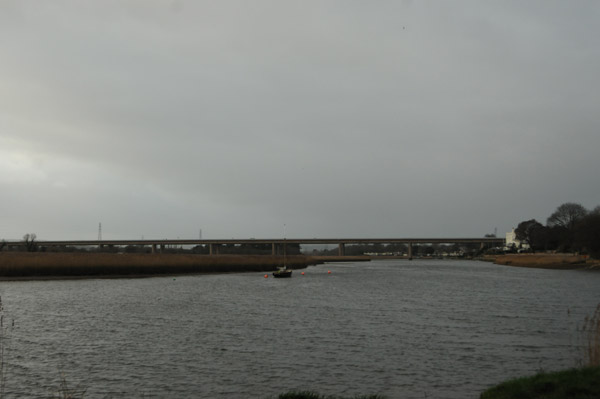
This is the gull-count view. Birds tend to mass over and behind the bridge in the background, before moving down the river at anything between 1 and 100m height.
The gulls tend to come downriver in a particular pattern. First of all, there are always a couple of hundred birds loafing around the river when we arrive; mainly Black-headed Gulls, with a smattering of Common and Herring Gulls here and there and perhaps the occasional Great Black-back. Looking upriver past the M5 road bridge which spans the floodplain, you can see a gathering mass of Black-headed Gulls floating and swirling around the Countess Wear sewage works. The first flocks of Black-headeds start to make their way purposefully down past us, initially twenties and thirties, but soon building to a constant stream of birds. The first birds come through low down, perhaps 10-20m above the water, but the bulk of them drop down from somewhere above 100m height, slight black silhouettes against the evening's grey skies. Common Gulls are sprinkled sparingly throughout the flocks; it's tricky, but feasible, to pick out their slightly more rakish shape amongst the Black-headeds which are by now sleeting past us.


Eventually the Herring Gulls put in an appearance. At first just singles and twos amidst the smaller gulls, soon they are the bulk of the flight, many of them dropping down from even higher than the Black-headed Gulls. The numbers of Black-headed and Common Gulls dries up rapidly, leaving us with a stream of Herring Gulls floating down in gathering darkness until they too peter out. A last quarter hour of patience is rewarded with a late flock of about a hundred Black-headed Gulls suddenly hurtling past, bellies almost touching the water, and a couple of groups of Herring Gulls, necks stretched and calling as they sail past.

Spot the Common Gull.

So, limbs numbed with the lack of movement in a biting northwesterly wind, and brains slightly numbed with counting gulls past in fifteen-minute blocks, we end up with a total count that is - once again - slightly lower than the previous year. One day we'll perhaps be able to find out why the number of gulls roosting on the river is dropping, but for now we're happy to guess that it might be a combination of climatic changes across Europe, population declines of some species (especially Herring Gulls) and/or changes in food supply and availability in the catchment of the Exe.
Either the sun just came through below the cloud, or Haldon Forest has just been taken out with a tactical nuke. I favour the former personally, as though it does make counting tricky for a while, at least it means dinner will still happen.

Today (Sunday), for variety's sake we took a pleasant mid-day walk down the river Otter; Na, Sabina and myself. We started out from Budleigh Salterton and wandered upriver to the footbridge across the river, then back down the eastern bank. Despite the continued presence of the same stiff north-west wind as yesterday's gull count, the weather was pleasant enough to find an increasing presence of spring flowers: hazel catkins are out in some numbers - yellow tassels bobbing and flapping in the wind, spreading pollen on the air; Red Campion and Herb-robert shining pink-red from the longer vegetation on the side of the path; Hogweed and Cow-parsley taller still with white umbels swaying in the gusts; and a small patch of White Deadnettle by the river, with their hooded creamy-white flowers looking richly succulent amongst a spray of vivid green leaves.

White Deadnettle

The rivermouth was alive with gulls (sorry!) using the fresh water of the ebbing tide to bathe and drink. The vast majority were Herring and Black-headed Gulls, with a trio of Great Black-backed Gulls hulking in the middle and a solitary Common Gull floating serenely downriver on the breeze. Further upriver, whilst Sabina settled into her lunch, a Dipper was peacefully hunting the edge of the water, ducking into the water and pulling out what looked like water-snails, then calmly battering them on a handy rock before swallowing them. We ended the walk - throughout which Sabina remained resolutely asleep - with a coffee on the beach, relaxing out of the wind in the afternoon sunshine. Couldn't really be much better than this, I guess...
Sabina relaxes and blows some bubbles after a tiring day being carried around in her sling.

The afternoon sunshine, looking westwards along the coast towards Ladram Bay.