Wednesday, 15 June 2011

Surprise, surprise surprise surprise

Yesterday I was helping to run some training for colleagues. During the indoor session I noticed a Wren dashing rapidly back and forth, as if it was visiting a nest - and when we took our lunch-break, I had a look. There, sure enough was a Wren carrying food up to the edge of the office. More interestingly it was carrying it to an open-fronted nestbox. 'Aha,' thought I, 'this is an opportunity to have a quick butchers at the contents of a Wren's nest without disturbing the nest itself' - wrens tend to build a mossy globe of a nest which you can't check for eggs/nestlings without damaging; something no responsible person wants to do. But, a nest in a nestbox offers a chance to peek in through the front without touching...

Wren (Troglodytes troglodytes) at open-fronted nestbox


...so...

today I remembered to go and check the nest. I scrambled up the ladder with a colleague at the bottom, waiting to watch and laugh catch me if I fell, and to have a quick look at the nest herself. Typically the ladder was a tad too short, so I was balanced a little precariously near the top when I got my line of sight over the rim of the nestbox...

...and....

Big enough to swallow a poor wren!

WHAM! A huge orange gape came lunging out of the nest. At this point I nearly did fall off the ladder - partly though shock, partly through excitement: we have a baby cuckoo which has taken over the Wren's nest on the office! Interestingly, the Wrens seem to have taken over the box from something else themselves - the biter bit, you might say - but it seems to be the Cuckoo which will have the last laugh. I apologise for the shocking pictures, but it's so dark up there as to be almost unworkable, and trying to manually focus a lens whilst balancing on the top of a ladder is not for the faint-hearted, I can assure you.

With a little care and balancing, it was eased out of the nest, ringed, and  returned to the mossy comforts of it's home, where the poor wrens lost no time in resuming their feeding - they'll be worn to a frazzle by the end of this season.

Juvenile - pullus, in fact - Cuckoo. Interesting to note the number of white feathers on the head.

A timely pointer also to some on-going research on the behaviour of Cuckoos: we know next-to-nothing about their migration routes or wintering grounds, so the BTO have begun a project which has satellite-tagged 5 male Cuckoos in East Anglia and is following them through their breeding - and their post-breeding seasons, with some unexpected results already... well worth a look. You can follow - and sponsor - each individual cuckoo if you so wish.

A final point of some vague interest is that this is the second Cuckoo chick we've found on site this year, both attended by wrens - presumably the same female Cuckoo's work. Comfy nest to grow up in, mind.

Sunday, 5 June 2011

TO...YP

It's turned noisy in the garden now. The air is filled with a shrill insistent demanding whine, as recently-fledged Blue, Great and Coal Tits work a determined line along the trees and through the veg. The potatoes seem to be particularly favoured at the moment, which leads me to suppose that there is some sort of insect food to be had there - perhaps the aphids have found the potatoes themselves and are now being snacked on by the growing birds.

Moving out to the edge of the moors, and the situation is similar, though the number of birds out in the scrub is greater still. The addition of broods of Marsh, Long-tailed and Willow Tits, and the first fledgling Chiffchaffs, as well as a smattering of Robins makes the willow scrub echo with begging calls first thing in the morning. The grass has grown appreciably in the last month, and the first flowers of Creeping Soft-grass - Holcus mollis - are showing. Ragged-robin and Yellow Flag-iris raise patches of shocking pink and yellow flowers up above the green on occasion; the former is something of a magnet for Small Pearl-bordered Fritillary butterflies at the moment, creating an outrageous clash of vivid pink and orange which somehow seems to look perfect.

Small Pearl-bordered Fritillary amongst Ragged-robin. The butterfly is mid-way between meals, which is why it's not sharp.

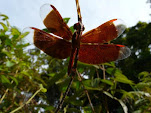
Maturing Large Red Damsel. Everything's in the throes of growing up and/or breeding at present. It's a fabulous time of year.

The Pied Flycatchers are also fledging in the woods. One, or perhaps two, more visits and we'll be finished with them for the year - it's frightening how quickly the season goes in many respects. Nice to see that we've again had a good breeding season for them this year (so far!) and we can hope for a good number of returning birds next year, all things being equal.

Pied Flycatcher and young. The youngsters at this stage haven't yet got to their full feathered state, so look like a cross between gawky teenager and Sesame Street character.

Male House Sparrow framed amongst the remains of our old kitchen

Friday, 27 May 2011

David and the Owl

A cold and almost frosty morning is a good time to be up at the crack of dawn, especially at this time of year. The world is devoid of human life, at least in our neck of the woods, and the only sounds are birds getting on with the business of the season, which is - well - doing the business.

The latest visit to our shared ringing site paid off with a spectacularly unexpected Tawny Owl in the net. He seemed a little out of sorts, as was only to be expected, but that's all part of the fun of it. Interestingly I've been seeing day-active Tawnies a lot recently, perhaps because food's been hard to come by for them and they have a growing family to feed.


More exciting still than the owl, though, was an unexpected mist-net catch: a Narrow-bordered Bee Hawkmoth. Despite being well tangled in the net, we eventually extracted it without major harm - some scales rubbed off the abdomen - brought it back for a quick photoshoot and watched it warm up, and head off into the blue.


Despite the lack of rain in this part of the UK - seems more like the southeast than the southwest - there is plenty going on. Our 'lawn' has come out with a spectacular show of Yellow Rattle. This is a semi-parasitic plant which is often found in good quality hay-meadows, and was a component of the green hay we spread across scarified ground last autumn, hoping for something a bit more interesting than the dog-muck-fertilised Perennial Rye-grass that we then had. The lack of rain hasn't helped much, but a bit of diligent watering and some luck has produced a nice selection of species, including Hairy Tare, Black Knapweed and a handful of eyebrights.


Since this last ringing trip I've been out on the moors doing site assessments, which haven't necessarily resulted in a lot of interesting things to write about. A draggled-looking Pale Tussock caterpillar (I think) on some Soft Rush was a nice find, though I have a sneaking suspicion that it is in fact dead...


...some spectacularly warty lichens growing on the granite...


and some atmospheric Hare's-tail Cottongrass waving in the wind.

Thursday, 5 May 2011

What...

...is the air-speed velocity of an unladen swallow?

Desperate to get out of Devon, we shot up the M5 like scalded cats last weekend. We threw ourselves out of the car, clapped on various bits of kit and trotted smartly into the Avalon Marshes, where we were greeted by a dodgy-looking geezer with a tunic and horse who asked if we'd seen Merlin. Na gave him her Paddington-Bear-stare, and we shunted on into the wetland, past a watery tart waving a sword around (shouldn't be allowed) and into the relative safety of a nice quiet hide.

The memorable page about the sexual proclivities of otters was no longer there in the logbook (shame) - I couldn't find it anyway - and true to form we missed seeing one by about 20 minutes, but the sound of a booming Bittern and the sight of a Hobby or two elegantly drifting over the waters took the edge off the disappointment. I was slightly stunned by the number and variety of dragonflies already out - Large Red, Azure, Blue-tailed, Red-eyed and Variable Damselflies all in numbers, and Hairy Dragonflies and Four-spotted Chasers like you wouldn't believe. We must have hit a major emergence of the latter, actually, as they were literally everywhere: clouds of them lifting from sheltered spots. Surprised the Hobbies could still fly, to be honest.


A prolonged stroll through the reserve produced no fewer than five booming Bitterns - one of which we saw briefly - and a couple of Marsh Harriers, as well as perhaps the most pompous photographer it's been my pleasure to listen to for a long time. Maybe the lens was compensating... We also bumped into a small flock of Black-tailed Godwits, all gingerbread-red and ready for Iceland, as well as a trio of Bar-taileds, though sadly they were all pretty much in winter duds. And a final treat: our first Swifts of the year drifted over amongst the Hobby flock. Mmmm. Nice.

Just to prove that summer's on the way, plenty of nice invertebrates have been out and about locally...

Hoverfly. Species.


Green Tiger-beetle.


Brown Silver-lines. This one has an unfortunate disability: one hindwing has somehow become twisted and now sticks up over it's back like an aeroplane's tailfin. Don't think it's a survivor.


Small Purple-barred moth. Now flying on a heathland near me.


Common Redstart. Having serenaded us from the roof of the office, he sat nicely in the neighbouring Rowan so I could take some distant photos.


White Rock-rose Helianthemum apenninum. For no other reason than they're pretty.

Tuesday, 26 April 2011

Signs of things like spring

As things seem to have been a little quiet of late, here are a few of the bright points of spring in our part of the world. For almost the last two months we've been pretty much rain-free, which is unusual, and it's starting to be a little worrisome for the sake of our garden veg. That's beside the point though...

The sun hits the back of our house full-on, so early on in the year the plants get a good boost of warmth and get on with flowering. We're then visited by a variety of invertebrates, bumblebees and honey-bees first, then overwintering butterflies and an increasingly varied crop of flies, bees, wasps, moths and beetles. As it stands, we've not got a great deal in the way of early-flowering plants to offer them nectar, but the bank of grape-hyacinth behind the door is particularly popular with the bees.

Honey-bee at grape-hyacinth.

Soon the birds get in on the act. Song swells from the odd Robin and Great Tit, then they're joined by Mistle Thrush, Woodpigeon, Song Thrush, Dunnock, Wren, Blackbird... and it's not long before we're seeing Blackbirds and Robins hurtling through the garden with beaks full of nest material, looking like some kind of surreal handlebar moustache.

Blackbird nest. This one in a particularly vulnerable place, next to a track and almost on the ground - in fact no more than 20cm off.

The variety of flowers on offer in the garden also starts to increase, and the bees are quick to take advantage. From the early few Bombus terrestris, we're now seeing a nice variety of bumblebees, including the ambulatory ginger-snap which is Bombus pascuorum.

Bombus pascuorum.


By this time there are plenty of other species beginning to emerge in the woods and lanes around the house, and working out of the Yarner NNR office has its advantages when there is a wealth of wildlife around to enliven lunch-breaks...

Pearl-bordered Fritillary. A species which emerges early in the season, and has benefited from the last few years of warm dry springs down here in Devon.


Woodpigeon. The half-murmured growling coo of Woodpigeons is one of my favourite sounds, always associated with hot, lazy, sunny afternoons, redolent with the hum of bees and hoverflies and the scent of green things growing.

And now, by the end of April, we've got the first brood of Robins squalling for food just beyond the fence - dicing with death at the hands of the neighbours' cats. Given that about 90% of young birds die in their first year, their chances aren't good, but for the moment the weather at least is doing them a favour. Shame I can't say the same for the local cats...

Robin. One of the early broods to come out - much squealing and agitation when mum or dad hove into view with a juicy morsel.
Finally, I was lucky enough to see what looks like a Large Tortoiseshell butterfly in my in-laws' garden on Saturday:


Large Tortoiseshell - believe it or not. A species probably now extinct in Britain and only occurring as an escape, a deliberate release or as a wandering vagrant on easterly winds. Given the state of this one, I'm going for the latter!

Friday, 1 April 2011

Dartmoor's most elusive mammal...

Have you ever walked the blanket bogs of Dartmoor? They can seem like an empty, open, drear place with little wildlife and an apparently limitless expanse of Molinia – a Chameleon-like grass which changes in character from purple-tinted green in summer to winter white. You may have heard the bubbling trill of Skylarks, the 'sweet-sweet-sweet' calls and songs of Meadow Pipits and perhaps, in the loneliest and most remote areas, the dry trilling calls of Dunlin. Other than these hardy birds and a specialist invertebrate fauna, you could be forgiven for thinking the place was pretty empty. Not so: take time, walk quietly and spend some time looking carefully at those bog pools – some are the home of a very special mammal: the Dartmoor Pygmy Sperm Whale. Known scientifically as Microkogia devoniensis, this is not only the sole freshwater European cetacean, but is also the world’s smallest whale; and it is a shy endemic resident of open bog pools on the blanket mires of Dartmoor.

Dartmoor Pygmy Sperm Whale - a rare glimpse in summer in an exceptionally well-vegetated pool. The flat back with dorsal fin just out of the water is characteristic of logging behaviour like this. They are easily disturbed, though, and an unwary footfall will result in nothing more than an expanding ring of ripples on the surface. This animal may be a lone bull, perhaps an adolescent feeding in the rich waters until he is of sufficient size to be capable of competing for a mate.

The Dartmoor Pygmy Sperm Whale is a fraction of the size of its better-known relatives - which include the world’s largest animal (the Blue Whale, Balaenoptera musculus). Measuring a maximum of 16cm from nose to tail, this is a unique creature in many different ways.

Much remains to be discovered about the biology and ecology of these diminutive specialities of the Dartmoor uplands. They appear to spend much of their time feeding in amongst the fringes of the Sphagnum moss which grows into the pools, perhaps hunting small invertebrates or even freshly-hatched tadpoles. There has been speculation that they even burrow their way into the mats of Sphagnum, though there is as yet no evidence of such behaviour. Their whereabouts in winter are also a mystery, although there have been reports of sightings at the ice fringe in the hardest weather, suggesting they probably remain faithful to their summer haunts throughout the year. It seems likely that they are able to live off their fat reserves through the tough winter conditions.

The clearest image yet obtained of this elusive species: the characteristic humped back and stubby projecting dorsal fin of a whale about to make a deep dive to the submerged vegetation. This appears to be an exceptionally large bull; the cows are more frequently seen, and are significantly smaller.

Your best chance of seeing one of these remarkable beasts is to find a bog pool, sit quietly and scan the water’s surface for the telltale ‘blow’ the animals make when they come to the surface. Their diminutive size means they surface rapidly, and even in a light wind, the ripples on the water’s surface can be sufficient to hide them. They rarely lift any part of their body far clear of the water, although tail-slapping and fin-beating are not unknown during their spring courtship period. However, other typical cetacean behaviour such as breaching is as yet unknown in the species.

Keep a close eye on the water when you're out there...

Wednesday, 2 March 2011

South Devon coast-walking

This is more like it! Spring is in the air. If you don't know how to tell that in the UK, here's a tip: the rain gets warmer and the wind blusters around you when you go out, trying playfully to tease your coat from your shoulders. It's a little like the old fable about the sun and the wind, competing to persuade a man to take his coat off as a test of which was the superior weather: the wind huffs and puffs, blows and blusters and all the man does is clutch his coat around himself. The sun shines bright and hot, and foom!: off comes the coat. Being Britain, of course, the wind then gets in on the act again and the coat goes back on. Then the sun tries again, and off comes the coat - and then the rain gets in on the act and you start all over again...

Still, Spring seems to be springing - the birds are singing more consistently, and it's easier and easier to find flowers out there: the first Celandines I'd noticed last week suddenly followed by Early (I think) Dog-violet, Primrose, and a few Red Dead-nettles. The glossy shield-shapes of Cuckoopint leaves are prominent in the base of the hedgerows, and a flush of green is climbing up from them, as Cleavers, nettles and Red Campion get themselves going for the year. All in all, it's pretty heartening.

We walked from Sidmouth to Branscombe, following the beach between Seaton Mouth and Branscombe, returning along the South West coast-path on a blustery, showery, invigorating day. The climb out of Sidmouth led to superb views west along the coast, with the town sprawled white in the valley, the old red sandstone cliffs rising abruptly to the west, levelling off to the flat land around Otterton and then drifting into an increasingly blue distance. The lines of showers were clear to see, marching down the flanks of Dartmoor and through the South Hams.

Sidmouth and the western cliffs

We continued on to Seaton Mouth, choosing to skirt the land and follow the shingle beach east. We distracted ourselves for a while looking at a plethora of fossils in some of the more recent landslip - all shells and tracks, patterns and marks, but fascinating to muse on, especially when you start to think about the layers with and without fossils, and the periods of time that elapse between.

The long trudge along the shingle was brightened by Rock Pipits flustering from the tideline, Peregrines gliding effortlessly overhead and the occasional presence of clumps of Coltsfoot, shining yellow on the pinky-red sandstone.

Coltsfoot

The western fringe of the Jurassic Coast, looking east towards the Isle of Portland

The foot of the cliff is also marked along this section by lines and streaks of salmon-pink stone, which occasionally twist and contort into shattered-mirror fragments, hinting at some cataclysmic event millions upon millions of years in the past. Of course, I could be utterly wrong about that. For periods the pink stripes are mirrored by a soft blue-grey clayey material which must have been somewhat softer than the surrounding sands or muds, as it appears in blotches and dots either side of the main stripe: rather as if a painter had walked several miles along the beach with a pot of grey paint, occasionally shaking the excess off their brush or carelessly dripping onto the rocks either side.

Stripy-stripy


Branscombe Mouth from the top of the slope to the west. It's a steep old climb, but on a day like this, the view is well worth it.

We eventually reached Branscombe, scarfed a welcome ice-cream, and headed back along the mud-slicked coast-path, trudging up a series of punishing hillsides, then coasting along the level tops, before plunging back to the valley floors. The brisk northerly wind made it a very good idea to keep moving at a steady pace, admiring the view which was now shower-free, and clear all the way to north Dartmoor, nearly 40 miles to the west.

Looking west towards Seaton in the distance

Couldn't resist messing with the exposure

A gratuitous picture of spring-like stuff for you