Tuesday, 26 April 2011

Signs of things like spring

As things seem to have been a little quiet of late, here are a few of the bright points of spring in our part of the world. For almost the last two months we've been pretty much rain-free, which is unusual, and it's starting to be a little worrisome for the sake of our garden veg. That's beside the point though...

The sun hits the back of our house full-on, so early on in the year the plants get a good boost of warmth and get on with flowering. We're then visited by a variety of invertebrates, bumblebees and honey-bees first, then overwintering butterflies and an increasingly varied crop of flies, bees, wasps, moths and beetles. As it stands, we've not got a great deal in the way of early-flowering plants to offer them nectar, but the bank of grape-hyacinth behind the door is particularly popular with the bees.

Honey-bee at grape-hyacinth.

Soon the birds get in on the act. Song swells from the odd Robin and Great Tit, then they're joined by Mistle Thrush, Woodpigeon, Song Thrush, Dunnock, Wren, Blackbird... and it's not long before we're seeing Blackbirds and Robins hurtling through the garden with beaks full of nest material, looking like some kind of surreal handlebar moustache.

Blackbird nest. This one in a particularly vulnerable place, next to a track and almost on the ground - in fact no more than 20cm off.

The variety of flowers on offer in the garden also starts to increase, and the bees are quick to take advantage. From the early few Bombus terrestris, we're now seeing a nice variety of bumblebees, including the ambulatory ginger-snap which is Bombus pascuorum.

Bombus pascuorum.


By this time there are plenty of other species beginning to emerge in the woods and lanes around the house, and working out of the Yarner NNR office has its advantages when there is a wealth of wildlife around to enliven lunch-breaks...

Pearl-bordered Fritillary. A species which emerges early in the season, and has benefited from the last few years of warm dry springs down here in Devon.


Woodpigeon. The half-murmured growling coo of Woodpigeons is one of my favourite sounds, always associated with hot, lazy, sunny afternoons, redolent with the hum of bees and hoverflies and the scent of green things growing.

And now, by the end of April, we've got the first brood of Robins squalling for food just beyond the fence - dicing with death at the hands of the neighbours' cats. Given that about 90% of young birds die in their first year, their chances aren't good, but for the moment the weather at least is doing them a favour. Shame I can't say the same for the local cats...

Robin. One of the early broods to come out - much squealing and agitation when mum or dad hove into view with a juicy morsel.
Finally, I was lucky enough to see what looks like a Large Tortoiseshell butterfly in my in-laws' garden on Saturday:


Large Tortoiseshell - believe it or not. A species probably now extinct in Britain and only occurring as an escape, a deliberate release or as a wandering vagrant on easterly winds. Given the state of this one, I'm going for the latter!

Friday, 1 April 2011

Dartmoor's most elusive mammal...

Have you ever walked the blanket bogs of Dartmoor? They can seem like an empty, open, drear place with little wildlife and an apparently limitless expanse of Molinia – a Chameleon-like grass which changes in character from purple-tinted green in summer to winter white. You may have heard the bubbling trill of Skylarks, the 'sweet-sweet-sweet' calls and songs of Meadow Pipits and perhaps, in the loneliest and most remote areas, the dry trilling calls of Dunlin. Other than these hardy birds and a specialist invertebrate fauna, you could be forgiven for thinking the place was pretty empty. Not so: take time, walk quietly and spend some time looking carefully at those bog pools – some are the home of a very special mammal: the Dartmoor Pygmy Sperm Whale. Known scientifically as Microkogia devoniensis, this is not only the sole freshwater European cetacean, but is also the world’s smallest whale; and it is a shy endemic resident of open bog pools on the blanket mires of Dartmoor.

Dartmoor Pygmy Sperm Whale - a rare glimpse in summer in an exceptionally well-vegetated pool. The flat back with dorsal fin just out of the water is characteristic of logging behaviour like this. They are easily disturbed, though, and an unwary footfall will result in nothing more than an expanding ring of ripples on the surface. This animal may be a lone bull, perhaps an adolescent feeding in the rich waters until he is of sufficient size to be capable of competing for a mate.

The Dartmoor Pygmy Sperm Whale is a fraction of the size of its better-known relatives - which include the world’s largest animal (the Blue Whale, Balaenoptera musculus). Measuring a maximum of 16cm from nose to tail, this is a unique creature in many different ways.

Much remains to be discovered about the biology and ecology of these diminutive specialities of the Dartmoor uplands. They appear to spend much of their time feeding in amongst the fringes of the Sphagnum moss which grows into the pools, perhaps hunting small invertebrates or even freshly-hatched tadpoles. There has been speculation that they even burrow their way into the mats of Sphagnum, though there is as yet no evidence of such behaviour. Their whereabouts in winter are also a mystery, although there have been reports of sightings at the ice fringe in the hardest weather, suggesting they probably remain faithful to their summer haunts throughout the year. It seems likely that they are able to live off their fat reserves through the tough winter conditions.

The clearest image yet obtained of this elusive species: the characteristic humped back and stubby projecting dorsal fin of a whale about to make a deep dive to the submerged vegetation. This appears to be an exceptionally large bull; the cows are more frequently seen, and are significantly smaller.

Your best chance of seeing one of these remarkable beasts is to find a bog pool, sit quietly and scan the water’s surface for the telltale ‘blow’ the animals make when they come to the surface. Their diminutive size means they surface rapidly, and even in a light wind, the ripples on the water’s surface can be sufficient to hide them. They rarely lift any part of their body far clear of the water, although tail-slapping and fin-beating are not unknown during their spring courtship period. However, other typical cetacean behaviour such as breaching is as yet unknown in the species.

Keep a close eye on the water when you're out there...

Wednesday, 2 March 2011

South Devon coast-walking

This is more like it! Spring is in the air. If you don't know how to tell that in the UK, here's a tip: the rain gets warmer and the wind blusters around you when you go out, trying playfully to tease your coat from your shoulders. It's a little like the old fable about the sun and the wind, competing to persuade a man to take his coat off as a test of which was the superior weather: the wind huffs and puffs, blows and blusters and all the man does is clutch his coat around himself. The sun shines bright and hot, and foom!: off comes the coat. Being Britain, of course, the wind then gets in on the act again and the coat goes back on. Then the sun tries again, and off comes the coat - and then the rain gets in on the act and you start all over again...

Still, Spring seems to be springing - the birds are singing more consistently, and it's easier and easier to find flowers out there: the first Celandines I'd noticed last week suddenly followed by Early (I think) Dog-violet, Primrose, and a few Red Dead-nettles. The glossy shield-shapes of Cuckoopint leaves are prominent in the base of the hedgerows, and a flush of green is climbing up from them, as Cleavers, nettles and Red Campion get themselves going for the year. All in all, it's pretty heartening.

We walked from Sidmouth to Branscombe, following the beach between Seaton Mouth and Branscombe, returning along the South West coast-path on a blustery, showery, invigorating day. The climb out of Sidmouth led to superb views west along the coast, with the town sprawled white in the valley, the old red sandstone cliffs rising abruptly to the west, levelling off to the flat land around Otterton and then drifting into an increasingly blue distance. The lines of showers were clear to see, marching down the flanks of Dartmoor and through the South Hams.

Sidmouth and the western cliffs

We continued on to Seaton Mouth, choosing to skirt the land and follow the shingle beach east. We distracted ourselves for a while looking at a plethora of fossils in some of the more recent landslip - all shells and tracks, patterns and marks, but fascinating to muse on, especially when you start to think about the layers with and without fossils, and the periods of time that elapse between.

The long trudge along the shingle was brightened by Rock Pipits flustering from the tideline, Peregrines gliding effortlessly overhead and the occasional presence of clumps of Coltsfoot, shining yellow on the pinky-red sandstone.

Coltsfoot

The western fringe of the Jurassic Coast, looking east towards the Isle of Portland

The foot of the cliff is also marked along this section by lines and streaks of salmon-pink stone, which occasionally twist and contort into shattered-mirror fragments, hinting at some cataclysmic event millions upon millions of years in the past. Of course, I could be utterly wrong about that. For periods the pink stripes are mirrored by a soft blue-grey clayey material which must have been somewhat softer than the surrounding sands or muds, as it appears in blotches and dots either side of the main stripe: rather as if a painter had walked several miles along the beach with a pot of grey paint, occasionally shaking the excess off their brush or carelessly dripping onto the rocks either side.

Stripy-stripy


Branscombe Mouth from the top of the slope to the west. It's a steep old climb, but on a day like this, the view is well worth it.

We eventually reached Branscombe, scarfed a welcome ice-cream, and headed back along the mud-slicked coast-path, trudging up a series of punishing hillsides, then coasting along the level tops, before plunging back to the valley floors. The brisk northerly wind made it a very good idea to keep moving at a steady pace, admiring the view which was now shower-free, and clear all the way to north Dartmoor, nearly 40 miles to the west.

Looking west towards Seaton in the distance

Couldn't resist messing with the exposure

A gratuitous picture of spring-like stuff for you

Tuesday, 1 March 2011

Isle of Man. Part II

Time flies by. Sorry. Our trip to the island was rounded off by a patchwork of ringing, abortive ringing, birding and walking - we headed over to a harrier roost to admire a handful of birds coming in to sleep, we spent time in a local garden ringing normal garden fare, we walked the Agniesh Valley to the old mine spoils (and boy, are the motorcyclists making a mess up there!) and we rounded it all off with a pleasant couple of hours at a brand-new wetland near Onchen and at Derbyhaven Bay. Brief, and to the point.

Hen Harrier, in the dim

Near Snaefell

Snaefell

Chris. And Kay's hat.

Evening light

Langness from Castletown

Monday, 7 February 2011

Isle of Man

It just draws you back... Na and I caught the early-morning flight from Birmingham to be with Chris & Kay for the weekend. From a drear grey English morning to a bright, sunny Manx morning, fresh with promise of walks and wildlife and a few nice meals with friends... Castletown was positively glowing in the sun when we stumbled out of the airport and down for a restorative coffee in Kay's pad. The day brightened still further with a small party of Choughs flying down past the window to forage in the deep beds of sea-washed wrack on the tideline. They are always a pleasure to watch, with their cheerful-sounding 'cheeow' call and their constant wing-flicking and self-important walk. Whilst we admired the Choughs, a couple of dapper Eiders dived for shellfish just off the breaking surf.

We headed out for a walk round into Port St Mary Bay, following the round-island coastal path across fine maritime grassland in the teeth of a fresh onshore breeze. A Stonechat perched up on a gorse-bush gave us all pause for pleasure - they've been hit hard by the cold weather over the last two winters, and this was the first any of us had seen this year. We carried on round into Port St Mary Bay, where a Little Egret pranced around one of the rockpools, amidst a flock of large gulls, a scatter of Wigeon and a pair of Gadwall - a relatively unusual bird for this part of the island.

Tired heads forced a return to the greasy spoon in Castletown, where a solid helping of bacon rolls and egg-&-chips got the cholesterol pumping once again, and we headed north to Laxey.

Choughs, bickering over who should eat that particular juicy sandhopper

Saturday saw an early start, heading north to the old gravel pits near the Point of Ayre, where Chris had a bird-monitoring transect to walk. We helped. The pis are typical worked-out gravel extraction, with a sandy, shingly ruderal look to them, and a good selection of duck lurking on the pools. The bulk were Pochard, Tufted Duck, Mallard, Wigeon and Goldeneye, but a couple of Goosander lurked in one corner, and the large flock of Greylag and farmyard geese held a single Greenland White-front and a rather less convincing Bar-headed Goose. The geese eventually decided we were more risk than they liked to run, so headed off for pastures west, leaving the duck and ourselves breathing a collective sigh of relief at the lowered noise levels. The final pool held a pleasant surprise: a small flock of Whooper Swans circling nervously on the far side, heads bobbing and tails waggling. We carefully left them in peace and finished off the transect.

A brief sea-watch at the point produced almost nothing of note, bar a couple of distant Scotsmen on the adjacent mainland (you could tell they were Scots because they were wearing kilts). A Gannet or two,  single Kittiwake and Red-throated Diver and a handful of unidentifiable auks do not a seawatch session make, so we headed back to Ramsey and another welcome cholesterol feast. We left in timely fashion, to the welcome sight of a Kingfisher on the harbour wall: we duly admired it and then headed off to the Curragh. A short quiet walk around the site paid dividends: no fewer than five Red-necked Wallabies were seen, all watching us with deep suspicion from the shelter of the woodlands.

Red-necked Wallaby through the trees. They eat Purple Moorgrass - perhaps we should be using them to maintain the south-west Culm grasslands...

Wallaby no.1. They not only look quite rabbit-like in profile, but they occupy a similar ecological niche

Red-necked Wallaby. A final goodbye.

Wednesday, 29 December 2010

Frozen cold

Some winter cheer - best wishes to anyone who's reading that you have a happy and successful 2011.

You may have heard that the UK's been suffering the coldest December for a century: it's certainly been an interesting one down here in Devon! A bit of chilly weather in mid-December, whilst the rest of the country was gripped by ice and snow, left some of us feeling smug and happy that we lived in the 'soft south'...

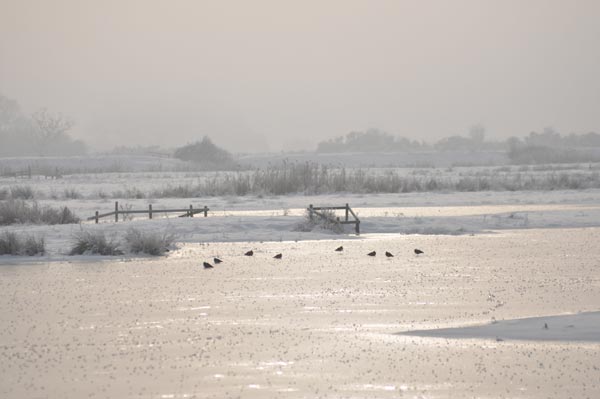
Pre-snow, Exminster Marshes in the first hint of the cold weather: the pools all frozen and almost every bird on or around the main storage lagoon on the site. Picturesque, though.

A pale and watery sunrise,  reminiscent of Turner's work. Only in England...

Reed Bunting

However, a short while later a 20cm layer of snow appeared overnight, wiping the smile off my face. A nice selection of interesting birds promptly appeared in the garden, including the expected Brambling, Redwing and Fieldfare, and a thoroughly unexpected Moorhen, walking down the neighbours' hedge!

Chaffinches were confused by the depth of the snow

A poor and grotty photo of a nice bird in the garden: Redwing

Even the squirrels were out making snowmen

Moorhen wondering what on Earth is going on.

And of course, a sunny day makes a perfect opportunity for a walk and a chance to take some pictures.

The river Bovey, as it ripples and roils downstream to join the Teign

Dipper

Holly in the Bovey

Holly in the Bovey. Again.

Snow, snow, snow...

Freezing fog dusts a lone oak on the edge of the Parke estate

The river Bovey between Bovey Tracey and Lustleigh, steaming in the early morning sunshine

Frozen birch

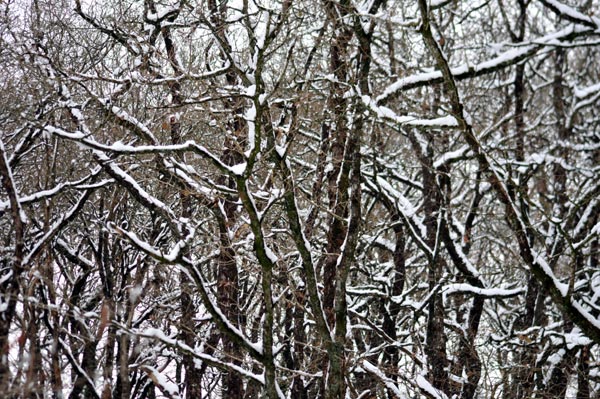
More frozen frosty snowy trees. You know the score.

Yarner woods looking monochromatic and chaotic

The clear skies and even layer of snow also made a very nice combination to take the camera for a walk when we headed over to my parents' place for Christmas.

Haldon Belvedere in the evening sun

Nice male Brambling. Through the parents' double-glazing.

Blue Tit

The lure of a handful of apples was enough to bring in plenty of Blackbirds and Starlings, with Song Thrush, Redwing and Fieldfare thrown in for good measure. One female Blackbird in particular was extremely aggressive, chasing everything - even Fieldfares - off 'her' apples.

Blackbird vs Song Thrush

Blackbird makes victory salute after a first round KO

Apples: they've got tough skins...

...takes some effort to get...

...that...little...

...bit of...(aargh)...

skin off!

Just as a thaw was predicted, the temperatures tumbled lower: Boxing Day morning saw a rather nippy -7C at my parents' house, close to Exeter (I know it's nothing compared to many others, but cold enough for us, thankyou very much!) - a walk around Exminster Marshes that morning was particularly interesting.

To begin with, the canal was frozen solid. A small hole in the ice was kept free by a group of Coot, with a pair of Gadwall and a single Little Grebe - all moving rather sluggishly in the cold.

The Exeter ship canal, sans ships.

Coot freezing into the canal

Spot the Gadwall

Coots still freezing in the ice. Little Grebe huddling in for warmth.

A little further along the canal, a small seep of flowing water into a ditch was providing a life-line for a Water Rail; normally a bird which is extremely wary - this one was presumably so close to the edge that it let us wander past a few metres away without running for cover.

Water Rail, on the edge

At the Turf Locks hotel, a disconsolate group of Black-tailed Godwit, Lapwing and Oystercatcher huddled on the frosty grass, whilst Dunlin and Black-tailed Godwit flew up and down river, searching for the earliest opportunity to get onto fresh mud before it froze solid.

Black-tailed Godwit - looking odd because its legs are tucked in to its belly, rather than flapping along behind - they look oddly chesty in this pose.

Turf locks jetty

Lapwing heading over to check whether the marshes are snow-free yet. Nope.

Crystals on the fringes of the snow

To cap it all, ice floes were floating down the river Exe on the ebbing tide, with cargoes of Lapwing and Dunlin. Quite, quite surreal!

Lapwing and Dunlin drift downriver on ice-floe.

Reed-heads in the growing sunlight

Lapwings looking mournful in the snow

Lapwing on ice

Cheers... to a successful 2011!