Tuesday, 23 November 2010

National London bus aquarium

You wait for ages, then they all come at once. Some pictures from a recent visit to the National Marine Aquarium at Plymouth. Not all of the titles of the pictures are accurate...


Plymouth sound from Sutton Harbour 

 Plumose Anemones

 1980s Headbanging Anemone
 
 Many-tentacled leaping anemone

Upwards Snakelocks Anemone
 
Downwards Snakelocks Anemone

 Moon Jellyfish + Helena

 Moon Jellyfish+Chris

 Indigo Zombiefish.

 Bandy shrimp

Frondy cammofish

 Giant Pacific Octopus.

 Yellow man-eating anemone

 Yellow fish-eating anemone+clownfish

 Catshark

 John Prescott Lumpfish?

 Thorny starfish

 Lionfish

Coral reef tank

New birds, old birds, autumn

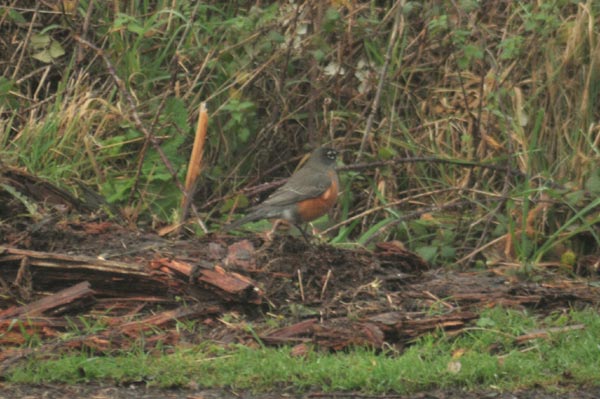
A couple of weeks ago I was fortunate enough to be in the office when news of a 'possible' American Robin began to spread around the county. As only the fourth record for Devon, and perhaps the first on the mainland, it was quite a draw - add in the fact that the last time I was able to try and twitch (ouch) one, it was last seen the day before I got there. Despite some initial scepticism about the reliability of the sighting, there were plenty of people out searching, so I was able to take a leisurely wander to the site during an extended lunch-break, dodge some nasty, nasty rain showers and see a right beautiful bird before the ravening hordes descended at the weekend.

American Robin. Despite the poor photo, you can see the pale fringes to the greater coverts (halfway down the wing, if you didn't already know!) which age it as a 1st-winter bird. Worth wondering where it came from, as most of the Redwings here in SW England seem to be Scandinavian rather than Icelandic. Speculation all the way!

Soon after this piece of unashamed twitching, I was back on site, leading a training event about waterbird ID and ecology for some colleagues, with the help of a friend of ours. By some unaccountable event, we gathered on one of the two calm, sunny days sandwiched between howling winds and lashing rain. We started with a slow wander up the river from Powderham Church to Turf Locks... Immediately, we were faced with a mixed bag of waders and wildfowl feeding quietly on the rising tide: Black-tailed and Bar-tailed Godwits, Oystercatchers and Curlew, with a smattering of Wigeon and Brent Geese. A raft of female &/or juvenile Red-breasted Mergansers drifted gently upriver, and several small flocks of Avocet and Dunlin flew past.

Early days learning waterbirds... and just how far away waders can be.
 
Powderham marshes in the sunshine
 
Further upriver, we stopped to look at the quantity of bird footprints on the intertidal mud, coming right to the edge of the sea-wall, showing how much of the river the birds use at night when disturbance is lower - and bumped into the tracks of an otter, heading straight out across the mud, tail dragging behind it. First time I've seen evidence of Otter on the Exe myself, though I know several people who've seen the beasts themselves in the area.
Otter tracks - next best thing to seeing an Otter.

A little further on upriver, we were treated to spectacular views of a male Red-breasted Merganser feeding with utter aplomb just a few metres offshore; diving with barely a ripple, then bringing back a number of small fish to the surface where they were then squeezed and manipulated until they slipped down his throat - prompting much speculation as to the sensations experienced by both bird and fish! Can't say the fish gets much of a deal out of it, but there you go.

Drake Red-breasted Merganser, sans fish

Soon after this, we came across a flock of Lapwing doing just exactly what Lapwing do; bobbling around a grassy field amongst a herd of cattle, until a passing motorised parachute-thingy dropped down the marshes, circled the cattle and put them all to flight: a perfect demonstration of the effects of casual disturbance...

A temporary disturbance, but they all add up...
 
Soon after this, whilst we watched a cluster of Black-tailed Godwits probing deep into the mud, Amanda let out a cry of 'Ooh! - a Kingfisher!' and sure enough, there was a smart bird sat on the end of the jetty below Turf Locks, fishing in the canal-Exe confluence, and staying still long enough for everyone to enjoy good views through the telescopes.
Looking to the Turf Locks hotel
 
The gang get to grips with distant blobs, Avocets, Redshank  and godwits

which are all out there. Somewhere.
 
A short while later, we managed to walk past the American Robin - and it's attendant twitchers - without so much as a backwards glance; the first time I've ever managed to walk past a major UK rarity without stopping to look. Weird feeling, I have to confess! After discussing twitchers and their various habits for a short digression, we spent a while scanning the marshes and discussing freshwater waterfowl and waders,from swans to Snipe. The marshes and pools were not particularly busy, compared with how things can be in midwinter, but a liberal dash of Wigeon and Black-tailed Godwit were on the fields, with a smattering of Teal, Shoveler, Tufted Duck, Coot and Gadwall on the pools - a backing track of Water Rail and Cetti's Warblers kept us company from the scrubby ditches.

The Exe from Powderham on a rising tide. 

Finally we tracked back to the cars, then headed downriver to have a look off the back of Dawlish Warren and watch the departing roost. The weather and the tide combined to frustrate us, though, so we had to be content with views across the estuary and a very slowly ebbing tide, with a dusting of ducks up Shutterton Creek and a cloud of Woodpigeon in the adjacent copse.

A few Dartmoor autumn pictures follow, for the hell of it...:

 The ascent of fungi

 Between Hexworthy and Dartmeet

 Dartmeet

 More fungi, but not ascending - more like an exploded brain, really

 
Nuthatch 

Dartmeet
Friday, 29 October 2010

Black-headed gulls again

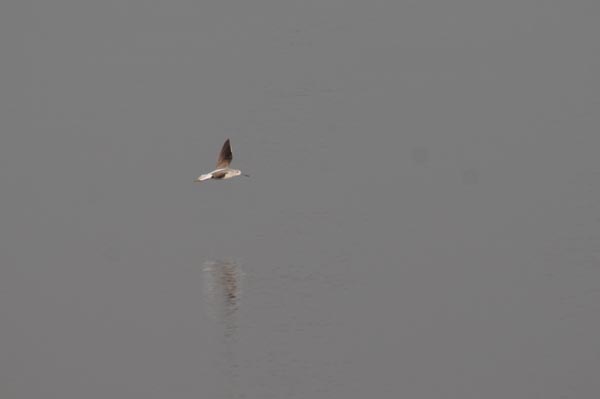
Must be winter. A lunchtime stroll to the quay in Exeter produced two returning Black-headed Gulls: one Latvian bird ringed a couple of years back, the other a Finnish-ringed bird which was ringed back in 1997, so 13 years and counting. They get to be like old friends, even if they don't treat you that way...

Saturday, 23 October 2010

An American on the Exe.

Every second Friday I have a day 'off' (working compressed hours, not skiving!) where I usually get to do the housework, shopping and whichever other miscellaneous chores have built up over the past fortnight. Yay. Yesterday, however, the sun was shining, there were birds to be seen and I had the bonus excuse that I need pics of some of the local waterbirds for a training course I'm running soon. So, down to the Exe I went. I started out at Powderham, where the autumn sun was low and bright, highlighting the turning yellows and browns that are starting to appear in the oaks, and bringing a velvety sheen to the coats of the Fallow Deer which roam the park. The tide was high, so after a cursory look at the mouth of the river Kenn, I headed back to the church and the track leading to the Turf Locks Hotel.

 Little Egret heading upriver at Powderham, Somehow, they always sound so very, very angry when you disturb them.

Powderham Park glowing in the morning sun.

 Powderham marshes doing likewise.

 The Exe, glistening.

Soon after crossing the railway tracks, I noticed a Robin shoot to the top of a low bramble beside a ditch, sit straight up and start calling - he was rapidly joined by a Wren, which rattled and churred like a bird possessed. Very soon, a Stoat's head popped up out of the grass on the ditch edge, and looked coolly at the two birds, before it dropped back into the vegetation and continued hunting whatever it was hunting! The two bird tracked it along the ditch for a good 50 metres, never once letting up on their incessant alarm-calling.To be fair, the Stoat didn't seem at all bothered.

 Stoat, regarding me balefully. I think it resented not being asked whether I could take it's photo, but mindful of the attitude displayed by the Stoats towards Toad, I made sure to keep a safe distance. In any case, I don't carry a cudgel, and Stoats are well known for being armed on a regular basis.

I could see that I wasn't going to have the day all my own way, as bruise-black clouds were building to the north, over Exeter. However, the sun was shining on me and the tide was ebbing, so I pottered on. A couple of flocks of Shelduck and some scattered Grey Plover diverted me for a short time, trying to get some halfway recognisable shots of the latter being rather tricky! Eventually I gave up and moved upriver. A Kingfisher on the rocks was another brief diversion, but unfortunately I managed to fumble the camera.

 Greenshank. No, really.

This couple of Rock Pipits were so intent on beating seven bells of hell out of each other that they completely ignored me. The bird currently on top came out the victor in the end, but not before several air-to-ground tussles which looked, quite frankly, extremely vicious.

 Rock Pipit - the victor.

I then settled down to a bit of a scan of the river, when a plover flew straight upriver past me. 'Hmm' - I thought to myself - 'looks like those pits need a wash'. The penny dropped with an audible clunk, and I worked out I was looking at either a Pacific or an American Golden Plover; the question then being: which one? As it settled, it resolved itself as a nicely greyed-out bird, with a chunky flared supercilium (technical term for what is the equivalent to the eyebrow on a bird) and primaries extending well beyond the tail, with rather short tertials. American Goldie it was - and is still there today, being perved at by dubious-looking men in long flasher-macs.

A truly awful picture of what is in fact a very nice-looking bird. American Golden Plover - see what I mean about the striking supercilium? The reason for the bad picture is that I was holding an old Panasonic Lumix to the eyepiece of a slightly clapped-out telescope. Anything for a record of a rarity, eh?

After that, everything else was bound to be a bit of an anticlimax, but that's life. A couple of Mediterranean Gulls up at Topsham, one bearing a red colour-ring (perhaps from Slovakia, if Dirk Raes' c-r birding projects page is up-to-date) rounded off a decent day.

Today's time was spent lurking around the head of the river, admiring a chunky flock of Black-tailed Godwits - one of which was ringed by my wife in Iceland a few years ago -along with a single Spotted Redshank and a handful of Avocet. A flyover Merlin shoo-ed them all away from the edge of the river, so I met up with a friend, wandered down the west side of the river, and then spent the last of the usable daylight watching the rising tide gradually shunting the Brent Geese and the waders ever closer to the shore by Starcross.

 Black-tailed Godwits (the centre bird is the one Na ringed, hence another poor photo)

 Black-tailed Godwit

Avocets roosting as far away as possible. One of these birds is also colour-marked. Which one?

Starlings in hawthorn

Every so often on the Exe, something out of the ordinary turns up. Sometimes it's from America, sometimes from Asia. Clearly, this Black Swan was fresh in from Australia - apparently unringed and very wary indeed. Or maybe it had just learnt from the Mute Swans around that people aren't to be trusted. Or maybe it had a bad experience with a handler..


A small flock of Redshank flying downhill upriver to roost.