Tuesday, 22 November 2011

A farewell to palms.

Eastern Grey Kangaroo. Not tied down.

One bonus from hanging out with a bunch of bird-banders is that they know the best places to look for waders, and they tend to have a tide-table conveniently to hand (thanks Brenda!) - so Monday saw us heading back south towards Brisbane, to the pleasantly anonymous town of Toorbul, at the civilized hour of 9 in the morning. Unfortunately the weather wasn't going to let us have it all our own way: a stiff southerly breeze was bringing cool air into the state, with scudding clouds and the occasional burst of rain to remind us what we were missing at home in England.

Toorbul is the sort of place you'd probably never think of going unless you had to. Nice enough, but nothing particularly special - apart from hordes of kangaroos feeding along the roadside. We followed the road to the very end of town, south until we had a nice view of Bribie Island, then parked up by a little grassy bund, beyond which was a small sandy beach. Even as we parked, the first birds were pushing in on the rising tide, looking for a safe spot to hunker down until the mud was exposed again. Larger migrant species; Bar-tailed Godwits and Whimbrel, made up the bulk of the flock - only about 150 birds at first - with a handful of resident White-headed Stilts, Pied Oystercatchers and a couple of disconsolate-looking Gull-billed Terns.

Curlicues.

Wader palindrome: Bar-tailed Godwit. Grey-tailed Tattler. Sharp-tailed Sandpiper. Grey-tailed Tattler. Bar-tailed Godwit.

Small flocks of waders soon started to appear, heading down into the wind in straggling lines: mainly godwits, but an increasing number of smaller migrants as well: Grey-tailed Tattlers, Sharp-tailed Sandpipers, Great Knot, Red-necked Stints... A line of Black Swans stood offshore on a small sand-bar, black curlicues against the green-grey waves. The roost built up steadily to around 1,500 birds, then the parties of waders pretty much stopped coming - those that had been displaced by the tide all arrived at their respective hangouts. Caspian Terns joined the party, and with the birds a little more settled, we began to pick out a few other species: a small group of Greenshank, a Black-tailed Godwit or two; best of all a smart Terek Sandpiper, with yellow ochre legs and a perpetually smiling expression.

Snooze-time on the sand. The bulk are Bar-tailed Godwit, with a smattering of Great Knot (smaller, slightly curved bill, dark chevrons on the flanks). A single tattler on the left with a plain grey back and an out-of-focus Curlew Sandpiper at the front left, disappearing out of shot.

The birds may have been settled, but they were far from still: the larger birds tried to sleep, heads turned round and bills under wings, whilst the sandpipers trotted rapidly around below them, tucking in to the unfortunate invertebrates in the sand. Every so often one of the Pied Oystercatchers would take great exception to all these interlopers and take a run at the roosting birds, sending them running - or flying - out of its way.

Eventually the tide turned, the birds began to think about moving off to the mud again, and we headed back towards Palmwoods for our last evening, before heading south, to Tasmania and a whole new week.

Ichneumonoptera chrysophanes (a.k.a. Carmentera chrysophanes), a clearwing moth, bids us goodbye from Queensland, leaving a parting kiss on my jacket.

Green Tree-frog on pot.

Wednesday, 16 November 2011

Nudgee Nudgee, wink wink, say no more...

Our first full weekend in Aus. We headed off south to meet a bunch of bird-banders - for so 'tis termed outside of Britain - at the Border Ranges National Park, just over the New South Wales border. En route, we thought we'd pay a visit to what looked like a bit of tidal estuary; break the journey at least. We arrived at Nudgee Beach to the sight of water lapping the carpark fringes. Clearly, the tide was going to have the last word over any plans to see mud-loving birds! Undaunted, we set off around the short boardwalk to the one and only hide that we encountered on our travels. The path leads through some rather nice Grey Mangrove woodland, which is always a treat for the mangrove-less European. A forest of aerial roots, light beaming through the canopy and the salt-laden scent of the mud make it a wholly satisfying experience. The birds were there, though thin on the ground - it was getting hot by this stage - Mangrove Gerygones flitted through the canopy doing a good impression of Chiffchaffs, an Australian Spotted Crake trotted quietly through the roots and a rather bored-looking Osprey sat on an exposed branch by the hide. Rainbow Bee-eaters and soaring Brahminy, Whistling and Black Kites were a good supporting cast, with Collared Kingfishers prowling for the abundant small fish in the myriad of pools.

We were also slightly mystified by the number of single men wandering around the boardwalk, particularly as some of them looked fairly blatantly as if they batted for the other side, so to speak (we were later told that the site has a bit of a reputation as a meeting ground for gay men, which explained that, though why in a mangrove swamp? The mosquitoes must be a bit of a passion-killer).

After a brief tussle with the Brisbane traffic, we were suddenly out on the road to Tamborine, winding through gently agricultural country, interspersed with Eucalypt woodland and homesteads. The countryside then changed around Beaudesert, becoming more determinedly agricultural with - frustratingly - a lot of shallow wetlands alongside the road, often chock-full of birds, but nowhere safe to stop and look. We finally left the Mt Lindsey Highway at Innisplain and wound our way into the mountains along an increasingly wriggly and potholed track which eventually gave up all pretence of being a tarmac surface and settled dolefully into a corrugated dirt track.

The Pinnacle (that lump on the right) and the view into New South Wales.

We stopped for lunch at a lookout, surrounded by the chiming calls of Bell Miners and the weirdly melodic wails of Pied Currawongs (try this link for an idea of their call). Finally we returned to the car and headed into the National Park proper. The weather began to close in a little, with swirling cloud dropping down, so we were slightly apprehensive that the journey would be in vain, but after a four hour drive (for a single weekend's banding! Youch!) we were keen to get out of the car and move around again. After encountering several groups of Brown Cuckoo-doves and the odd Crimson Rosella on the road, we finally arrived to find the early-birds putting up nets. A quick intro to Graham (or maybe Graeme), Brenda and Stephen and we dived in to help learn the net positions and some of the birds we'd be handling. Immediately there were some new species: Yellow-throated Scrubwren, Large-billed Scrubwren, Grey Fantail, Brown Gerygone in the nets, whilst Green Catbirds and Noisy Pittas called unseen from the surrounding forest. The cloud, and the temperature, continued to fall, so the nets were furled for the day, tents erected and we sat around and waited patiently for Jon - leader of the pack - to arrive. In the gathering gloom, a Satin Bowerbird paid us a fleeting visit, before deciding that we were not going to be any use to him (not quite blue enough with cold, I suspect).

Grey Fantail. One of the more abundant species in this part of the forest, where they inhabit the canopy and edge habitats, frequently flitting out into the open to snatch insects, with tail fanned behind.

The more colourful relative: Rufous Fantail. Behaves in a similar fashion to Grey Fantail, but seemed to inhabit the understorey rather than the canopy.

Jon arrived and we were all informed about what we'd be doing the next morning, whilst a Fawn-footed Melamys, one of Australia's few native rodent species, scurried around behind the boxes of food, trying to get a snack.

Somewhere in the middle of the night, the rain finally arrived. A blaring alarm at about three a.m. signalled that someone hadn't quite worked out their new car's safety features. The rain then came a little more persistently, and by 4.30, the designated getting-up-and-getting-out time, we knew we weren't going to be banding any time soon. Bravely - or was it foolishly? - I left Na curled up in the warm and got up to see what everyone else was doing, to discover that the rain was expected to be short-lived and that with any luck we might get going at about 7.30. I returned to my bedclothes, where, to my horror, I discovered that the water level was rising. Inside the tent. It's amazing how fast you can move when you have to. The bedclothes and all our belongings were rapidly thrown into the car to prevent them getting any wetter, and we slunk over to the barbeque shelter, feeling a little sorry for ourselves, to have breakfast.

Antarctic Beeches; Nothofagus antarctica. Truly magnificent trees, which my photo does no justice to at all.

True to the forecast, by 7.30 the rain had eased enough to get out and get on. The two of us piled into Jon's car and headed off to the 'Antarctic Beeches' lookout, where we were to put in our effort. The skies cleared in that tropical manner - one moment thick cold cloud, the next a clear blue with added steam - and we banded. There's a lot of effort involved in setting nets for relatively few birds, when compared with our own sites here, but when the background chorus is Rufous Scrub-birds and Albert's Lyrebirds, with Paradise Riflebirds (one of Australia's four Bird-of-Paradise species) and Rose Robins backing them up, you don't really care. Besides, the species being banded were all fairly new to us, so there was a lot to learn about deciding on their age and sex.

Yellow-throated Scrubwren - a male (black lores), and apparently an adult (crisp black centres to the median and greater coverts [the small feathers on the wing, just above my index finger], with broad olive fringes)

The same male, demonstrating exactly why he's called a Yellow-throated Scrubwren

A succession of scrubwrens, thornbills and fantails was enlivened by a very smart Bassian Thrush - somewhat like a large and scaly Mistle Thrush (or a White's Thrush if you're of the birdy persuasion) - and a couple of Yellow Robins; I was then handed a suspiciously large and lively bird-bag and instructed not to look in closely before opening it. I carefully slid my hand around to get the bird inside into a safe grip through the bag (a useful trick at times), then carefully opened the drawstring to be met with a rather long, hook-tipped bill and a baleful beady yellow eye at the bottom of the bag. A Pied Currawong. It was eventually ringed with minimal blood loss (on my part - none on it's part), measured, photographed and released with some alacrity.

Jon and Naomi deal with a Bassian Thrush

I take instruction from Jon on the most appropriate way to handle a currawong ('I'm not touching that; you can have it', was, I think, what Jon actually said). Photo courtesy Naomi Barker

That's why it's called a Pied Currawong. Photo courtesy Naomi Barker

Ready to fire. Note the careful distance maintained between bird and anything remotely sensitive on the body. Photo courtesy Naomi Barker

We eventually tidied up and headed back to base to help finish off their day. A similar mix of species had been caught near the campsite, rounded off with a fine Rufous Fantail. As the day drew to a close, the weather began to close in again. Na pottered off to nap in the relocated tent - now on higher ground - whilst I sat out and did a spot of birding. The rainfall radar suggested some heavy rain to come, and the cloud thickened perceptibly. Suddenly the sky grew blacker and blacker. And blacker. Within about 10 minutes, the wind picked up and within another five the trees were lashing like the masts of a yacht on a lively sea. There were a couple of rumbles of thunder - the equivalent of the cloud clearing it's throat for the main event - and then the rain hit. Like some over-the-top scene in a film, water poured out of the sky, and Na emerged from the tent and joined us in the barbeque shelter at a pace that would have stunned Usain Bolt. After 10 or 15 minutes the rain and wind settled into a 'normal' thunderstorm mode, and we all gradually relaxed again, to the background rumble of the occasional tree falling in the forest around us.

A surprisingly uneventful night passed, and we set up for the final morning, all together at a third site just down the road. The whole forest still seemed to be saturated with rainwater, so as the rising sun lifted the temperature, everything steamed. Aside from the steam, the rain had brought out a sever attack of the leeches. These seem to have a bit of an action-hero complex, as not only do they attack from the ground, they drop from the trees and attach to your neck, ear or even eye (for one unfortunate person we met, in any case)! This final ringing session produced such delights as a Pale-yellow Robin, a couple of Golden Whistlers, Russet-tailed Thrush and, best of all, an Azure Kingfisher. A final tally of some 130 birds over the weekend seemed to be a very good return, judging by the happiness shown by Jon, and we headed back to take lunch, pack up and enjoy a final walk from the campsite before tackling the road back to Palmwoods.

A rather beautiful skink, living in a rotten log along the path near base camp...

...and this is the neighbour: a Black-bellied Swamp Snake. Rather small and very elegant, this is a venomous but not particularly dangerous species - chief food items frogs and skinks. Living about a metre from each other, we wondered whether snake viewed skink as a larder, of skink thought it better to keep your enemy in plain view.

Brindle Creek steaming in the morning sun. You can't make out the leeches from this distance.

Grey Shrike Thrush.

The Greater Peeved, or White-browed, Scrubwren. A bird which has evolved a perpetually grumpy expression.

Female Golden Whistler. Pretty...

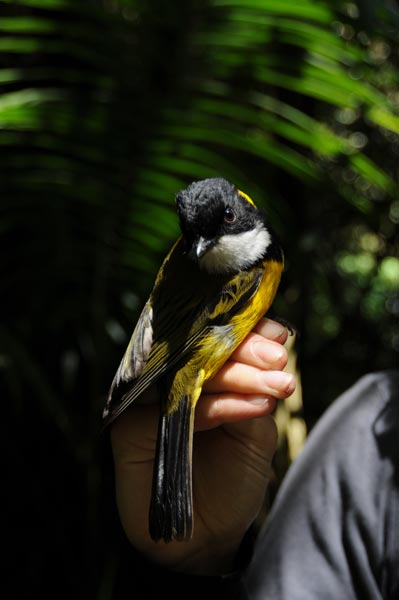
...but not as spectacular as a male. Not the best photo out there, but a stunningly-bright yellow. Fine, fine birds.

Azure Kingfisher. The camera didn't pick this up, but under the wings, along the flanks, the bird has the most stunning lilac wash I have ever seen.

Azure (you don't say!) Kingfisher.

Thursday, 10 November 2011

Noosa and beyond

A distinct turn for the better in the young lady's health meant we had the opportunity to get out and about a little further from Palmwoods. A trip to Noosa was on the cards! We headed up the coast road, stopping first at an outpost of the National Park at Coolum, just to the south of Noosa. Designated to protect the highly endangered coastal heath and dunes, which would otherwise by now be a concrete sprawl of Costa del Sol proportions, it's a clue to the habitats that were present a couple of hundred years ago when the continent was just being colonised by our forebears (not to be confused with any other kind of bears).

Pea species in flower in the coastal heath of Noosa National Park

Parking in a small patch of dry sclerophyll woodland, the path almost immediately deposits you into a most superb landscape. Behind you is the woodland, and somewhere in front of you the sea - you can hear the waves rolling onto the sand. All around is a scrubby, semi-open, sandy tangle of shrubs; many of them covered in a bewildering variety of flowers and attended by White-cheeked Honeyeaters, which look a little like large feathery humbugs. The whole landscape is squeezed into a narrow ribbon a couple of hundred metres across, before rising sharply into dunes covered with more dry woodland, then dropping precipitately onto a broad golden sandy beach, littered with people exercising themselves and their dogs. Rainbow Bee-eaters patrol the dune fringe, swooping and gliding between lookout posts.

Australian Brush-turkey. Not a lot you can say about this one, beyond the fact that it's a pretty ugly bird!

Fringed Lily.

We continued on to the main focus of the National Park, where we walked out to a lookout point called Hell's Gate along a scenic, though rather flat, path, crammed to bursting with joggers and walkers. Being a tad slower, we stopped frequently, which resulted at one point in a tea-break and sea-scan. Idly watching a yacht tacking slowly north, the calm blue ahead of it was suddenly rudely shouldered aside by about 60 tons of suddenly-airborne whalemeat. Unsurprisingly the yacht rather quickly changed tack. After breaching a couple more times, the Humpback returned below the surface. A small pod of Bottle-nosed Dolphins just offshore was almost anticlimactic in comparison. At the headland, we saw another two or three Humpbacks somewhat closer in, though they were resolutely staying within the water. We trekked back along a far less popular track, which was well worth doing for the peace and quiet alone. Note to others, by the bye, settling down for a quick kip under the trees is likely to result in a party of concerned Aussies enquiring loudly whether you are alright. Kind of them, but not conducive to a nap... Despite an intensive search, we failed to find any Koalas, but the searching paid off with a fine Tawny Frogmouth instead - every cloud...

Lizard species. Noosa National Park

Frilled Lizard.

Finally, we headed back towards Palmwoods, briefly trying another section of the park on the way, but the heat of the day defeated us and we slunk back to loaf and - some of us - to swim.

The very next day we returned to the area, this time with my relatives, to spend a little time wandering the tracks around Lake Cootharaba; a large lake about 20km north of Noosa. Despite its size (about 15 square km) and shallowness (on average 1.5m), it proved to be relatively birdless, probably because it's pretty brackish. Nevertheless, the day was fine, there were enough birds around to be interesting, Na was convalescing well and it was a properly chilled-out day. Much of the entertainment was derived from watching a bunch of schoolchildren at Elanda Point campground, who enthusiastically paddled canoes around some 100m off the lakeshore; and when they fell behind their mates, got out and pushed until they caught up. Clearly not really a lake for swimming in...! (On a serious note, apparently it's really not a good lake to swim in in some areas, as Bull Sharks frequent some of the channels; not something to tangle with).

Never trust a bird that smiles. Laughing Kookaburra at Elanda Point campground

Lake Cootharaba. There are some Australian Pelicans somewhere in the picture too.

Crested Pigeon lowering it's spike preparatory to charging.

Friday, 4 November 2011

Lake Baroon, Kondalilla, Maroochydore

Native - or Ivy-leaved - Violet Viola hederacea

A visit to the doctor meant the prospect of Na's stomach clearing up seemed a distinct proposition, so we carefully planned an excursion to Lake Baroon Pocket Dam, with the option of a walk up into Kondalilla Falls National Park should she feel fit for it.

Lake Baroon is a fairly small reservoir to the west of Palmwoods, popular with picnickers. Surrounded with Eucalypt woodland, it looks a bit like a Spanish or South African reservoir, though at least here the Eucalypts are native. We started with lunch at the dam itself, watching Pacific Baza displaying whilst a couple of Australian Pelicans drifted languidly in to snooze with cormorants and darters on the little island just offshore. A gentle wander to the lookout below the dam yielded few birds, but some information boards helped us to identify some of the trees around us (Grass-trees, Red Oaks and the mildly-amusingly-named Black-butt). Fuelled with enthusiasm for a longer leg-stretcher, we headed off up towards Kondalilla Falls.

The birdlife immediately changed - an early morning visit would have been ideal, but we were there in the late afternoon. Sulphur-crested Cockatoos screeched incessantly from the taller trees, occasionally pausing to regard us with a baleful eye as we ambled by. Brown Thornbills - somewhat like a plainclothes Goldcrest - twittered and flitted in the understorey and the canopy, occasionally joined by Rufous Fantails which flicked determinedly after them, their tails splayed wide in a splash of vivid russet against the browns and greens of the trees.

A break for water at a bench offered us our first snake: a Black Whip-snake gliding rapidly past us, keeping a wary eye in case we attacked it. We kept a wary eye on it in case it attacked us, and so the danger passed by for all concerned. We wandered on until we reached a small waterfall, where again we stopped and admired the view and a Grey Shrike-thrush (neither shrike nor thrush, but definitely grey).

Kondalilla National Park - the river below Lake Baroon

Waterfall in Kondalilla National Park

Lake Baroon from Kondalilla NP

The following day was a relapse day, so we confined ourselves to Palmwoods and the local ponds again.

Native waterlily species (Nymphoides indica?)

Splendid Longlegs Austrocnemis splendida

Wandering Percher (Diplacodes bipunctata), I think.

Eastern Water-skink Eulamprus quoyii

By evening, Na was well enough for a brief jaunt to Maroochydore, where we wandered along the beach in the dying rays of the sun, watching the waves break and the dog-walkers, joggers and walkers going their different ways. A handful of Red-capped Plovers suddenly popped up with a couple of Red-necked Stints, and a rather nice collection of Gull-billed, Crested and Common Terns streamed in to roost on the sand-bars at the river-mouth. We rounded off the day with a couple of Mangrove Honeyeaters and a pleasant picnic dinner.

Sunset over the Maroochye river

Wednesday, 2 November 2011

Inselaffe goes walkabout

Touchdown... "Ladies and gentlemen, welcome to Sydney"... look out of the window: it's raining... bundled out of the plane and down to immigration and a 14-km queue of sleep-deprived, tousled, gaunt tourists trying to gain admittance to the sceptred isle... finally, squeezed out past the customs officials to the baggage carousels, where our bags come through - remarkably - at the head of the queue... and over to the Qantas check-in desk to be told we've just missed our connecting flight to Brisbane... into the bus... Silver Gulls... over to the other terminal... onto the next plane to Brisbane... and down the runway to sit and wait for a suitable window in the weather that will allow us to land at Brisbane... and finally touching down at Brisbane to miss our second bus connection by five minutes... Noisy Miner, Common Mynah, Australian Raven, Australian White Ibis... spitting rain... onto the bus for an hour to Ettamogah (Aussie World: some bastardised pub-theme park)... and into the car for the last 20 minutes to Palmwoods and finally FINALLY stop travelling, because we've arrived in Australia and can take a breather.

Birding through a haze of sleep deprivation and lack of food can be quite fun. However, birding off the back of a strong cup of coffee can be so much more fun! We rolled up at the door of my aunt & uncle in Queensland to the sight of a Pale-headed Rosella bouncing over the garden fence, the shrill chatter and screech of a family of Rainbow Lorikeets in the bottlebrush and the glorious feeling of a nice steady 27 degrees Celcius. Mm-hmm.

After a pause to freshen up, feed ourselves and generally learn the lay of the land, we all headed down to the local ponds for a bash at some semi-rural birds, beasts and flowers, a chance to unwind and an attempt to get some blood moving in the legs again. A mildly bewildering flurry of new sounds, smells and sights - Blue-faced Honeyeaters, Noisy Friarbirds, Laughing Kookaburras, the scent of Eucalyptus in the air, and a background which looked both familiar and unfamiliar at the same time. On the ponds, Dusky Moorhens look pretty much like Common Moorhen, but shoulder-to-shoulder with Purple Swamphens which are after your pie-crumbs? And though the swallows look superficially like Barn Swallows, they sound like Red-rumped Swallows and are actually Welcome Swallows. Confused? Me too (briefly). By this stage the coffee is wearing off, so head back to the house, relax, read and recover.

Dusky Moorhen.

Static Wandering Whistling-ducks.

Pacific Black Duck. Made up to look a little like Buster Keaton.

Lotus (?) blossom on the local ponds

And at dawn the next morning, a cacophany of new sounds: Laughing Kookaburras chortling away, Rainbow Lorikeets squealing, King-parrots peeping (a most un-parrot-like sound), Magpie-larks wheezing their strange 'beep, bleep' duet, and all interwoven with the melodic whistles of Australian Magpie and the blasts of sound from Blue-faced Honeyeaters and Noisy Friarbirds. Unable to stand the suspense ("what the hell was that anyway??"), I slip quietly out of the house at 5.30 and go for another walk around the ponds. Yesterday's cast is joined by a Double-barred Finch, which looks like a mini House Sparrow dressed as a pavement mime, some Silvereyes - small Willow Warbler-green birds with brilliant white spectacles and a White-browed Scrubwren, which looks a little like an ornate wren with beetling white eyebrows and behaves like a Dunnock.

Blue-faced Honeyeater.

Laughing Kookaburra looking a bit like those cuddly toys that you press to get a bird noise from. Don't be fooled: they're killers. Look at that beak. They take more children per year...

Rather bad photo of a Rainbow Lorikeet.

After breakfast we head out to the local Bushland Botanical Gardens to stretch legs whilst remaining within dashing distance of a loo for Na, who's picked up something undesirable from the plane (and before you say it, no, she picked me up long before this plane trip...). Our first butcherbirds appear: Pied and Grey Butcherbirds both parade around the picnic areas waiting for an unwary Aussie whose lunch can be pirated. Scaly-breasted Lorikeets join the Rainbows in the bottlebrush bushes, squabbling for nectar. In the trees, above all the low-level trashy parrot-noise, Scarlet Honeyeaters and Mistletoebirds flit and shimmy from flower to flower with the larger olive-green Lewin's Honeyeaters. We sit and watch kookaburras perched in the trees, who in turn watch the ground, before dropping with surgical precision onto some unfortunate skink, or worm, or snake.

Australian Flatwing Austroargiolestes icteromelas

Pied Butcherbird just washing down a small child.

In the afternoon we head over to the grounds of the Sunshine Coast University, to look for Eastern Grey Kangaroos. Just two animals are out there feeding, but the ponds yield some more interesting birdlife: Masked Lapwings with chicks, Fairy Martins building bottle-shaped mud nests under a canopy, a Black-faced Cuckooshrike posing in the dying sunshine, and a smattering of egrets: Cattle, Intermediate and Great.

Noisy Miner. How did I forget to mention these birds in the text? Especially their morning chorus of twangs, plinks and squeaks. Endearingly unmusical...!

Eastern Grey Kangaroos whispering secrets to the worms.